

Fake Hospices Billed Medicare for Seniors Who Weren’t Dying. Dr. Oz Is Keeping Them Out.
Medicare just extended its nationwide freeze on new hospices and home health agencies for six more months. When it took a close look at new hospices in four states, nearly 1 in 5 got thrown out.

Hospice is supposed to be the gentlest corner of medicine. A nurse comes to the house, the pain gets managed, and a family gets to say goodbye without a hospital in the way. Medicare pays for it because nobody should have to choose between dying in peace and going broke.
That kindness is exactly what the crooks found. Sign up a senior who isn’t dying, bill Medicare every day for care that never shows up, and keep the money. When auditors get close, close the shop, buy a fresh billing number and start over.
On Thursday, Medicare said it isn’t done shutting the door on that racket. The Centers for Medicare & Medicaid Services extended its nationwide freeze on new hospices and new home health agencies joining Medicare for another six months. The pause started May 13. The extension took effect Friday and runs into mid-May.
“We’ve made real progress over the past six months, but fraud in hospice and home health persists and our work isn’t finished,” said Dr. Mehmet Oz, who runs CMS. “Medicare beneficiaries deserve protection from these bad actors, and American taxpayers need to know the programs they rely on aren’t being bled dry by fraudsters.”
CMS on 𝕏, Nov. 13, 2026: extending the nationwide pause on new Medicare hospice and home health enrollments for six months.
— @CMSGov View on 𝕏
A business model built on people who weren’t dying
The agency laid out its case in two notices filed with the Federal Register, and the details read like a crime file. Hospices certified patients as terminally ill when they weren’t, then provided little or no care. Some told seniors they were dying when they weren’t. That isn’t harmless paperwork. A patient wrongly put on hospice can be denied coverage for the regular treatment they actually need.
Recruiters were paid to round up seniors who didn’t qualify, sometimes without the senior even knowing. Doctors took kickbacks to sign off on terminal diagnoses. Some operators opened a hospice only to sell it for a profit before Medicare could catch up, and patient care, in CMS’s words, “was not a priority, or even a consideration.”
The FBI saw enough of it to put out a public warning in June. Scammers were going door to door, the bureau said, offering free house cleaning and meal delivery to seniors, as long as they signed up with a particular hospice.
The money adds up fast. In August, an Anaheim hospice owner pleaded guilty to submitting more than $2.2 million in false claims for patients who had no terminal illness. In March, a Los Angeles-area woman got 35 months in federal prison after she and others, often using fake names, ran several fictitious hospices and billed Medicare more than $14 million for care patients never needed or never got.
Home health has the same rot. A Michigan agency owner was convicted in May of a $1.6 million scheme in which she paid a Detroit hospital discharge nurse to fax over patients’ private records, then billed Medicare for home visits no doctor had ever ordered. She used real doctors’ names to fake the paperwork.
When Medicare looked closely, the numbers got ugly
The best evidence that this is a real problem, and not a bureaucrat’s hunch, comes from what happened when CMS put new hospices under a microscope.
Starting in 2023, the agency placed new hospices in Arizona, California, Nevada and Texas under extra review. By June 2025, about 670 of them had been checked, and 122 were thrown out of Medicare. That is 18%. Across Medicare, CMS says only about 1% to 3% of providers are ever revoked.
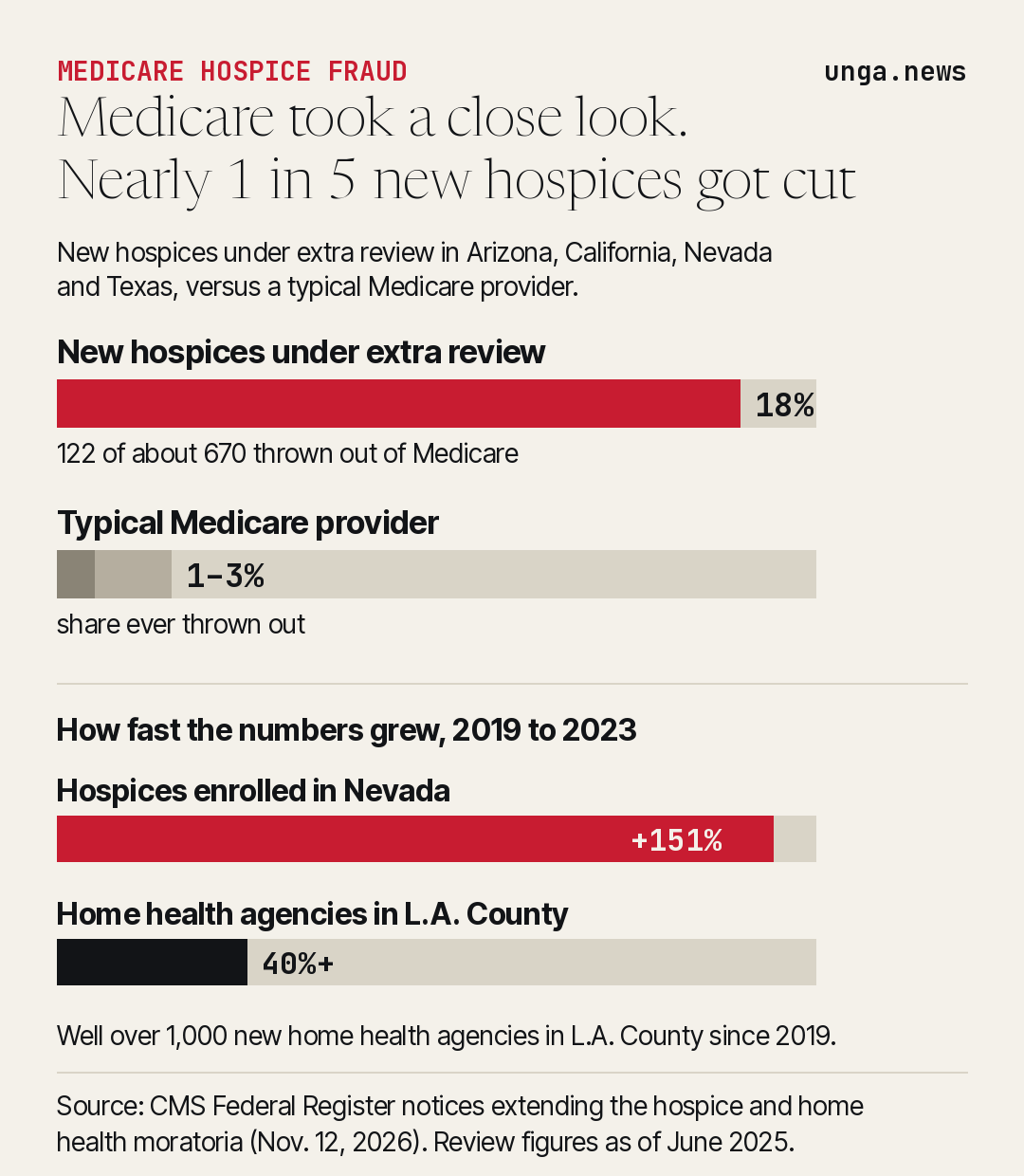
The growth tells the same story. Nevada’s count of enrolled hospices jumped 151% from 2019 to 2023. In Los Angeles County, home health agencies grew more than 40% over the same years, and well over 1,000 new ones have signed up there since 2019. CMS found hospices stacked inside a single building and addresses that didn’t appear to be open for business. In Ohio, it found one address with 18 home health agencies registered to it.
Nobody’s grandmother needed 18 home health companies in one office suite. That is what a billing mill looks like.
Last month, CMS teams spent two days making surprise site visits to hospices and home health agencies in California. They came back with 145 revocations of providers tied to more than $703 million in Medicare and Medicaid payments.
Stopping the next one before it bills
The theory behind the freeze is simple, and it is the right one. For decades Medicare ran on “pay and chase.” Send the check first, then spend years trying to claw it back from a company that has already vanished. CMS says it wants to stop fraud before it starts, and the cleanest way to do that is to stop letting unknown new players in the door while investigators work through the ones already inside.
The freeze is nationwide for a reason. A local ban just sends the operation one state over. Five states, Louisiana, Nevada, Ohio, Pennsylvania and Rhode Island, have added their own hospice freezes for Medicaid.
It also isn’t a blunt instrument. Hospices and home health agencies already in Medicare keep working, keep billing and keep seeing patients. In the extension, CMS loosened one piece: existing providers can again open new branches and locations within their current enrollment, so a legitimate hospice can grow where families need it. The trade group National Alliance for Care at Home praised that change, HomeCare magazine reported.
CMS says it has seen no sign the freeze has cut seniors off from hospice care anywhere in the country, even at the state level, and it promises to keep watching rural areas. The agency’s own inspector general signed off on the extension, agreeing the fraud risk remains significant.
There is more coming. A new home health payment rule makes revocations retroactive to the day a provider broke the rules, which means Medicare can go after the money paid out in the meantime. It also targets clusters of agencies jammed into small areas and medical directors who claim to oversee hospices from too far away to actually do the job.
The freeze can be renewed six months at a time for as long as CMS thinks it is needed. If the next round of site visits looks anything like California’s, it will be. For the families who trust a stranger to walk into the bedroom of a dying parent, that is good news. For the people who saw that trust as a billing opportunity, the door stays shut.
Sources
- Centers for Medicare & Medicaid Services — CMS Extends and Modifies Nationwide Freeze on New Medicare Hospice and Home Health Enrollment for Six Months to Combat Fraud (Nov. 12, 2026)
- CMSGov on 𝕏 — Extending the nationwide pause on new hospice and home health enrollments (Nov. 13, 2026)
- Federal Register (public inspection) — Extension of nationwide temporary moratorium on enrollment of hospices (2026-23242)
- Federal Register (public inspection) — Extension of nationwide temporary moratorium on enrollment of home health agencies (2026-23241)
- Centers for Medicare & Medicaid Services — Home Health and Hospice Nationwide Moratorium Q&As
- FBI / IC3 — Emerging Hospice Fraud Targeting Medicare Recipients (June 3, 2026)
- U.S. Attorney’s Office, Central District of California — Anaheim woman pleads guilty to submitting more than $2.2 million in fraudulent hospice care claims
- U.S. Attorney’s Office, Central District of California — Larchmont woman sentenced to nearly 3 years in federal prison for her role in hospice and diagnostic testing fraud
- U.S. Department of Justice — Michigan home health care agency owner convicted in $1.6M Medicare fraud scheme
- HomeCare — CMS Extends Home Health, Hospice Moratoria for 6 Months
- Home Health Care News — CMS Extends Medicare Home Health, Hospice Moratorium