

Feds Say a ChatGPT Engineer Bugged the Boardroom and Taped a Foreign Government’s Briefing
Prosecutors say the ex-OpenAI engineer, a Saudi national, kept dozens of secret recordings sorted by topic, used the company’s own SI to set up his bug, and was weighing a job offer from a Saudi royal.
The bug was smaller than a matchbook, and it was plugged into the back of a TV in the room where ChatGPT’s maker meets with executives, partners and government officials. Federal prosecutors now say it wasn’t a one-off stunt. In a filing Monday in San Francisco federal court, they said agents found hundreds of audio files on former OpenAI engineer Abdulrahman Alfozan’s personal computer, including dozens of recordings of OpenAI meetings from September, sorted by date and labeled by topic.
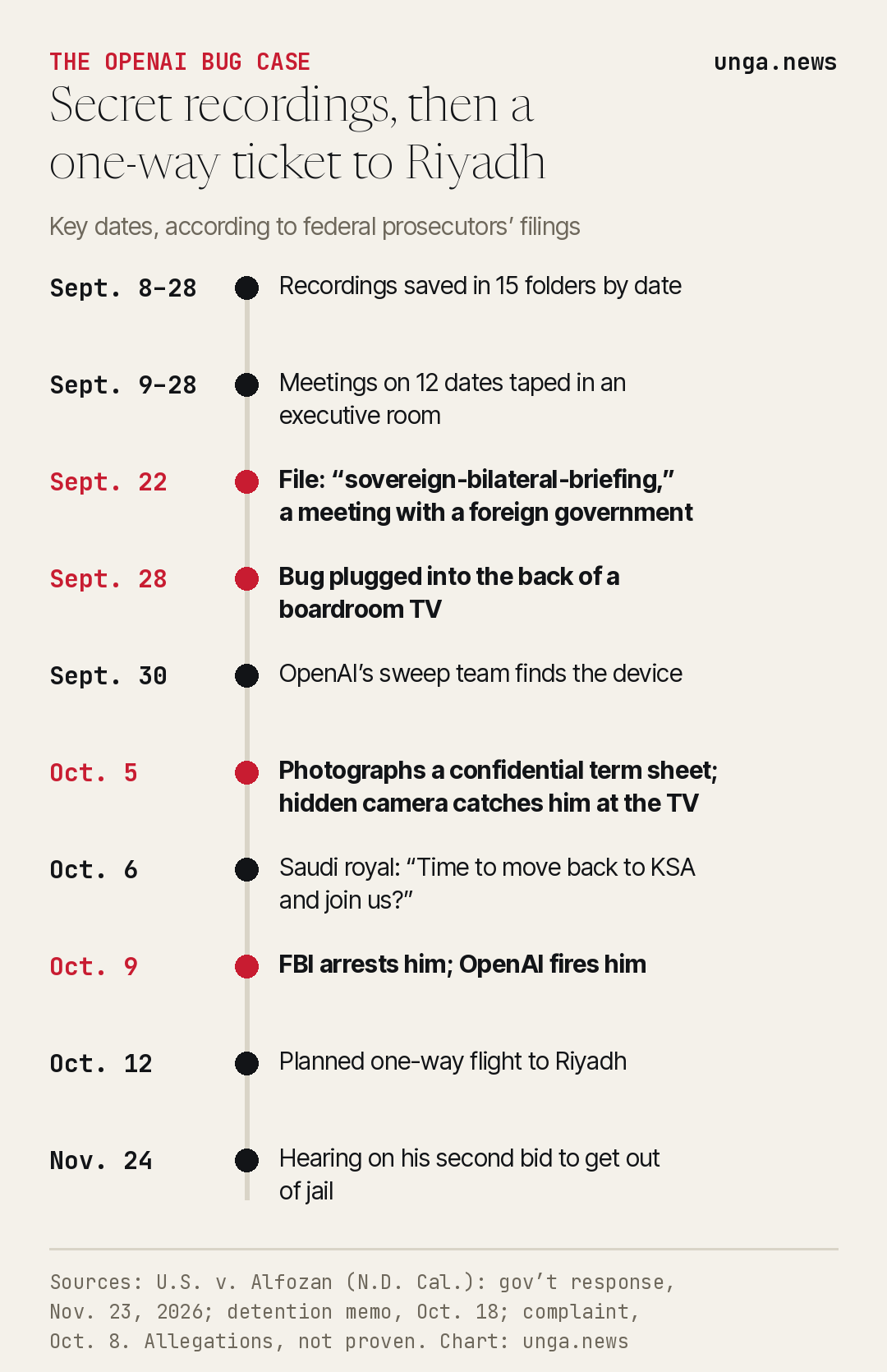
One of those files, prosecutors wrote, is a recording of “at least one meeting between OpenAI and representatives of a foreign government.” Its name on his computer: “1200-sovereign-bilateral-briefing-sep22.opus.” A transcript of it sat right next to it.
Alfozan, a 35-year-old Saudi national and U.S. permanent resident, has pleaded not guilty to a single count under the federal Wiretap Act, which carries up to five years in prison. He hasn’t been charged with spying or stealing trade secrets. But Monday’s filing lays out why the Justice Department wants him kept behind bars until trial, and it’s a lot more than a guy fiddling with gadgets.
Folders with names like a spy novel
According to the government, the recordings cover meetings on 12 different dates between Sept. 9 and Sept. 28 in the executive conference room where the device was later found. Many “involved discussions of what appears likely to be confidential trade secret material,” such as meetings with OpenAI customers and talks about what the company’s systems can do. OpenAI flagged others as protected legal advice.
Prosecutors said he kept it all “meticulously categorized by date and renamed according to the content of the recording.” Examples include files titled “ai-safety-research” and “product-activation” from Sept. 22, each paired with a machine-made transcript, spread across 15 dated folders running from Sept. 8 to Sept. 28.
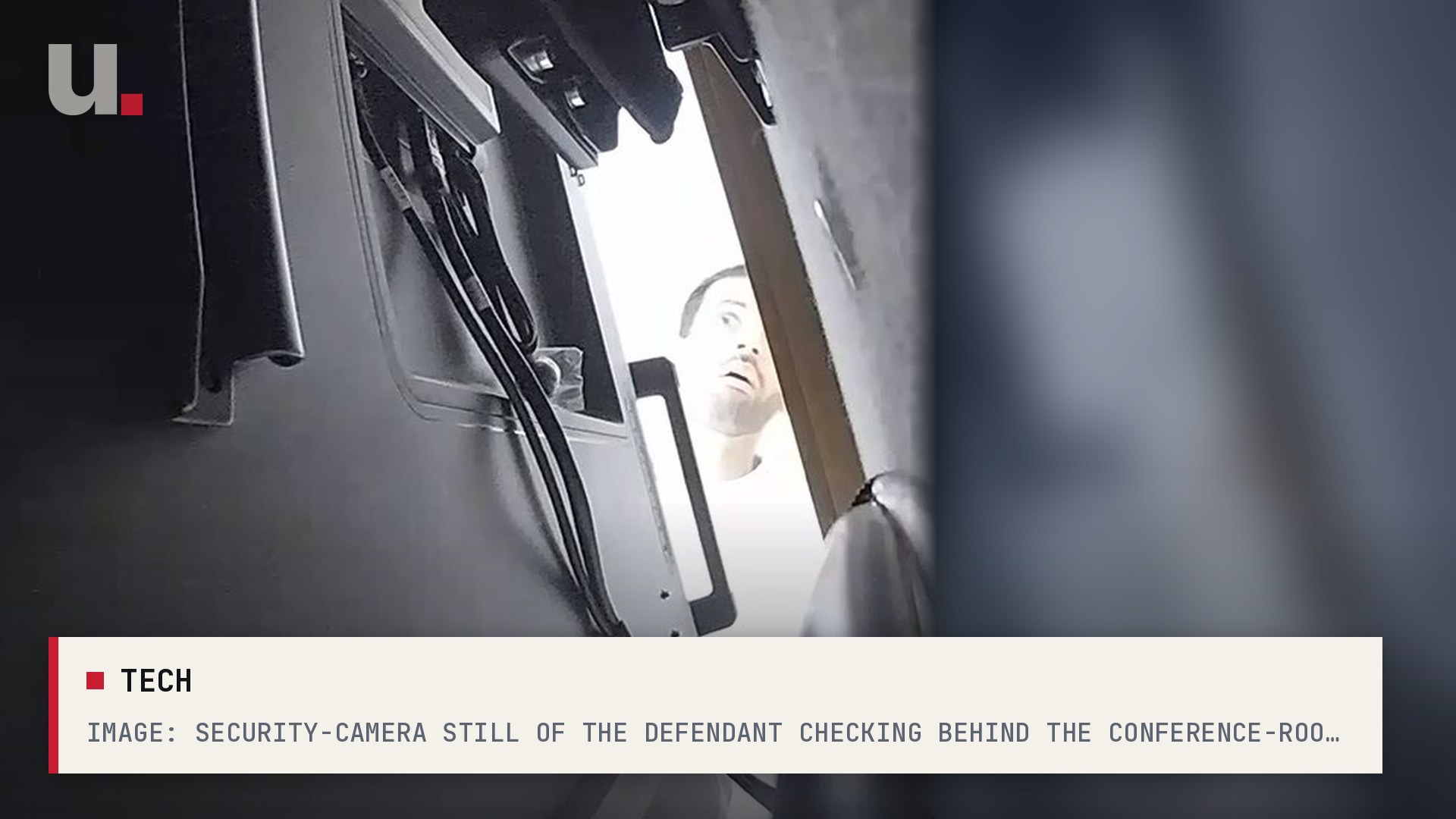
Then there’s the paperwork. Investigators say his phone held photos of every page of a printed document stamped “CONFIDENTIAL” that appears to be a term sheet for a “strategic partnership” between OpenAI and another company, signed by an OpenAI lawyer on Aug. 13. Phone data suggests he snapped them at home in the early morning of Oct. 5. Later that same day, a hidden camera OpenAI had placed in the room caught him checking behind the TV where the bug had been.
He used the company’s own SI to build it
The most jaw-dropping detail may be how the device got set up. Records OpenAI turned over show Alfozan used Codex, the company’s own SI coding assistant, logged in through his wife’s account, to help configure the recorder and move the audio into Dropbox, prosecutors said.
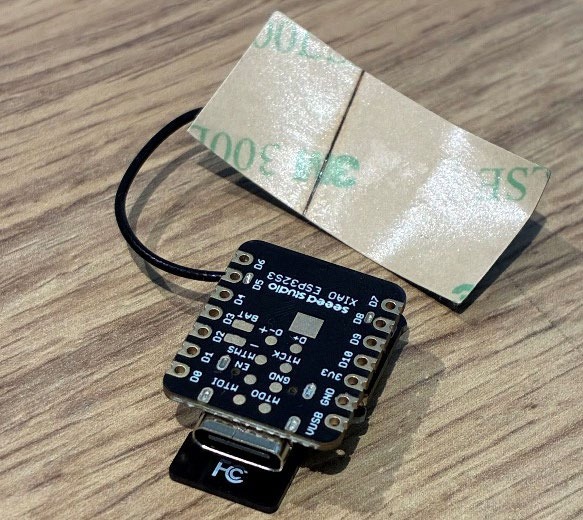
On Sept. 27, he allegedly had Codex load a passphrase into the firmware for a XIAO ESP32, a circuit board about the size of a postage stamp. That’s “the same kind of device OpenAI found inserted into a television three days later,” the filing says. The next day he got an email titled “You deleted 5026 files from Dropbox.” On Sept. 29 he asked Codex to add voice detection, explaining that the “goal is to only record speech.”
The FBI’s original complaint shows a second recorder of the same make that OpenAI security found Oct. 5 in a bag he left in a printer room, next to his wallet and ID.
“Saudi needs you more then the US!”
This is the part that turns a workplace scandal into a national security worry. The government’s October detention memo said he was in frequent WhatsApp contact with a member of the Saudi royal family, who urged him to come home and join a Saudi SI push and wrote, “Saudi needs you more then [sic] the US!” He said he’d go once his stock vested.
Monday’s filing adds more. On Oct. 6, the royal sent him a link to Echelon, a Riyadh company the official described as “our AI transformation company working with the Kingdom’s largest government and enterprise organizations,” and asked, “Time to move back to KSA and join us?” Alfozan said he might, “after the IPO.” Two nights later the same official called him for 16 minutes. Prosecutors say he also messaged regularly with Saudi Arabia’s communications and technology ministry, including the minister himself, in August and September.
He was arrested Oct. 9, three days before a planned one-way flight to Riyadh with his wife and infant son, and OpenAI fired him that day. After the arrest, prosecutors said, his wife and son were first booked on a one-way flight paid for by the Saudi government, then flew out about 36 hours later on business-class seats bought by a Saudi military official. Their timing argument is blunt: his contacts with Saudi officials “appears to match the timing of his efforts to record OpenAI meetings.”
Saudi Arabia is an American partner, and nothing in the filings says the kingdom asked for any of this. Prosecutors say what he “did or intended to do with those audio files remains under investigation.”
His lawyer says it’s mostly static
Alfozan’s attorney, David Rizk, filed a renewed motion for release last week offering a $1 million bond. He argues the government has turned up no new evidence of espionage or trade-secret theft, that the vast majority of the recordings “apparently contain just random noise and silence,” and that the charge left standing is “the equivalent of a misdemeanor.” The defense has called him “an overly curious tinkerer.”
Prosecutors answered that a five-year felony is no misdemeanor, that his family is now in Saudi Arabia with no plans to return, and that he has the money and connections to vanish. If the judge does let him out, they want a ban on touching any OpenAI material, warning he may still reach the recordings through cloud accounts he controls. OpenAI has said it found no sign he took model weights, source code or customer data.
Give OpenAI credit for catching this. Its own sweep team found the first bug on Sept. 30, a camera was waiting in the room when he came back to check on it, and the FBI had him in custody nine days after the find. America’s lead in SI lives in rooms like that one, and those meetings with foreign governments are exactly what rivals would love to hear. U.S. Attorney Craig Missakian’s office is treating the case that way, and it should.
Magistrate Judge Alex Tse hears the bail fight Tuesday morning. Trial on the wiretap count is set for January.
Sources
- U.S. District Court, N.D. Cal. (via CourtListener) — U.S. v. Alfozan, Government’s Response to Defendant’s Renewed Motion for Release, Dkt. 33 (Nov. 23, 2026)
- U.S. District Court, N.D. Cal. (via CourtListener) — U.S. v. Alfozan, Defendant’s Motion for Release, Dkt. 32 (Nov. 20, 2026)
- U.S. District Court, N.D. Cal. (via CourtListener) — U.S. v. Alfozan, Memorandum in Support of Motion for Detention, Dkt. 12 (Oct. 18, 2026)
- U.S. District Court, N.D. Cal. (via CourtListener) — U.S. v. Alfozan, Criminal Complaint, Dkt. 1 (Oct. 8, 2026)
- CBS News — Ex-OpenAI engineer accused of planting bug in office was in contact with Saudi royal family (Oct. 19, 2026)
- Quartz, citing The New York Times — Former OpenAI engineer recorded dozens of meetings, prosecutors say (Nov. 23, 2026)