

FIFA Confirms Hackers Stole Personal Files by Pretending to Be Its Own Staff
The crooks didn’t break FIFA’s computers. They reportedly fooled its people, then bragged online for a week before soccer’s ruling body admitted the break-in.
Nobody had to crack a code to get inside FIFA. According to people familiar with the case, the crooks who just raided soccer’s world governing body did it the old-fashioned way. They pretended to be FIFA’s own people, and somebody let them in.
On Thursday, FIFA finally said out loud what a hacker crew had been bragging about online for a week. “FIFA can confirm that it has been the victim of a criminal cyber-attack resulting in unauthorised access to a limited set of personal and business information,” the organization said in a statement, adding that it is “working closely with the relevant authorities, including law enforcement.”
That’s the same outfit that ran the World Cup on American soil this summer, the one that ended with Spain beating Argentina at MetLife Stadium in New Jersey in front of President Trump. Now some of its internal files are sitting on a criminal forum.
The hackers who named themselves
The group taking credit calls itself the Handsome Boy Hacking Club. Yes, really. The Record, the cybersecurity news site run by Recorded Future, reported that the crew only surfaced last week and that little is known about who is behind it.
Here’s how the week played out. On Nov. 19, according to Insider Sport, the group posted a picture that appeared to show FIFA’s internal “My Apps” portal, the Microsoft dashboard employees use to reach the organization’s work programs. A day later it posted on 𝕏: “FIFA leak is coming. Issues with Gofile right now. Stay tuned!”
The crew says it took more than 12 gigabytes of data, tried to squeeze FIFA for money and got nowhere, then dumped the files on a cybercriminal forum. The hackers claim the haul includes identity and immigration papers, financial records, legal documents, details on executives and internal governance files. FIFA hasn’t confirmed any of that list, and it didn’t answer The Record’s follow-up questions.
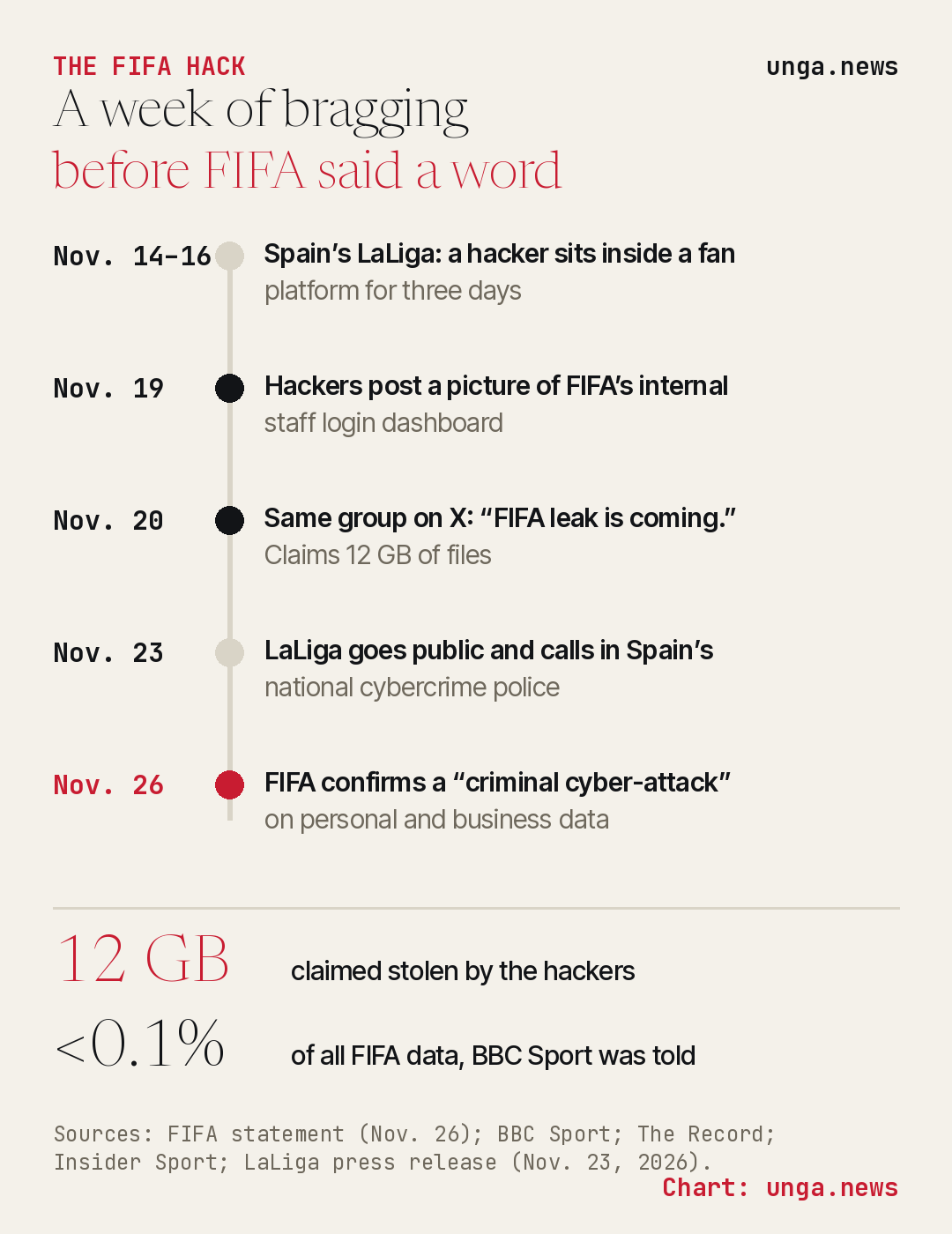
FIFA’s side of it is that the damage is small. A person with direct knowledge told Reuters that less than 0.1% of FIFA’s total data was touched. BBC Sport reported the same figure and said the theft was aimed at the organization, not at individual fans.
Tricked, not broken
The most useful detail in this whole story is how they got in. BBC Sport said it understands this was “not a systems or technology failure” at FIFA. Instead, the criminals reached the documents “by impersonating and taking advantage of staff.” ESPN’s sources told the same story.
That should get every reader’s attention, because it’s the oldest trick there is and it still works on the biggest names in the world. You can spend millions on firewalls. If a worker gets a convincing call, text or email from someone who sounds like the IT department or a boss and hands over a login, the locks don’t matter.
FIFA has about 700 employees at its headquarters in Zurich. That’s not a giant workforce. It took only one or two of them believing the wrong voice on the other end.
FIFA isn’t pretending this is no big deal, either. “FIFA condemns in the strongest possible terms the unlawful acquisition and publication of information, particularly personal data,” its statement said. “Such actions constitute a serious and unacceptable violation of privacy and can have significant consequences for the individuals concerned.”
One thing the hackers apparently didn’t get was the paperwork on FIFA Forward Enterprise, Gianni Infantino’s since-dropped idea of selling a stake in the World Cup to private investors. BBC Sport said those files were not part of the breach. Plenty of people in English soccer would love to see them. The head of England’s Football Association was only allowed a look this week after signing a nondisclosure agreement.
Soccer has a hacker problem
FIFA isn’t alone. Just days earlier, Spain’s top league went public with its own break-in. In a press release on Nov. 23, LaLiga said a cybercriminal got into one of its fan-services platforms between Nov. 14 and 16 and pulled out personal data on users registered with the league and some of its clubs. LaLiga said it shut the attacker out on Nov. 16 and reported the attack to Spain’s data protection agency and the national police’s cybercrime unit.
Clubs including Leganés, Real Oviedo and Real Zaragoza warned fans that the stolen names and contact details could be used for scam emails, texts and calls pretending to come from the club or the league. That’s exactly the con that reportedly opened FIFA’s doors. In May, Dutch police arrested a 35-year-old man accused of hacking into the systems of Ajax, one of the most famous clubs in the Netherlands, and France’s soccer federation disclosed its own attack in 2025.
Big sports bodies make tempting targets. They hold passports and travel records for players, staff and officials. They move huge sums in TV and sponsorship money. And they are full of people who are used to getting urgent messages from VIPs.
Lessons for America’s next big show
America just pulled off the biggest World Cup ever, and the 2028 Summer Olympics are headed to Los Angeles. Every hacker crew on the planet has noticed how much valuable data flows through events like these. The FIFA break-in is a cheap reminder that the weak spot usually isn’t the computer. It’s the phone call nobody double-checks.
The same goes for your house this holiday weekend. A message that sounds like it comes from your bank, your kid’s school or your boss and asks for a code or a password is the exact same play that just embarrassed the most powerful body in world sports. Hang up and call back on a number you already trust.
FIFA says police are on the case. The Handsome Boy Hacking Club, for its part, is still out there, and still bragging.
Sources
- BBC Sport — Fifa confirms internal data stolen in cyber attack (Nov. 26, 2026)
- Associated Press — FIFA says it has been victim of a cyberattack accessing ‘personal and business information’ (Nov. 26, 2026)
- The Record from Recorded Future News — FIFA says hackers accessed ‘limited set of personal and business information’
- Insider Sport — FIFA confirms cyberattack claimed by HBHC hackers (Nov. 26, 2026)
- DW — FIFA says it has been targeted in cyberattack (Nov. 26, 2026)
- LaLiga — LALIGA ha sido víctima de un ciberataque que ha afectado a datos personales de aficionados (Nov. 23, 2026)
- CD Leganés — Official statement on information security and personal data protection (Nov. 23, 2026)