

Five New Dem Trifectas Could Push Popular-Vote Compact From 222 to 283.
Pennsylvania, Michigan, Wisconsin, Nevada, and projected Arizona give Democrats the legislative path to activate the National Popular Vote Interstate Compact for 2028 — awarding those states’ electors to the national popular-vote winner without amending the Constitution.
Democrats’ midterm sweep did more than flip Congress. It handed the party full trifectas — governor plus both legislative chambers — in Pennsylvania, Michigan, Wisconsin, and Nevada, with Arizona also projected to land in the same column. Those five states hold 61 electoral votes. Added to the National Popular Vote Interstate Compact’s existing 222, that is a path to 283 — past the 270 threshold that would activate the compact for a presidential election.
If those legislatures enact it and it stays in force, participating states would award their electors to the candidate who wins the national popular vote — not their own statewide tally. The Electoral College would still formally meet. The practical effect would be to make the national popular-vote winner the president once compacting states control a majority of electors. No constitutional amendment required. That is the structural power play now on the table after Donald Trump won the Electoral College while losing the popular vote in 2016 and again in 2024.
How the compact works
The U.S. Constitution’s Article II, Section 1 says each state shall appoint electors “in such Manner as the Legislature thereof may direct.” Nearly every state today uses statewide winner-take-all. The compact is a state-law workaround: member jurisdictions pledge that, once they collectively hold at least 270 electoral votes, they will give all of their electors to the national popular-vote winner.
National Popular Vote’s own written explanation (updated with an Aug. 27, 2026 one-pager) says the compact has been enacted by 19 jurisdictions — 18 states plus D.C. — totaling 222 of the 270 needed. It governs a presidential election only if, on July 20 of that election year, it is in effect in states with 270 or more electoral votes. Until then, it sits dormant.
The 61-elector math
Axios’s Andrew Pantazi, writing Nov. 4, put the new Democratic trifectas in Pennsylvania, Michigan, Arizona, Wisconsin, and Nevada as enough to push the compact from 222 to 283. National Archives allocations for 2024 and 2028 (2020 Census) confirm the pieces: Pennsylvania 19, Michigan 15, Wisconsin 10, Nevada 6, Arizona 11 — 61 total. 222 + 61 = 283.
The New York Times, carried by the Philadelphia Inquirer on Nov. 6, noted Arizona’s blue trifecta was still projected while some races remained uncalled as of Thursday evening, and that the four fully called trifectas alone could tip the group over 270 if they all joined. Either way, the legislative door Democrats lacked for years is now open in the states that matter for the remaining 48.
Lawmakers are already talking
Michigan Rep. Carrie Rheingans told the Times, “The time is right,” adding that “this blue tsunami is really going to help push this forward across the whole nation.” Wisconsin Sen. Kelda Roys said national popular vote “will be something that we’ll prioritize early in the session.” Wisconsin Assembly Democrat Clinton Anderson said he planned to reintroduce a compact bill — “I want to make it a priority, but it’s not the thing I heard on the doors I knocked.” Maine Senate President Mattie Daughtry, who helped her state join in 2024, warned the biggest roadblock is “convincing them to use these majorities to do big things.”
They have failed before
This is not automatic. Michigan failed to enact the compact during its prior Democratic trifecta in 2023–24, despite House committee action. Nevada’s Democratic legislature passed it in 2019; then-Gov. Steve Sisolak vetoed it, warning it could diminish his state’s influence over presidential elections. Nevada later passed related measures again; the veto history remains the cautionary tale. Lawmakers in all five target states have introduced compact bills before. Introduction is not enactment. Enactment is not immunity from repeal, litigation, or a future trifecta reversal.
The Compact Clause cloud
Article I, Section 10 of the Constitution says no state shall, “without the consent of Congress,” enter into “any agreement or compact with another state.” Notre Dame Law professor Derek Muller has long argued the National Popular Vote compact needs that congressional approval. In an April 2023 Election Law Blog post revisiting his Election Law Journal work, Muller wrote that even under narrower Supreme Court readings, the compact “probably needed congressional consent,” and that recent Court language leans toward requiring consent for interstate compacts generally. Quoted by the Times this week: “It’s a very real possibility that enough states join this compact. There will be a lot of challenges.”
Compact proponents lean on Article II’s elector-appointment power and say Congress can bless the deal later. Opponents say smaller and red states would be sidelined — their statewide outcomes overridden whenever compacting blue metros tip the national tally — and that a deal shifting political power among states is exactly what the Compact Clause was written to stop. Officials have not explained how a 2028 activation would survive a hostile Congress, a Supreme Court challenge, or a mid-decade repeal in even one of the new member states.
What happens next
Watch the five capitals. Bills have to be introduced, pass both chambers, and be signed. The compact’s own trigger is hard: 270 electoral votes in force by July 20 of a presidential year. Legal fights over congressional consent are already telegraphed. Michigan’s last trifecta stalled. Nevada’s Democratic governor once vetoed the same idea. Rheingans and Roys say the moment is now. Anderson hears cost-of-living on the doors, not Electoral College redesign.
Bottom line: Democrats’ midterm trifectas opened a concrete path — 222 to as high as 283 — to activate a compact that would award those states’ electors to the national popular-vote winner and effectively sideline the Electoral College for 2028 without amending the Constitution. The math is public. The prior failures are public. The Compact Clause fight is public. Whether these legislatures actually pass it — and whether courts and Congress let it stand — is the fight that starts now.
Sources
- National Popular Vote — Agreement Among the States to Elect the President by National Popular Vote — written explanation; 19 jurisdictions / 222 of 270; Aug. 27, 2026 one-pager
- National Popular Vote — One-page explanation of National Popular Vote (PDF, Aug. 27, 2026)
- National Popular Vote — State status — 19 jurisdictions, 222 electoral votes; path for remaining 48
- Axios (Andrew Pantazi) — Nov. 4, 2026: Democrats’ midterm gains could sideline Electoral College by 2028 — 222→283 with five trifectas; Michigan/Nevada prior failures; Muller Compact Clause
- The Philadelphia Inquirer (New York Times / John Yoon and Ma — Nov. 6, 2026: Democratic gains could advance National Popular Vote Interstate Compact — Rheingans, Roys, Anderson, Daughtry; Nevada 2019 veto; Muller challenges
- National Archives — Distribution of Electoral Votes — 2020 Census allocations for 2024 and 2028 (PA 19, MI 15, WI 10, NV 6, AZ 11)
- Cornell Law School, Legal Information Institute — U.S. Constitution, Article II, Section 1 — states appoint electors in such Manner as the Legislature thereof may direct
- Cornell Law School, Legal Information Institute — U.S. Constitution, Article I, Section 10 — Compact Clause (no state shall, without the consent of Congress, enter into any agreement or compact with another state)
- Election Law Blog (Derek Muller) — April 18, 2023: Supreme Court’s developing Compact Clause jurisprudence may affect National Popular Vote — congressional consent argument
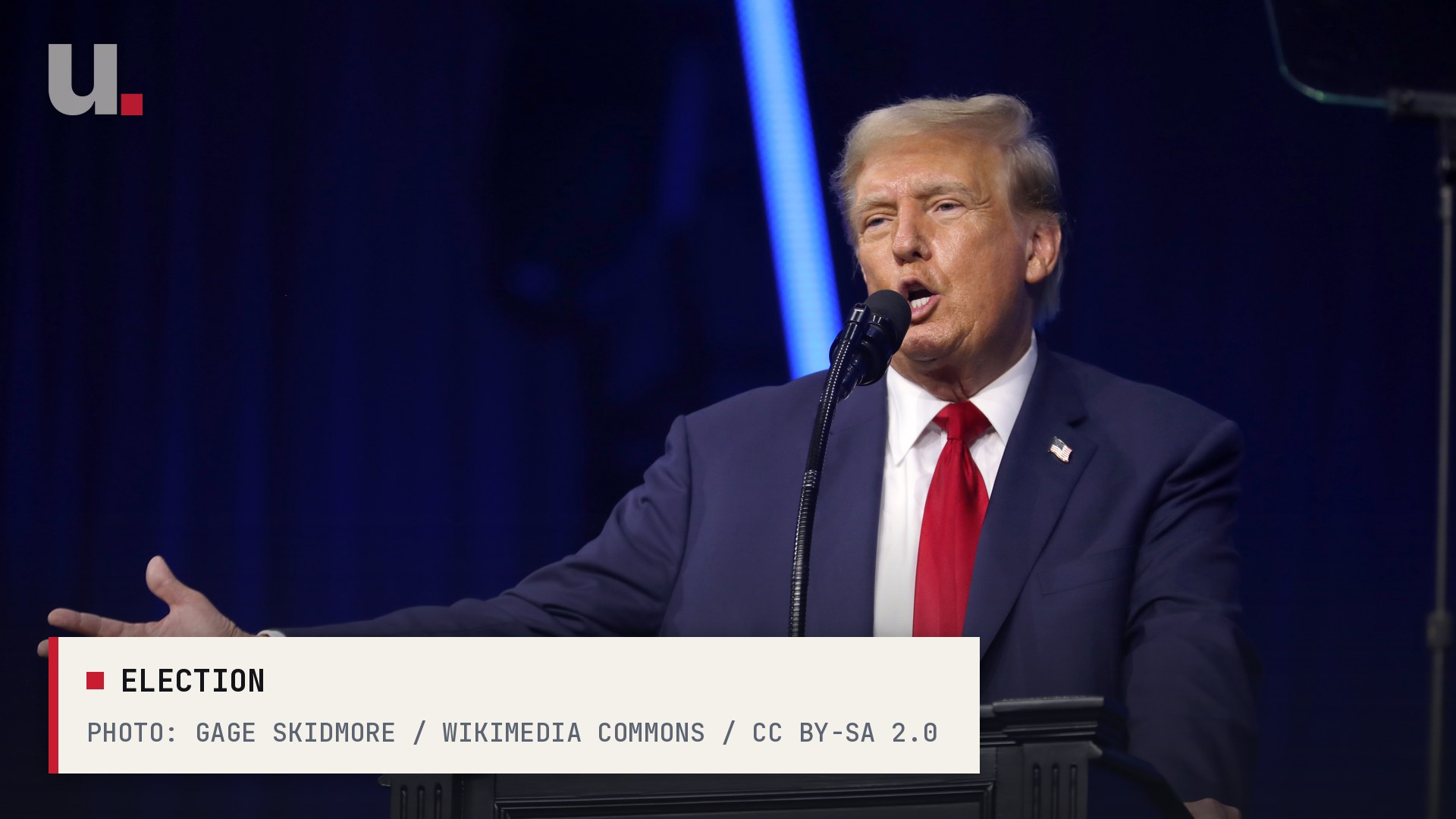
- Wikimedia Commons (Gage Skidmore) — Donald Trump (53807947262).jpg — People’s Convention, Detroit, June 15, 2024; CC BY-SA 2.0