

Florida Voters Slashed Their Property Taxes. DeSantis Says Cities Are Now Punishing Them for It
After 62% of voters tripled the homestead tax break, some local governments went after Christmas parades and rides for the disabled. DeSantis wants lawmakers back before he leaves office to lock the cut in.
Florida voters did something on Election Day that politicians almost never let them do. They cut their own property taxes, and by a lot. Three weeks later, some of the cities and agencies that lost that fight are already finding ways to make residents feel it.
Gov. Ron DeSantis isn’t having it. In Melbourne on Monday, at an unrelated briefing on the state’s flood response, he made clear he still wants lawmakers back in Tallahassee before he leaves office to put guardrails around the tax cut voters just approved.
“I’d hate to go into the new year and people are going to be planning to get $2,000 relief from property tax and then just get nickel-and-dimed in other ways,” DeSantis said. “I think there’s ways that that can be avoided, 100%, and we have responsibility to make sure that we’re generating the benefit of the bargain that the taxpayers voted for.”
Three counties said no. Sixty-four said yes.
The measure is Amendment 3, and it is a massive break for homeowners. Today a homeowner gets $50,000 of a home’s value shielded from city and county property taxes. Starting in 2027 that shield triples to $150,000. In 2028 it rises to $250,000. People who move to Florida after Jan. 1 have to wait five years to get the bigger break. Owners of rentals and businesses get help too, as the yearly cap on assessment increases drops from 10% to 5%. School taxes are left out of the bigger exemption.
Constitutional amendments in Florida need 60% to pass. This one got 62%. DeSantis pointed out that only three counties voted it down, Gadsden, Leon and Alachua, which he called the state’s three most liberal. Miami-Dade backed it with 66%. Rural counties, where opponents warned services would dry up, voted for it overwhelmingly.
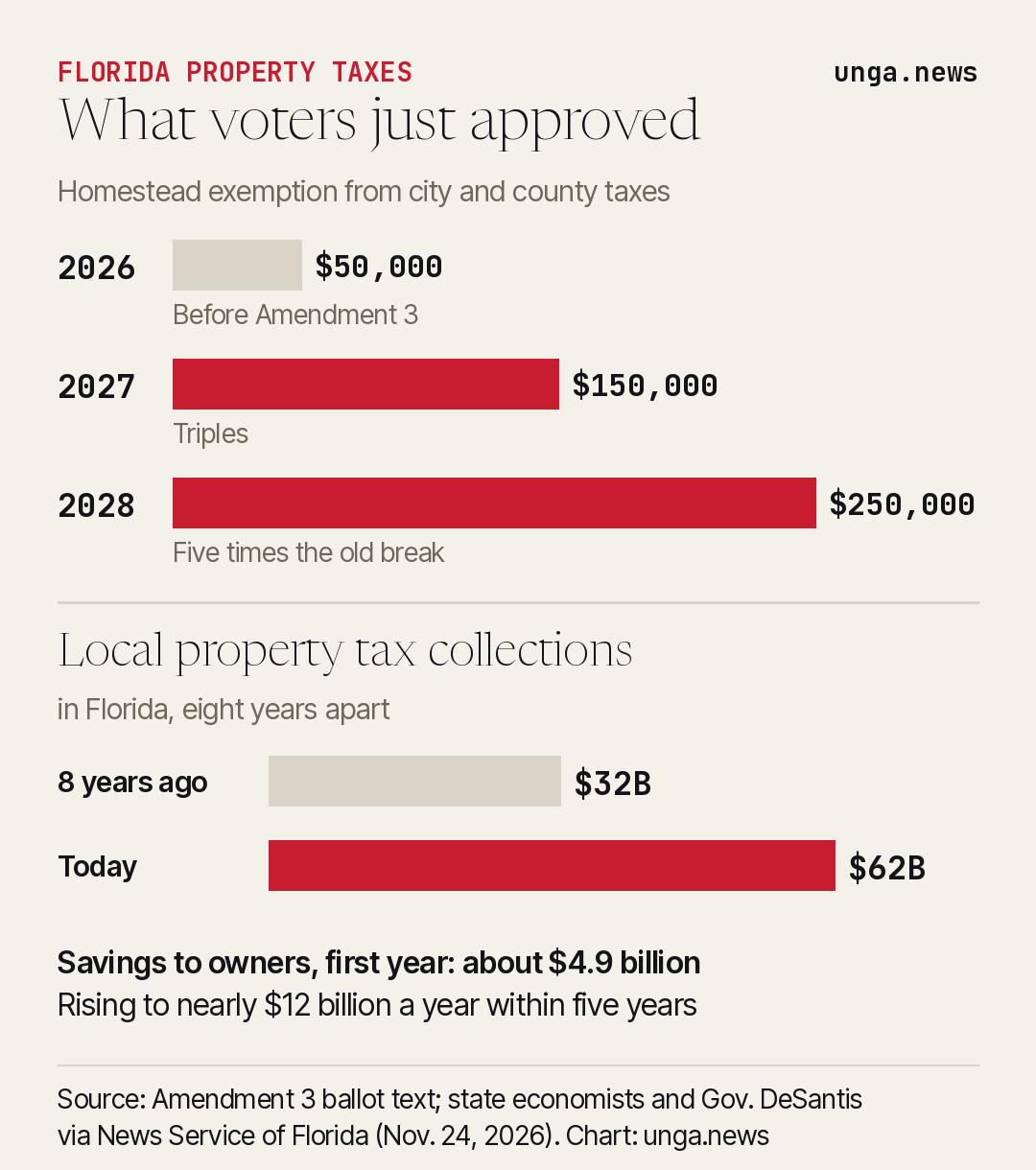
State economists figure homeowners keep about $4.93 billion in the first year, climbing to nearly $12 billion a year within five years. It sounds like a crisis until you look at the number DeSantis keeps bringing up. Property tax collections by Florida’s local governments have jumped from $32 billion to $62 billion in eight years, mostly because home values soared and the tax bills rose right along with them. Families didn’t get raises that fast. Their tax collectors did.
A Christmas parade and a bus for the disabled
So what did some local officials do after the vote? Deltona pulled its support for a Christmas parade. The Pinellas Suncoast Transit Authority, which runs buses around St. Petersburg and Clearwater, floated making disabled riders pay more for the van service that gets them to doctors and jobs.
Those are the budget lines people notice most and resent losing. That is the point, according to DeSantis. He calls it “Washington Monument syndrome,” named for the old Washington trick where the Park Service answers a budget fight by closing the monument tourists most want to see, rather than trimming anything nobody would miss.
Ron DeSantis on 𝕏 — “Behold another installment in Washington Monument syndrome…” (Nov. 19, 2026)
— @RonDeSantis View on 𝕏
His point lands. A $2,000 tax break doesn’t force anybody to cancel a parade. A city that chooses the parade first, before looking at administrator salaries, consultants or new office space, is sending voters a message about who it thinks it works for.
The governor’s own party wants to wait
The holdup isn’t Democrats. The new Republican leaders of the Legislature, House Speaker Sam Garrison of Fleming Island and Senate President Jim Boyd of Bradenton, said after being sworn in last week that they won’t rush into a special session.
“We believe Amendment 3 is self-implementing. It takes effect Jan. 1,” Boyd said. “We believe there’s time later on, during the regular session, to talk about this and give it the time and the attention that it needs.”
Garrison has called the amendment “the biggest fiscal challenge Florida has faced in a generation,” and said it hits all 67 counties differently. In his first speech holding the gavel he put it this way: “As someone who never met a tax he didn’t want to cut, let me be clear: the laws of economics remain undefeated, and there is still no such thing as a free lunch.”
That isn’t opposition to the tax cut. It is a fight over timing. Garrison and Boyd worry about rural counties with thin tax bases. DeSantis worries about local governments filling the hole with new fees, new taxes or cuts aimed at voters while the rules are still unwritten.
What he wants from a special session is specific. He wants limits on cities and counties inventing new fees or taxes to make up the money. He wants grants for rural counties that lean heavily on property taxes, and help for small bedroom communities so they can keep paying for police and other public safety basics. And he wants the law to spell out how newcomers from out of state qualify, possibly letting each county decide.
Can he make them show up?
Florida’s constitution gives the governor the power to call lawmakers into special session. DeSantis reminded reporters of that Monday, while admitting the catch. “The governor has the power to call one. And they’ve got to show up,” he said. “Now, it’s true, they don’t have to do anything, they could show up, pound the gavel, they can leave.”
He said he would do it by Jan. 1 and let legislative leaders pick the date. “Understand, the people spoke, and I think just show some urgency and initiative into making sure that this is implementing in the way that we said it would be,” he told them. Asked whether he had given up, he told reporters to “stay tuned.”
The clock is short. DeSantis is term-limited, and Gov.-elect Byron Donalds takes over on Jan. 5. Garrison and Boyd say they want to hear from both men. Donalds has noted that Florida’s Tax and Budget Reform Commission meets in 2027 with power to reshape the tax system. DeSantis has called Amendment 3 the “first step for property tax elimination.”
Florida Republicans spent the midterms selling this tax cut, and DeSantis credits it with drawing their voters to the polls. Whether the cut gets protected in a December session or in the regular session that opens in the spring, the voters have already settled the bigger question. They want to keep more of what they earn on the homes they own, and they told every city hall in Florida so at 62%.
Sources
- Florida Phoenix — Gov. DeSantis renews messaging on special session before he leaves office (Nov. 23, 2026)
- News Service of Florida via Tallahassee Democrat — Florida Gov. DeSantis not giving up on Amendment 3 special session (Nov. 24, 2026)
- Tallahassee Democrat — Florida leaders reject DeSantis call for Amendment 3 session (Nov. 18, 2026)
- Ron DeSantis on 𝕏 — “Behold another installment in Washington Monument syndrome…” (Nov. 19, 2026)
- Ron DeSantis on 𝕏 — “Amendment 3 results re: first step for property tax elimination…” (Nov. 7, 2026)
- Governor Ron DeSantis on 𝕏 — Governor DeSantis Provides Updates in Melbourne on State Flood Response (Nov. 23, 2026)
- CBS Miami / News Service of Florida — Gov. DeSantis presses for Amendment 3 special session, criticizes local cuts as Florida lawmakers hesitate (Nov. 24, 2026)
- News Service of Florida via Miami Herald — DeSantis to call special session on Amendment 3 tax cut (Nov. 4, 2026)