

Florida’s Next Governor Wants More Nuclear Power. Its Biggest Power Company Isn’t Planning Any Until After 2035.
Byron Donalds calls nuclear “cheap, green and affordable” and wants Florida ready for small reactors. Florida Power & Light’s own ten-year plan shrinks nuclear’s share and leans on solar instead.

Byron Donalds hasn’t even moved into the governor’s mansion yet, and he already knows what he wants Florida’s power grid to look like. More nuclear. Smaller reactors. A state government that clears the path instead of standing in it.
Speaking to reporters in Tallahassee this month, the governor-elect called nuclear power “cheap, green and affordable,” Politico reported Saturday. He said the state’s job is to lay the groundwork for small modular reactors and microreactors, and he pledged to push nuclear at the state level while working with other governors and Florida’s next congressional delegation to update the rules.
The problem is the people who would actually build the plants. Florida’s biggest power company isn’t planning a single new reactor for the next ten years. It says so in its own paperwork.
The plan sitting at the Public Service Commission
Every April, Florida law makes each big utility file a Ten Year Power Plant Site Plan with the state’s Public Service Commission. Florida Power & Light, which serves more Floridians than anyone else, filed its 2026–2035 plan this spring. Read it closely and the nuclear story is one of standing still.
FPL runs four reactors at two sites, St. Lucie on the Treasure Coast and Turkey Point south of Miami. Together they carry 3,502 megawatts of summer capacity: 1,821 at St. Lucie and 1,681 at Turkey Point. In 2025 they made roughly 20% of all the electricity FPL produced. The company plans to keep them running for decades, through 2052 and 2053 at Turkey Point and through 2056 and 2063 at St. Lucie.
That’s the good news. The rest of the forecast moves the other way. By FPL’s own numbers, nuclear’s share of its power slides every single year, from 20% in 2025 to 16.1% in 2035. Solar more than doubles, from 11.4% to 25.9%. Natural gas still does most of the work, dropping from 67.5% to 57%.
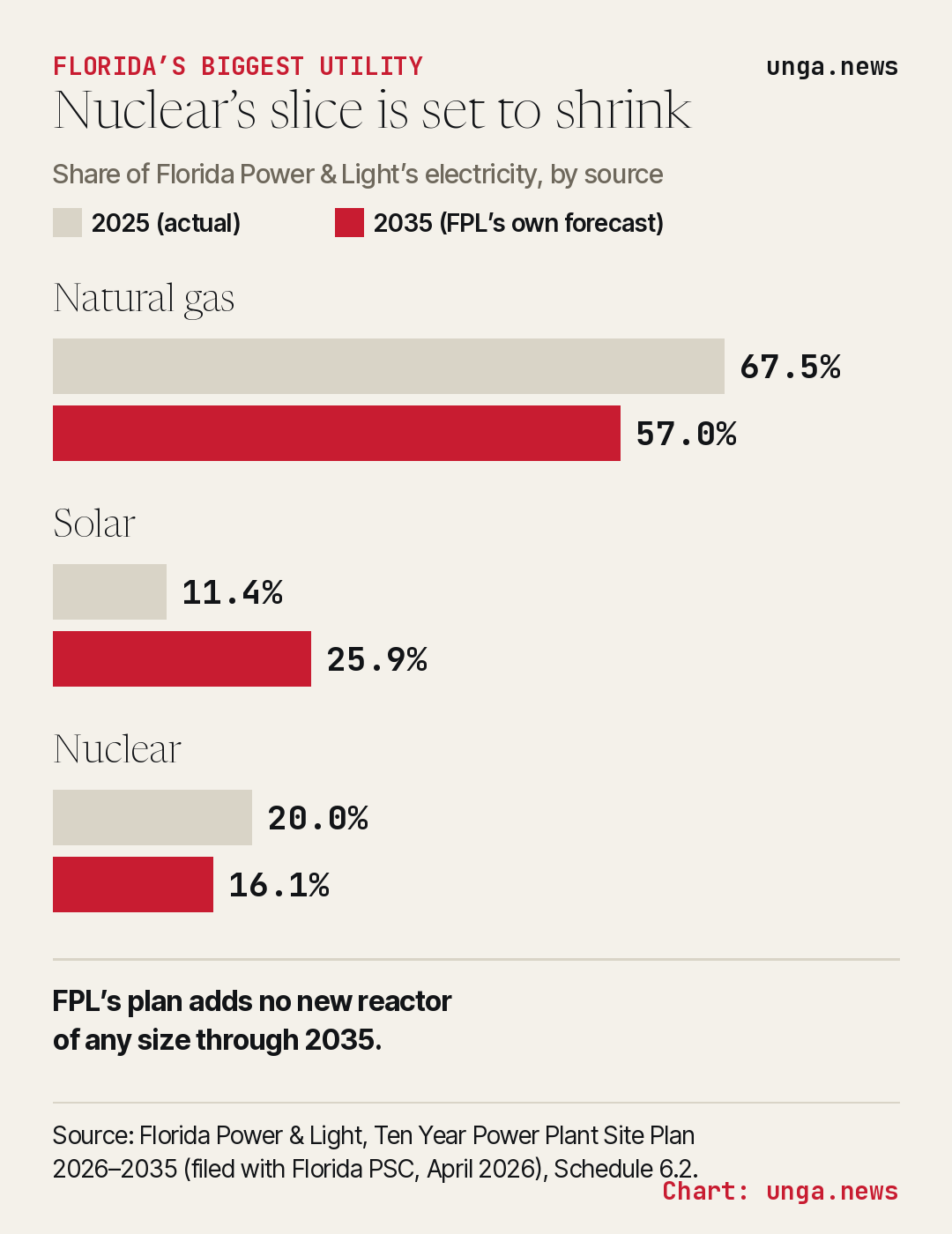
Then there are the reactors FPL already has permission to build. The company started the federal licensing process for two big new units at Turkey Point, Units 6 and 7, back in June 2009. The Nuclear Regulatory Commission approved those licenses in April 2018. More than eight years later, the plan says the earliest they could possibly come online is after 2035.
On small reactors, the kind Donalds is talking about, FPL says it will begin “the initial stages of Early Site Permitting” in 2026 or 2027 for a possible unit next to one of its existing nuclear plants. It calls that a “stepwise approach,” taken while “remaining cognizant of the current high costs of nuclear and SMR development.” The plan says any small reactor would come online outside the ten-year window. No site, no design, no partner.
FPL spokesperson Andrew Sutton told Politico the company has a dedicated team evaluating the technology. Duke Energy Florida, the state’s other big utility, has no nuclear plans at all. Its spokesperson, Ana Gibbs, called advanced nuclear “still a longer-term option.”
A governor who says yes to reactors
None of this is new territory for Donalds. In the House, he was one of nuclear power’s loudest backers, and he tied it straight to President Trump’s agenda.
Byron Donalds on 𝕏 — Dec. 26, 2025
— @ByronDonalds View on 𝕏
That agenda is real and it’s on paper. In May 2025, Trump signed an executive order telling the Energy Department to work with industry on 5 gigawatts of power upgrades at existing reactors and to have 10 new large reactors with complete designs under construction by 2030. Washington is pushing the gas pedal. The question in Florida is whether the utilities step on it too.
Donalds ran on the same idea. In February, while campaigning, he posted that Florida “is going to continue to grow” and that “we must ensure our grid is bolstered with nuclear, natural gas, & other innovative solutions.”
There’s a real reason a governor would care. Florida keeps adding people, and the data centers that power SI tools want electricity around the clock, not just when the sun is out. Nuclear runs day and night. FPL’s own plan praises it for exactly that, calling it important “due to its combination of low fuel cost, around-the-clock operation, and location close to major load centers.”
What Tallahassee can actually do
A governor can’t order a utility to build a reactor. But Florida’s own regulators have already handed the next one a to-do list.
In March 2025, the Public Service Commission sent the Legislature a feasibility report on advanced nuclear. It found that the small designs “appear technically feasible, but as of yet unproven,” and noted there are no small modular reactors or microreactors running anywhere in the country yet. Then it laid out options. Lawmakers could widen the special cost-recovery rules Florida created for new nuclear plants in 2006. The state could back grant money for new reactors and set up a workforce training program. Regulators should keep the freedom to approve special rates for a small reactor built to serve one big customer, “such as a data center.”
The report also pointed to Florida’s military bases. The Pentagon is already testing microreactors at bases in other states, and the commission said Florida utilities, with decades of nuclear experience, “may be well suited to work in partnership” with the Defense Department here.
Lawmakers took a swing at part of this in 2026. Senate Bill 1696 would have made the Public Service Commission the sole regulator of advanced reactors in the state. It died in committee in March. A governor who makes nuclear a priority from his first day could give a bill like that a very different ending.
Critics will say the timeline proves Donalds is dreaming. It proves the opposite. If nobody lays the groundwork now, the after-2035 date in FPL’s plan becomes after-2045. Turkey Point 6 and 7 already show how long a reactor can sit on paper when nobody in charge is pushing.
Florida has been here before. It already gets about 11% of the state’s energy from four reactors that were built decades ago, according to the Public Service Commission. The plants that keep the lights on in Miami tonight were somebody’s long-term bet once.
Donalds is placing the next one. He’s sworn in in January, the Legislature meets in the spring, and FPL’s next ten-year plan is due in April. That filing will show whether the company heard him.
Sources
- Florida Power & Light — Ten Year Power Plant Site Plan 2026–2035, submitted to the Florida Public Service Commission (April 2026)
- Florida Public Service Commission — Advanced Nuclear Power Feasibility Report (March 31, 2025)
- The White House — Executive Order 14302: Reinvigorating the Nuclear Industrial Base (May 23, 2025)
- Byron Donalds on 𝕏 — “We’re undergoing a nuclear power renaissance…” (Dec. 26, 2025)
- Byron Donalds on 𝕏 — “We must ensure our grid is bolstered with nuclear, natural gas…” (Feb. 21, 2026)
- The Florida Senate — SB 1696 (2026): Advanced Nuclear Reactors
- Politico — Donalds pursues Florida nuclear power revival despite industry headwinds (Nov. 28, 2026)