

A Burned Town Hall and 2,397 Arrests: France Is Paying for Decades of Lax Immigration
A burned town hall, 2,397 arrests and a government asking for lessons. The riots are the bill for decades of choices on immigration and enforcement, and America chose differently.
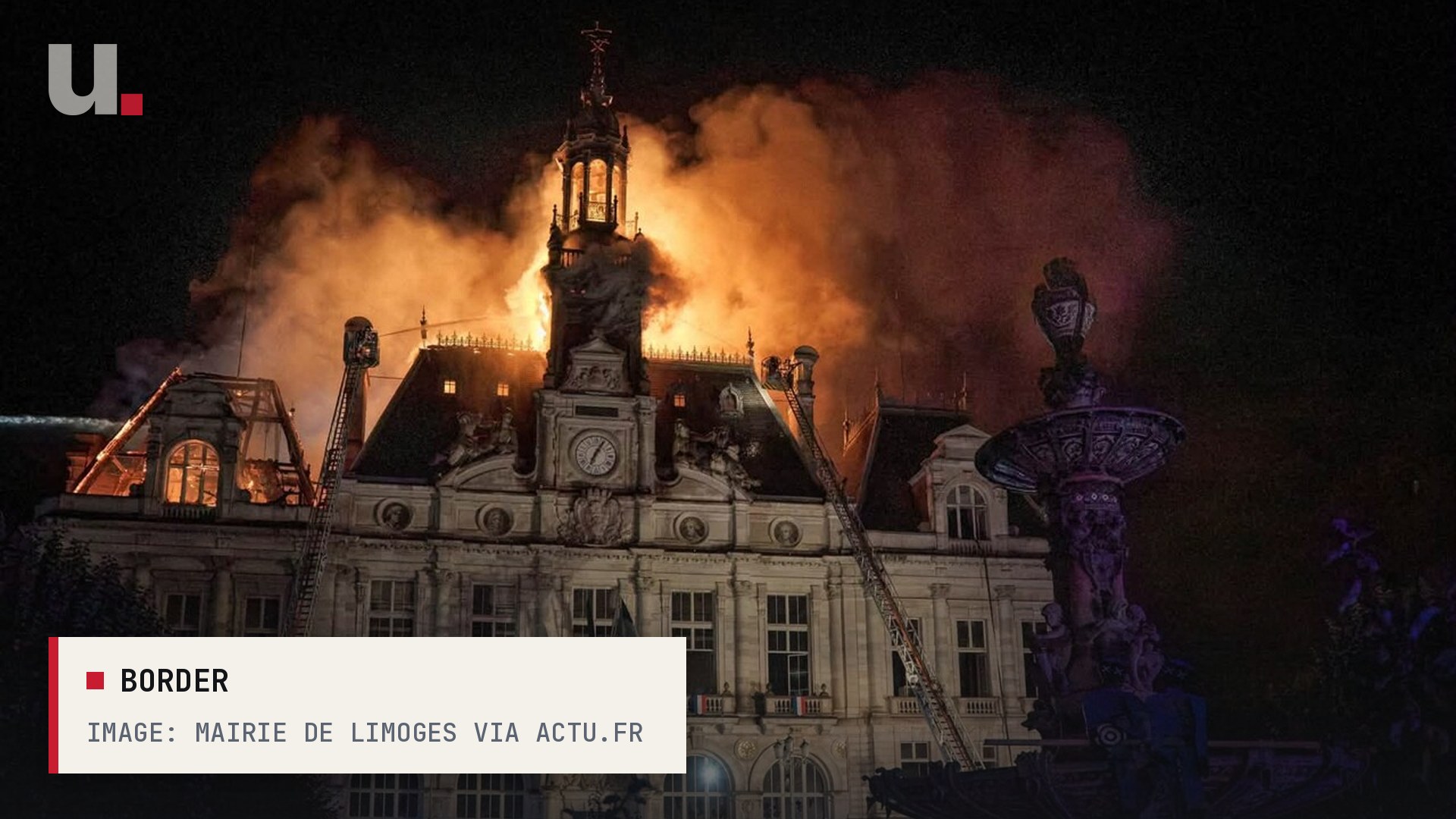
Limoges' town hall survived two world wars. On Saturday evening, rioters forced their way inside and set it on fire while staff and visitors were still in the building, according to the regional prefect. By Sunday night its spire had collapsed, 2,397 people had been arrested across France, and 997 police officers, gendarmes and firefighters had been hurt, the Interior Ministry said.
It would be easy to call this one bad night that got out of hand. It is better understood as a bill coming due. For decades, Paris let large numbers of people in, did little to make sure they became part of the country, and rarely enforced its own decision when someone was told to leave. Saturday is what that looks like when it reaches the street.
Limoges town hall, built in 1873, as its spire collapses on Oct. 17 (Visegrád 24, 7.5M views)
— @visegrad24 View on 𝕏
One day, many cities
The day began as a national protest over the cost of living and the state of schools. About 550,000 people marched, according to authorities, before it turned into what the Paris deputy mayor called "a level of violence that we have never, I believe, seen before," as Firstpost reported.
Paris police made 855 arrests, a figure they called a record, and prosecutors said most people held were suspected of handling stolen goods, joining a group bent on violence, or vandalism, Sud Ouest reported. In Marseille, the regional police authority counted more than 30,000 looters at the peak, including 8,000 rioters, per actu.fr. A few dozen people forced the doors of City Hall there too, CNews reported. Shops were stripped in Bordeaux, Nice, Strasbourg and Limoges.
One clip captured the evening better than any statistic. A young woman tries to stop looters from breaking into a supermarket. In the translation posted with the video by French commentator Thaïs d'Escufon, in a post viewed more than 2 million times, she shouts: "Why are you doing this? Stop it! That's not what we stand for!" They keep going.
“Why are you doing this? Stop it! That’s not what we stand for!” A young woman tries to stop looters at a supermarket.
— @ThaisEscufon View on 𝕏
Who did this? Paris isn't saying
So who was in the crowds? Interior Minister Laurent Nuñez blamed "plusieurs milliers d'individus d'ultragauche" (several thousand far-left individuals) in Marseille, who were then "rejoints par des délinquants qui ont pillé et saccagé de nombreux commerces" (joined by criminals who looted and ransacked many shops), ICI reported. President Emmanuel Macron also put much of the blame on far-left activists, AP reported.
What no French authority has published is a breakdown of this weekend's arrests by nationality or background. The claim that the rioters were mostly foreigners is all over social media, but there is no official count for 2026 that proves it, and this column won't pretend there is.
There is data from the last time France burned, though, and it is telling. During the 2023 riots after the police shooting of Nahel Merzouk, then-Interior Minister Gérald Darmanin told senators that "Seules 10 % des personnes que nous avons interpellées sont de nationalité non française" (only 10% of the people we arrested are not French nationals), per Public Sénat. That was the line Paris wanted remembered.
Ten months later, a Senate inquiry looked at the people actually convicted and found that 71% were French nationals, Public Sénat reported. Do the math the government skipped: that leaves 29% who were foreign nationals. Foreigners made up 8.2% of France's population in 2023, according to INSEE. That means foreign nationals were overrepresented among convicted rioters by roughly three and a half times, and that counts only passports. Children of immigrants who were born French don't show up in that figure at all.
A country that won't count
If that 29% sounds incomplete, it is. French crime statistics stop at the passport, and that is by design.
The 1978 Informatique et Libertés law states that "Il est interdit de traiter des données à caractère personnel qui révèlent la prétendue origine raciale ou l'origine ethnique" (it is forbidden to process personal data revealing alleged racial or ethnic origin), as the government's own Vie publique explainer quotes it. When lawmakers tried to open the door in 2007, the Constitutional Council shut it, ruling that studies of diversity and integration "ne sauraient, sans méconnaître le principe énoncé par l'article 1er de la Constitution, reposer sur l'origine ethnique ou la race" (cannot rest on ethnic origin or race without violating Article 1 of the Constitution).
So the arrest tallies count one thing: nationality. A teenager born in France to immigrant parents is recorded as French, exactly like a teenager whose family has farmed in Brittany for ten generations. Whatever pattern exists between the two, the official numbers are built so it never shows up.
France does know the broader picture. INSEE counts 7.2 million immigrants and another 8.0 million French-born children of immigrants, more than 15 million people in all as of 2023. About 3.6 million of those children have roots in Africa, and half of them are under 17. Among the 517 people Paris prosecutors held on Sunday, 171 were minors.
The data that could connect those dots exists. The Justice Ministry itself told the Senate in 2008 that the ruling still allows "données à caractère personnel objectives, telles que le nom, l'origine géographique ou la nationalité antérieure à la nationalité française" (objective data such as name, geographic origin or prior nationality), per the Senate record. None of it has been applied to the arrest figures released so far. It is like owning a thermometer and refusing to take the patient's temperature, then announcing there is no fever.
Then there is what the footage itself suggests. Watch enough of the clips circulating on X and you hear looters shouting in foreign languages. One Paris clip shared Saturday came with the caption that "chants of “Allahu Akbar” and “Free Palestine” are heard" as rioters clashed with police, according to the post. That is an observation, not an official count. But no official count can confirm it or rule it out, because France chose not to measure.
Fifty years of choices
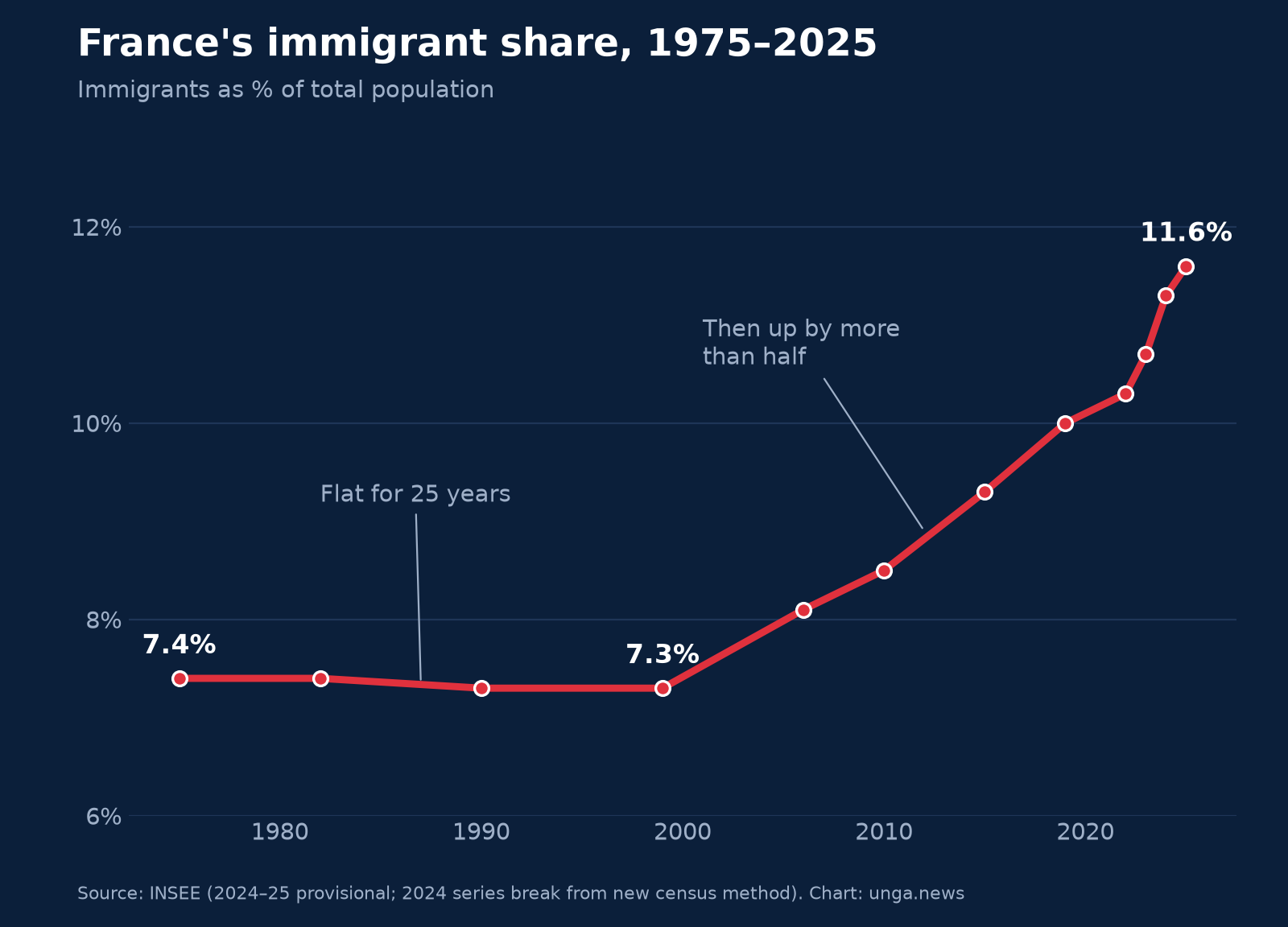
The numbers on immigration are not in dispute. Immigrants made up 7.3% of France's population in 1999. By 2025 the figure was 11.6%, close to 8 million people, according to INSEE. For a quarter-century the share barely moved. Since 2000, it has climbed by more than half.
It isn't slowing down. France issued 384,230 first residence permits in 2025, up 11.2% in a year, with humanitarian permits jumping 65%, according to the Interior Ministry. It also received 151,665 asylum applications and approved more than half of the cases it decided, franceinfo reported.
A strong country can absorb newcomers when it asks something of them and enforces its own rules. France has done neither for a long time. An Assemblée nationale report from June 2025 put the number of foreigners living in France illegally at about 500,000, and called the country's removal policy "de longue date déficiente" (long deficient), in its own words.
Orders that stay on paper
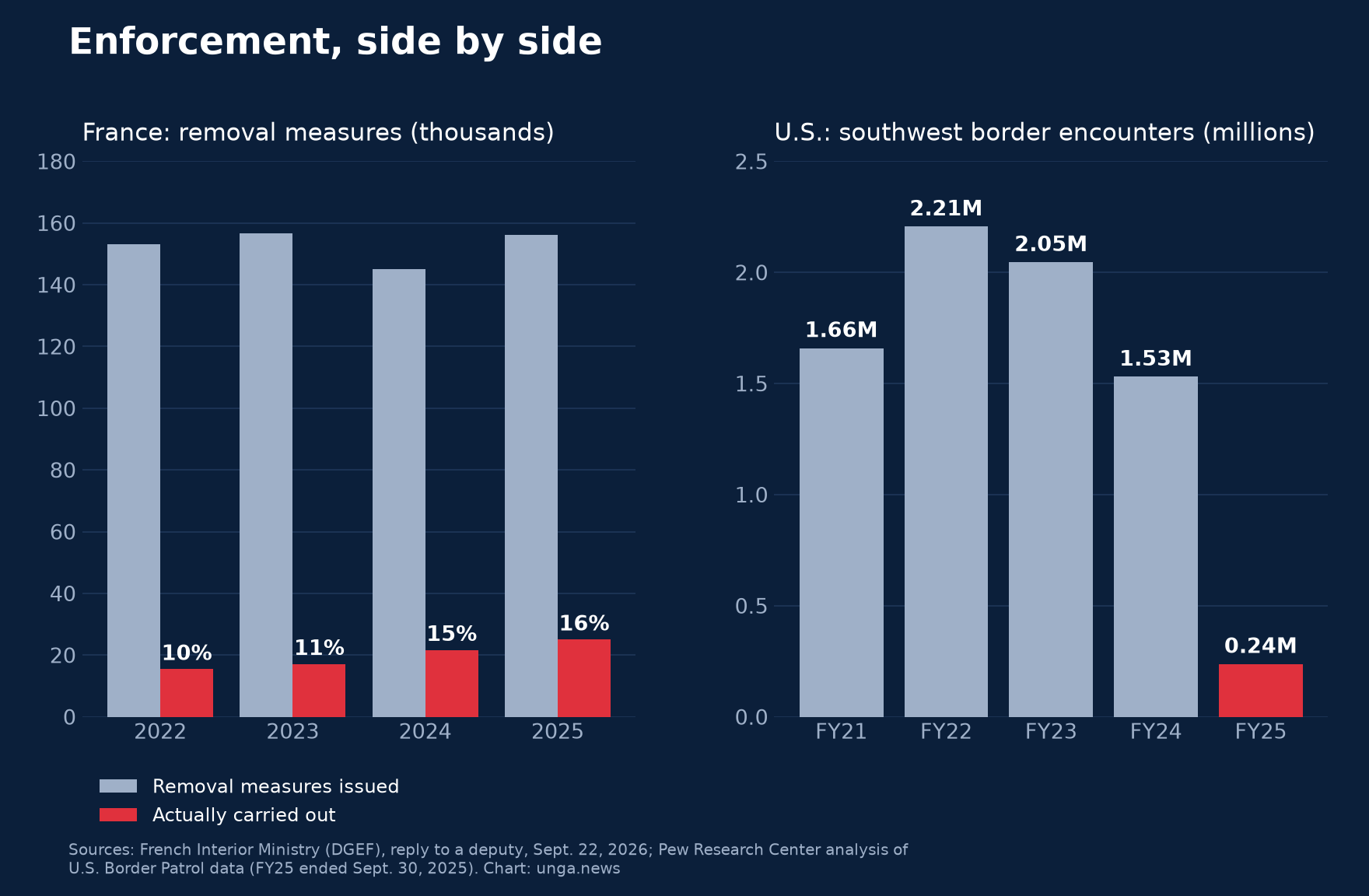
This is where the story turns from immigration to something worse: a state that doesn't follow through on its own decisions. France's audit court, the Cour des comptes, found that "seule une petite minorité - autour de 10% - des OQTF sont exécutées" (only a small minority, about 10%, of orders to leave French territory are carried out), France 24 reported. The Assemblée report put it at roughly 15,000 out of 130,000 in 2024.
The ministry's own numbers tell the same story. In 2025, France issued 156,180 removal measures and carried out 24,985, according to data it gave a deputy in September. Think of a city that writes parking tickets nobody ever has to pay. Before long, nobody reads the signs.
Where were the police?
In fairness to the officers in the street, many of them were outnumbered and paid for it, with nearly a thousand injured. The failure was higher up. Paris's first deputy mayor, Lamia El Aaraje, said police were "débordées" (overwhelmed), complained of "un manque de moyens" (a lack of resources), and said residents and shopkeepers kept calling to ask "mais où sont les forces de l'ordre ?" (but where are the police?), according to Le Figaro.
In Marseille, Mayor Benoît Payan demanded answers: "Je veux savoir pourquoi, dans cette ville, des gens ont pu impunément casser" (I want to know why, in this city, people were able to smash things with impunity), CNews reported. Even Macron told his government to "tirer toutes les leçons" (learn every lesson). A government that has to be told to learn lessons after its town halls burn isn't doing much. It is reacting.
The road America didn't take
Americans have seen this movie's opening scenes. The southwest border recorded 1.53 million Border Patrol encounters in fiscal 2024. In fiscal 2025, the year President Donald Trump returned to office, it recorded 237,538, the lowest since 1970, according to the Pew Research Center. CBP says the Border Patrol released zero people at the southwest border for five straight months through September 2025, per its own release.
Voters elected Trump to secure the border and stop the bleeding before it turned into scenes like Saturday's. On Sunday he wrote that "France is burning! The immigration of people from an entirely different world, people with hatred in their hearts, has shattered that once great country," and urged Paris to "Close your Borders and take control, before it is too late!" as The Hindu reported.
Vice President JD Vance said it in a sentence that has now been liked more than 200,000 times on X:
Western liberals imported the third world into France and other countries in the name of diversity and compassion. (JD Vance)
— @JDVance View on 𝕏
The bill comes due
Nobody in Paris planned for Limoges to burn. That is the point. Mass immigration without real integration, removal orders that are mostly ignored, and a government that keeps describing every riot as a surprise were all choices, made year after year, by leaders who were warned.
France can still change course. America already has. The difference between the two is not luck, culture or geography. It is whether a country decides its borders and its laws mean what they say.
Sources
- Préfecture de la Haute-Vienne — Mouvement contestataire du 17 octobre 2026 à Limoges
- CNews — Après les saccages et pillages, Laurent Nuñez attendu à Marseille
- ICI (France Bleu) — 1.800 interpellations en France, indique Laurent Nuñez
- AP — Macron condemns those who 'sought to bring down the Republic'
- Sud Ouest — « Un niveau de violence que nous n'avons jamais vu »
- actu.fr — 17 octobre à Marseille : plus de 30.000 pilleurs dénombrés
- Le Figaro — Violences du 17 octobre (live)
- Public Sénat — Darmanin before the Senate, July 2023
- Public Sénat — Violences urbaines : quel est le profil des émeutiers ?
- INSEE — L'essentiel sur les immigrés et les étrangers
- INSEE — En 2024, 6,0 millions d'étrangers vivent en France
- French Interior Ministry (DGEF) — Les titres de séjour pour l'année 2025
- franceinfo — Rapport annuel sur l'immigration du ministère de l'Intérieur
- France 24 / AFP — Expulsions d'étrangers : trop de cibles, peu de résultats, selon la Cour des comptes
- Assemblée nationale — Les résultats de la politique d'éloignement (OQTF), June 2025
- Assemblée nationale (via LesDéputésEnChiffres) — Government reply on removal measures, Sept. 22, 2026
- The Hindu — Trump says 'France is burning'
- Pew Research Center — Migrant encounters at the U.S.-Mexico border at lowest level in more than 50 years
- U.S. Customs and Border Protection — Lowest fiscal year for Border Patrol apprehensions since 1970
- Firstpost — 'France is burning!': Trump blames immigration for unrest
- Vie publique — Faut-il élaborer des statistiques ethniques ?
- Conseil constitutionnel — Décision n° 2007-557 DC du 15 novembre 2007
- Sénat — Interdiction de toute statistique reposant sur des critères ethniques (Justice Ministry reply, 2008)
- INSEE — Immigrés et descendants d'immigrés (France, portrait social)
- X (@ddfmarketing1) — Paris riot clip: chants of “Allahu Akbar” and “Free Palestine” are heard