

From a Brooklyn Jail Cell, an Iran-Backed Terror Boss Sent Coded Orders to Hit U.S. Troops, Feds Say
Prosecutors say three men tied to Iran ran nearly 20 attacks on Jewish targets in Europe and the U.S., then sent fuel-loaded vans toward a British base housing American bombers.
A man sitting in a federal jail in Brooklyn, waiting to stand trial for trying to bomb a synagogue in New York, allegedly kept running an Iran-backed terror operation from his cell. He did it, prosecutors say, through phone calls home to his mother and sister. Three days after one of those calls, three white vans loaded with barrels of fuel headed for a British air base where American bombers and troops were stationed.
That’s the heart of an eight-count indictment the Justice Department unsealed Tuesday in Manhattan federal court. It charges three men tied to Iran’s Revolutionary Guard and an Iraqi militia called Kata’ib Hizballah with a role in nearly 20 attacks and attempted attacks on Jewish communities in Europe and the United States, plus the September plot against RAF Fairford in western England. The full Justice Department release reads like a crime thriller.
The three are Mohammad Baqer Saad Dawood al-Saadi, 32, who holds both Iraqi and Iranian citizenship; Mohsen Mohajeri, 48, an Iranian national prosecutors call an operative of the Revolutionary Guard; and Mohammad Ali al-Hassani, 35, from Iraq. Only al-Saadi is in American custody. The other two were in Iran when the Fairford plot went down, according to the government.
The Justice Department on 𝕏 announcing the indictment of three Iran-backed operatives, Nov. 10.
— @TheJusticeDept View on 𝕏
Attorney General Todd Blanche didn’t dress it up. “Anyone who plans a terrorist plot on a military base housing American servicemembers will be prosecuted by the United States government,” he said.
“Light it up like a Christmas tree”
The government says this crew was behind a wave of attacks across Europe last spring, carried out under the name of a supposedly new group called Harakat Ashab al-Yamin al-Islamiya. Prosecutors call that name a front for Kata’ib Hizballah and other terror groups. It claimed 18 attacks in Europe, and seven of them hit the United Kingdom, more than any other country. They included arsons, explosives and a near-fatal stabbing of two Jewish men in London, one of them a dual U.S.-British citizen. The BBC reports that stabbing happened in Golders Green, a heavily Jewish neighborhood in north London, in April.
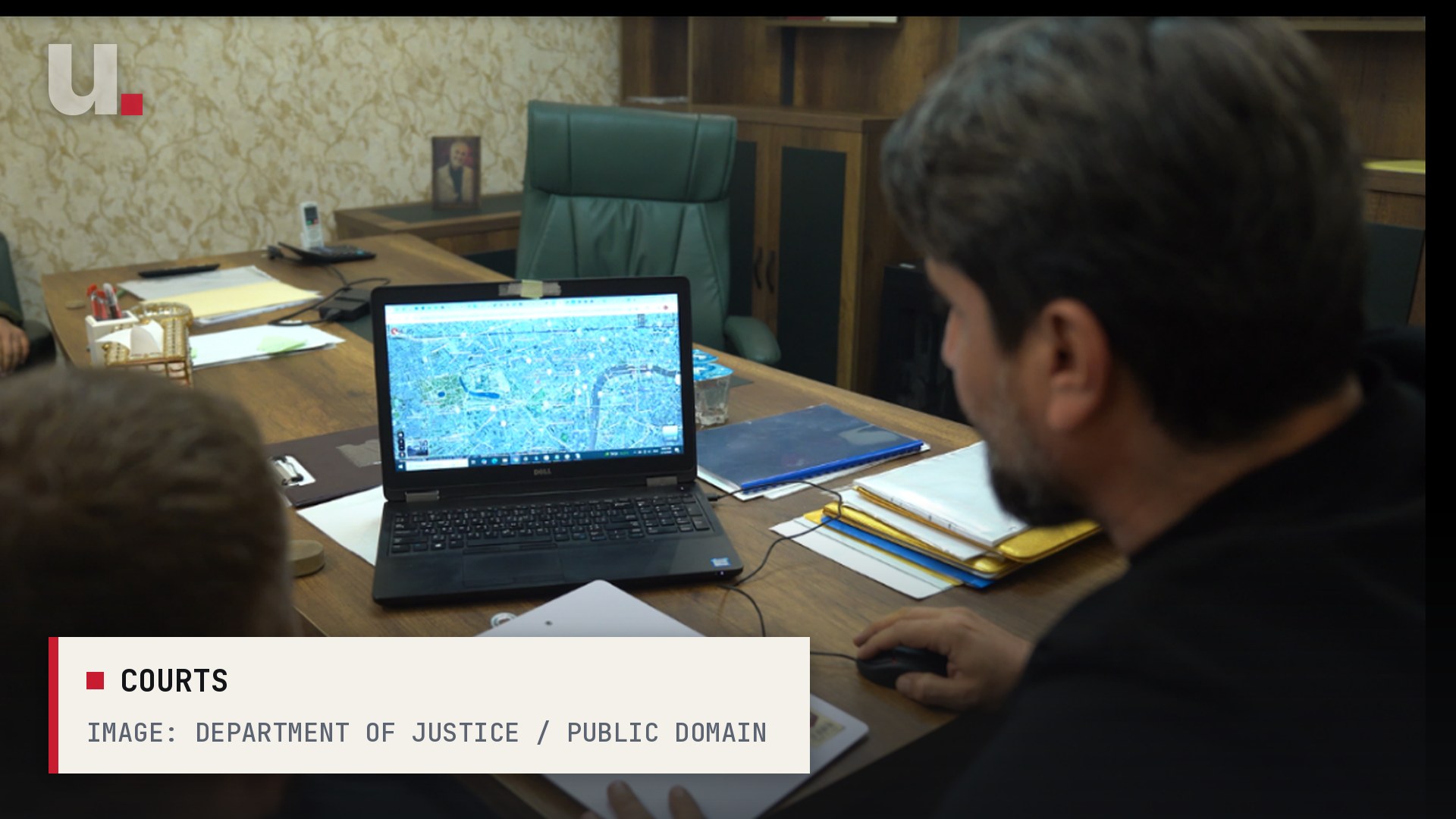
The details in the filing are chilling. On or about April 6, prosecutors say, Mohajeri and al-Hassani sat together in a room in Iraq with a map of London on a computer screen. In a video of the meeting, al-Hassani told Mohajeri, “we need to get focused on London.” About a week later, the group started claiming attacks in and around the city. Six of them.
On April 17, the government says, all three men watched an attack happen live over FaceTime, projected on a big screen in front of the group’s logo. Al-Hassani allegedly coached the attacker in real time: “light one in your hand,” “light it,” “throw the fourth one.” Al-Saadi filmed it. Mohajeri filmed the two of them filming it.
The next day, al-Hassani was allegedly on another video call with someone attacking a synagogue in London. His instruction, according to the indictment: “light it up like a Christmas tree.” The person lit a homemade bomb and threw it at the building.
Orders through his mother and sister
Al-Saadi was arrested abroad around May 1 and brought to the United States, where he was already charged with planning about 18 attacks in Europe and trying to bomb a synagogue in Manhattan. For roughly four months after his arrest, the attacks tied to the three men stopped.
Then, prosecutors say, the work quietly started back up. From jail, al-Saadi had phone calls with family members in Iraq. In June and July he allegedly talked with his mother and sister about Mohajeri using aliases like “Abbas, Abu Daniel” and “Sayyid Abbas,” said he owed Mohajeri money, and passed along messages about “work,” the word prosecutors say he regularly used for terrorist activity. On one call he asked his sister, “What are they doing about all our old work?” He wanted to know if it had been canceled or just paused. Her answer, per the filing: “it isn’t cancelled.”
On Sept. 24 he called again and asked how “Ali” was doing, meaning al-Hassani. Told that Ali had been moved to the “International Section,” al-Saadi allegedly told his family to “give him money so we can do it.”
Three vans and a roadblock
By then the Fairford plan was already moving. On Aug. 22, al-Hassani allegedly paid someone to scout the base’s perimeter and got videos of the area back. In September he paid others to buy vans and barrels of fuel, research chemical accelerants, and buy metal objects that could serve as shrapnel. At his urging, they slapped custom decals on the vans so they’d look like trucks from a fuel delivery company and a swimming pool supply business.
On Sept. 26, three vans rolled toward the base while al-Hassani stayed in frequent contact with the drivers, telling them where to go. At least two of the vans hit a security roadblock and were turned away. Early on Sept. 27, British police recovered three white vans with the fuel company logos and arrested the people inside. Britain declared a major incident that day, evacuated nearby homes and sent in a bomb disposal unit, according to DW, which also reports the U.S. has since pulled its bombers from the base.
Fairford mattered to Iran for a reason. Britain had allowed the United States to use the base this year for limited strikes on Iranian missile capabilities, Axios notes. In other words, the regime’s proxies allegedly tried to hit the very Americans who were defending against it.
“Justice will find you”
FBI Director Kash Patel said the case shows “the determination of Iran to commit terrorist attacks in Europe and the U.S.” He pointed out that one suspect was “behind bars awaiting trial yet he allegedly sent coded messages to assist in future acts of violence.” Patel added that the bureau has disrupted more than 1,300 terrorists over the last 21 months. “All those who threaten our homeland will get the message,” he said. “Justice will find you.”
Jamie McDonald, the U.S. attorney in Manhattan, put it bluntly: “The threat presented by Iran and Iran-backed terrorist groups to America and our allies is not hypothetical — it is very real.”
Two of the eight counts, conspiring to bomb a place of public use and al-Saadi’s attempted act of terrorism across national borders, carry up to life in prison. The rest range up to 20 years. Like any indictment, these are allegations, and all three men are presumed innocent until proven guilty in court.
Al-Saadi is still sitting in the Metropolitan Detention Center in Brooklyn, the same place he allegedly made those calls home. Mohajeri and al-Hassani, as far as the government has said, are still out of reach.
Sources
- U.S. Department of Justice — Three Iranian-Backed Operatives Indicted for Their Roles in Nearly 20 Terrorist Attacks and Attempted Attacks Across Europe and the United States
- The Justice Department on 𝕏 — The Justice Department on 𝕏 — Three Iranian-backed operatives indicted
- AP — US charges 3 men with plotting terror attacks, including planned assault on UK air base
- BBC — Three Iran-backed suspects plotted attacks including RAF Fairford incident, US says
- DW — US charges 3 over alleged Iran-linked terror plots
- Axios — 3 charged with plotting terror attacks in U.S., Europe