

FTC and 20 States Sue Dollar General, Saying It Kept Overcharging at the Register After Seven State Settlements
The chain logged 29,265 complaints that it didn't honor the marked price, the suit says. FTC undercover shoppers were overcharged on every trip, and seven past state settlements cost Dollar General less than 90 minutes of sales.
The Federal Trade Commission and 20 states sued Dollar General on Monday, accusing the 21,000-store discount chain of doing something every shopper hates: putting one price on the shelf and charging a higher one at the register. Not once in a while, the government says, but for years, in thousands of stores, after the company had already paid seven state settlements over the same thing.
The 95-page complaint, filed in federal court in Tennessee, where Dollar General is based, says the company logged at least 29,265 customer complaints it filed under "Did Not Honor Marked Price" from January 2023 through March 2026. Those came from all 48 states where it operates.
"Dollar General has betrayed the trust of millions of American consumers and imposed significant financial harm on communities and consumers who are already struggling to make their paychecks last," said Christopher Mufarrige, who runs the FTC's Bureau of Consumer Protection. The commission voted 2-0 to file. Dollar General did not immediately answer requests for comment from CNBC and CBS News, and its stock fell about 4% after the announcement, CNBC reported.
The FTC announces the Dollar General lawsuit, Oct. 26, 2026
— @FTC View on 𝕏
Who gets hurt
This isn't a story about a few cents at a fancy grocery store. The complaint quotes Dollar General's own words about its customers. About 80% of its stores sit in towns of 20,000 people or fewer. Households earning $35,000 or less bring in 60% of its revenue. Its CEO has described core shoppers as people who "run[] out of money before the month runs out."
Those are the people the suit says paid extra. An Ohio shopper saw eggs marked $5.10 that rang up at $6.35. An Alabama woman said Twinkies tagged at $2.50 came up $3.50, and the same thing happened with paper towels, toilet paper and bleach. A South Carolina customer wrote that it happened "EVERY time," and that workers at the store said they were "not allowed to change it or fix the price" by their bosses.
The FTC went shopping
The FTC didn't just read complaints. Between January and April of this year, its investigators made undercover buys at Dollar General stores in Cleveland, Ohio; Springfield, Missouri; Sharpsburg, Pennsylvania; and Baltimore. Every single trip came back with overcharges. In Cleveland, 13 of 58 items rang up at a price different from the tag. In Baltimore, all five wrong prices went against the shopper.
The dollar amounts per trip were small, $2.60 to $4.07 in net overcharges. That's exactly the point. Nobody hires a lawyer over $3. But $3 a basket, at a chain that rang up $42.7 billion in sales last year, adds up fast, and it lands on the families who can least spare it. The complaint also notes that at one store the running list of prices faced only the clerk, so the shopper couldn't watch the total build.
Failed inspections, state after state
States send weights-and-measures inspectors to scan random items and compare the register to the shelf. Most use a 2% rule: if more than 2 of every 100 items ring up wrong, the store fails. The complaint and earlier state settlements show Dollar General flunking those checks again and again.
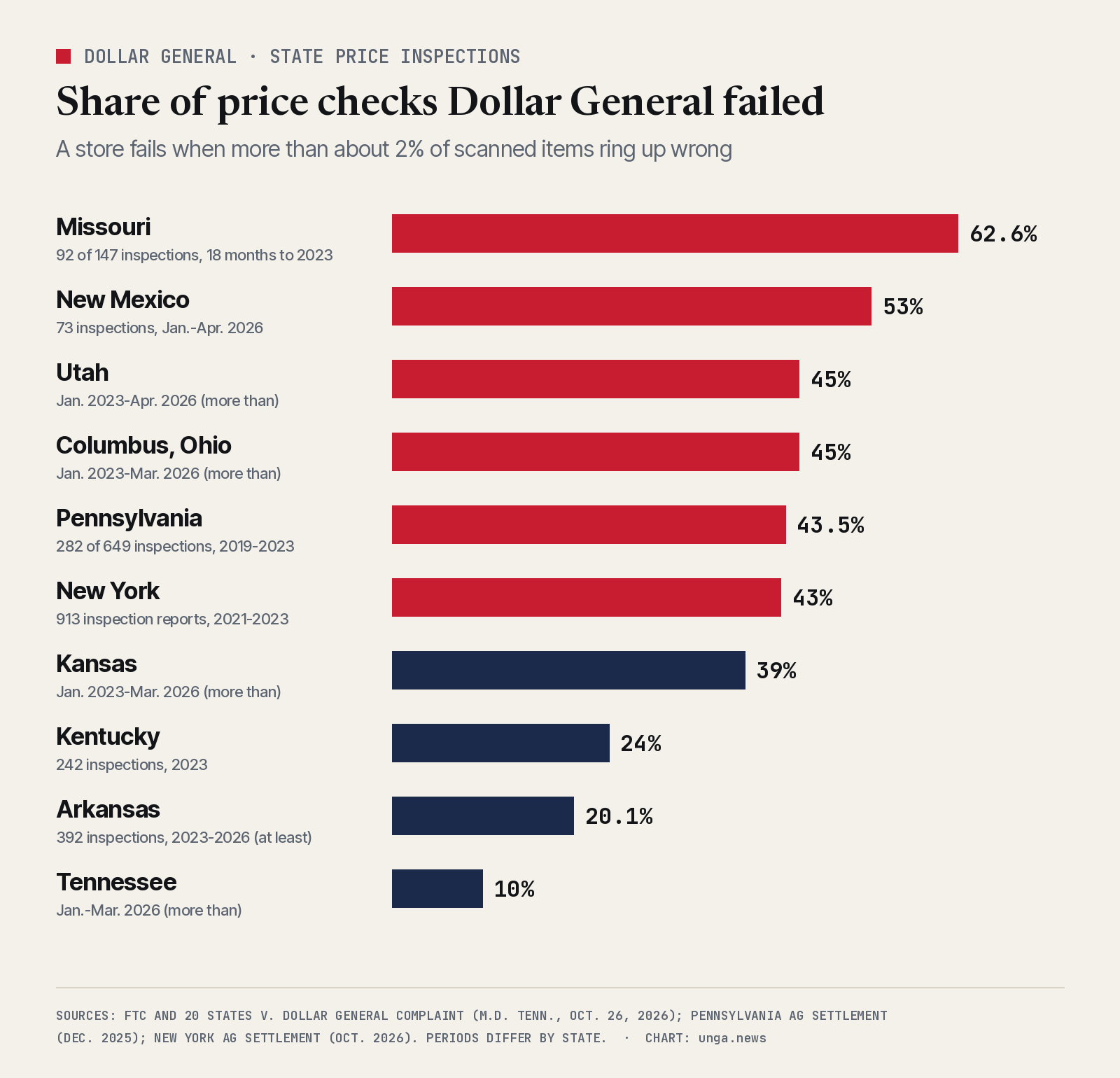
One store in Nephi, Utah, failed 15 of 19 inspections, including ten in a row from May 2025 to April 2026. One Kansas store failed 44 times. In Glasgow, Kentucky, inspectors found 20 of 50 items priced wrong, and every one was an overcharge. Tennessee, the company's home state, saw its failure rate double from about 5% in 2025 to more than 10% in the first three months of 2026.
The complaint also points to staffing. It says stores are often too thinly staffed to print new price labels and put them on the shelves, and that a news article sent to the CEO quoted a former Illinois assistant manager: "You're lucky if you get to work two to four hours of your eight-to 13-hour shift with another human being."
Fined, and fined again
Here's what makes this case different from a one-off pricing goof. Since 2019, the complaint says, Dollar General has settled seven state cases over inaccurate pricing, with Wisconsin twice, Vermont, New Jersey, Ohio, Colorado and Pennsylvania, paying more than $6 million. Two of those deals already required signs promising shoppers the lowest price. The overcharging kept going, the government says.
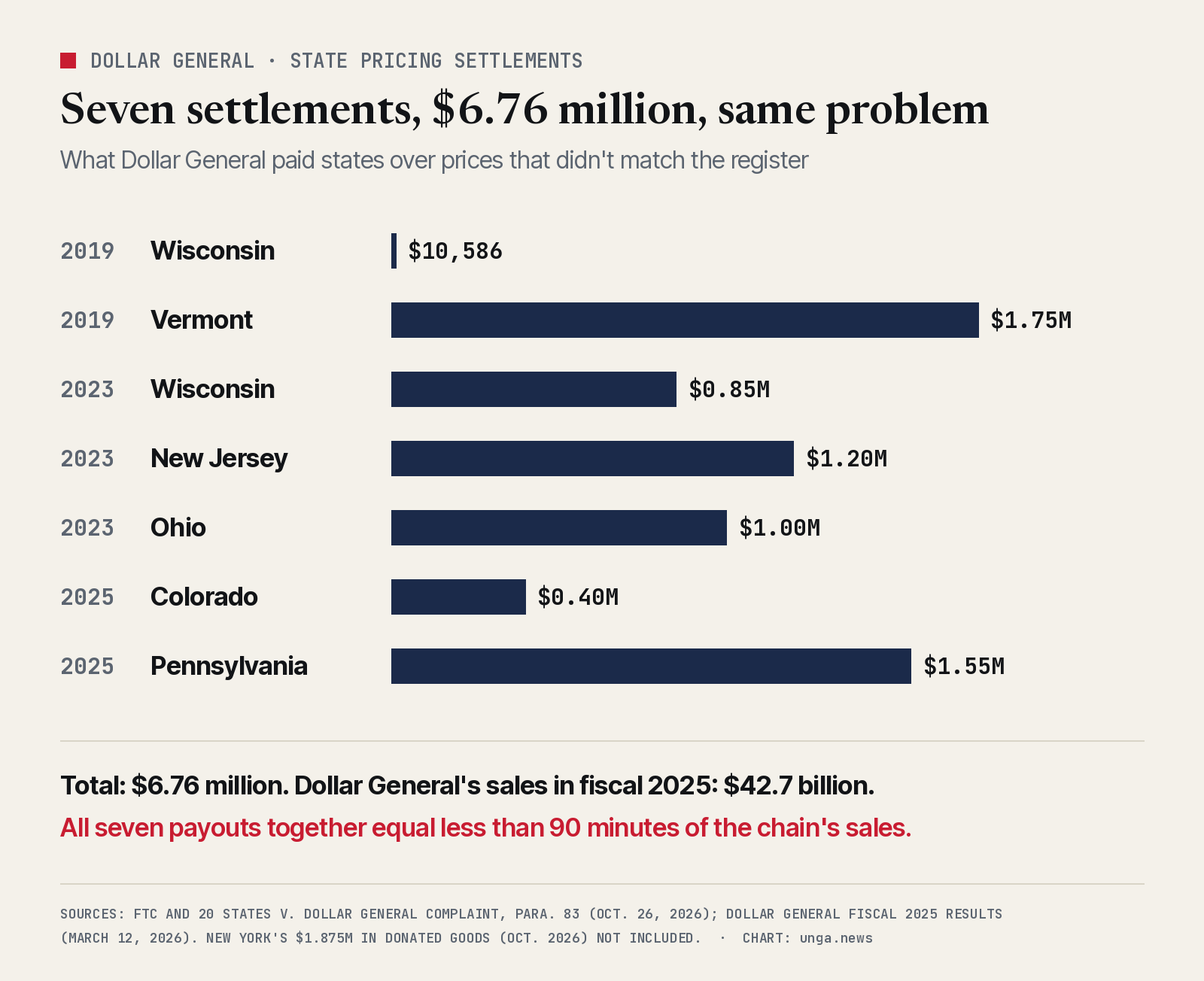
Add it up and all seven payouts come to about $6.76 million. Dollar General's sales last fiscal year were $42.7 billion, which works out to roughly $4.9 million an hour. Every state penalty since 2019 combined equals less than an hour and a half of business. It's like a driver who keeps paying speeding tickets out of his pocket change. The tickets aren't changing anything. And it isn't over: on Oct. 15, New York Attorney General Letitia James announced her own deal, $1.875 million in donated food and goods, after her office found 43% of state inspections failed and undercover shoppers were overcharged on about 14% of items.
Ohio has been here before too. It sued the chain in 2022 and settled for $1 million a year later. "The prices on store shelves are what customers should be paying," Ohio Attorney General Andy Wilson said Monday. "Dollar General has allowed the overcharges to continue at the expense of the very people who keep its lights on."
Why the FTC used a banking law
One detail most coverage skipped: besides the FTC Act, the suit charges Dollar General under the Gramm-Leach-Bliley Act, a 1999 banking law that bars using false statements to get a customer's bank or card information. The FTC's theory is that a false shelf price is what gets the shopper to the register to hand over a debit card, check or credit card. That matters because since the Supreme Court's 2021 ruling in AMG Capital Management v. FTC, the agency can't win refunds under its main injunction power alone. The banking law lets the FTC treat the overcharging like a violation of one of its rules, which opens the door to civil penalties and money back for shoppers.
Who's on the case
The coalition crosses party lines, but it leans red. Plaintiffs include Florida under James Uthmeier, Tennessee under Jonathan Skrmetti, Kansas under Kris Kobach, Iowa under Brenna Bird, Arkansas under Tim Griffin, Nebraska under Michael Hilgers and Ohio under Wilson, along with Alabama, Louisiana, Mississippi, Oklahoma, Utah, Arizona, California, Connecticut, Illinois, Michigan, New Jersey, North Carolina and Wisconsin.
They're asking the court for a permanent order to stop the overcharging, civil penalties and money back for customers. The FTC notes the case will be decided by the court. For now, the government's message to the cashier is simple: ring it up at the price on the tag.
Sources
- Federal Trade Commission — FTC and State Partners Sue Dollar General for Charging Consumers More than Advertised for Many Products (Oct. 26, 2026)
- Federal Trade Commission — Complaint: FTC et al. v. Dollar General Corporation, U.S. District Court, Middle District of Tennessee (Oct. 26, 2026)
- FTC (@FTC on X) — FTC and state partners sue Dollar General (Oct. 26, 2026)
- Ohio Attorney General — Ohio Joins FTC, 19 Other States in Suing Dollar General Over Ongoing Deceptive Pricing Practices (Oct. 26, 2026)
- Michigan Attorney General — AG Nessel Sues Dollar General for Charging Consumers More Than Advertised (Oct. 26, 2026)
- New York Attorney General — Attorney General James Secures $1.875 Million in Food and Goods from Dollar General for Overcharging Consumers (Oct. 15, 2026)
- New York Attorney General — Assurance of Discontinuance, DolGen New York LLC and Dollar General Corporation (2026)
- Pennsylvania Attorney General — Attorney General Dave Sunday Obtains $1.55 Million Settlement with Dollar General (Dec. 9, 2025)
- Pennsylvania Attorney General — Assurance of Voluntary Compliance, Dollar General (inspection figures)
- Dollar General via SEC — Dollar General Corporation Reports Fourth Quarter and Fiscal Year 2025 Results (8-K exhibit, March 12, 2026)
- CNBC — FTC and 20 states sue Dollar General, alleging retailer overcharged shoppers (Oct. 26, 2026)
- CBS News — Dollar General overcharged millions at checkout for years, FTC and 20 states allege (Oct. 26, 2026)
- Wikimedia Commons — Dollar General Store in Russell Kansas, Tony Webster (CC BY 2.0)