

Full Appeals Court Refuses to Rescue Congresswoman Charged With Striking ICE Officers
Rep. LaMonica McIver said her seat in Congress shielded her from assault charges over the Newark detention center clash. Only three of 12 active judges wanted to hear that again.
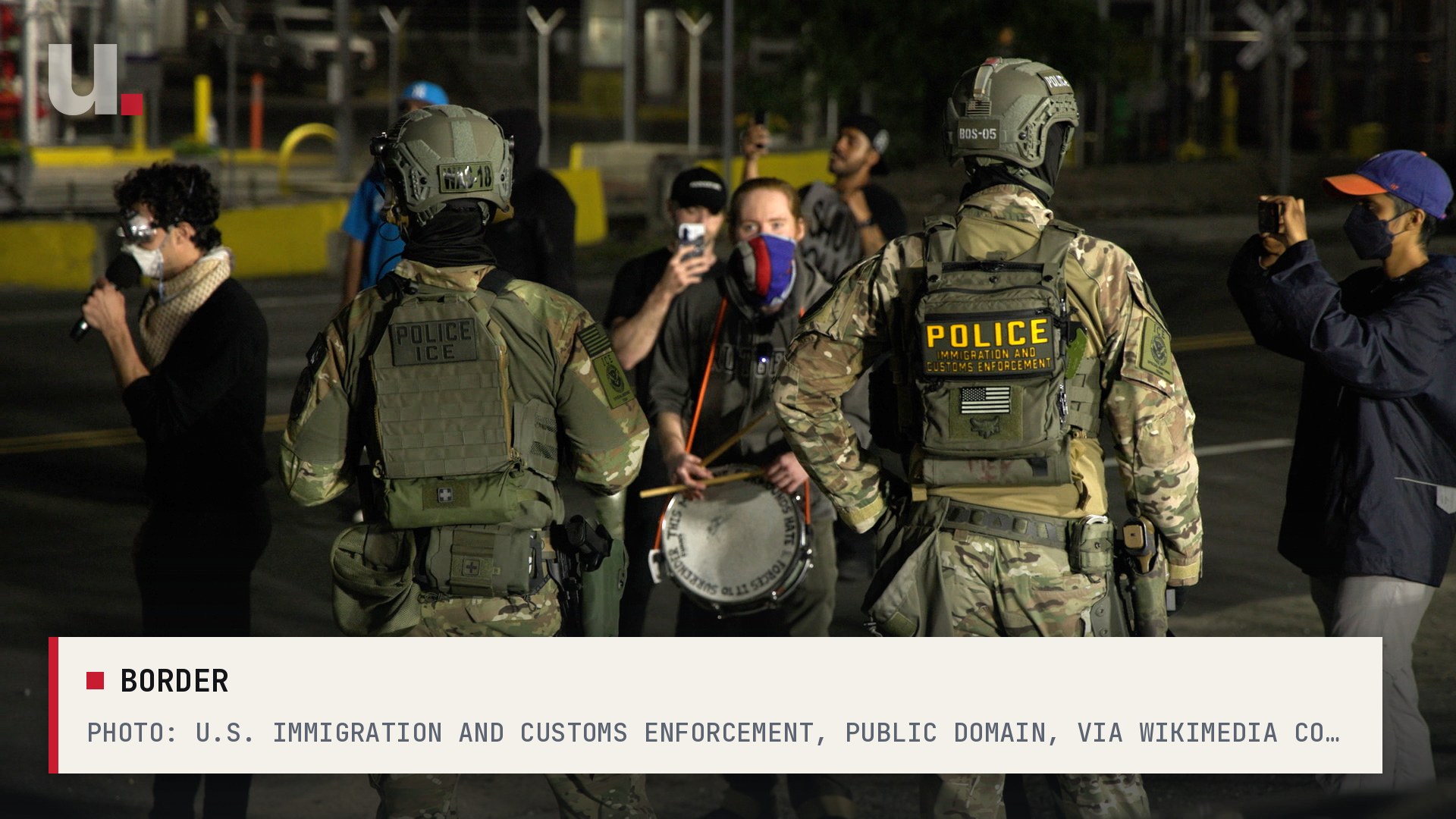
Rep. LaMonica McIver wanted the whole Third Circuit to rescue her from a criminal trial. On Thursday the full court said no. In a one-paragraph order, the federal appeals court in Philadelphia refused to rehear its ruling that the New Jersey Democrat’s seat in Congress does not shield her from charges that she forcibly struck federal officers outside Delaney Hall, the ICE detention center in Newark, on May 9, 2025.
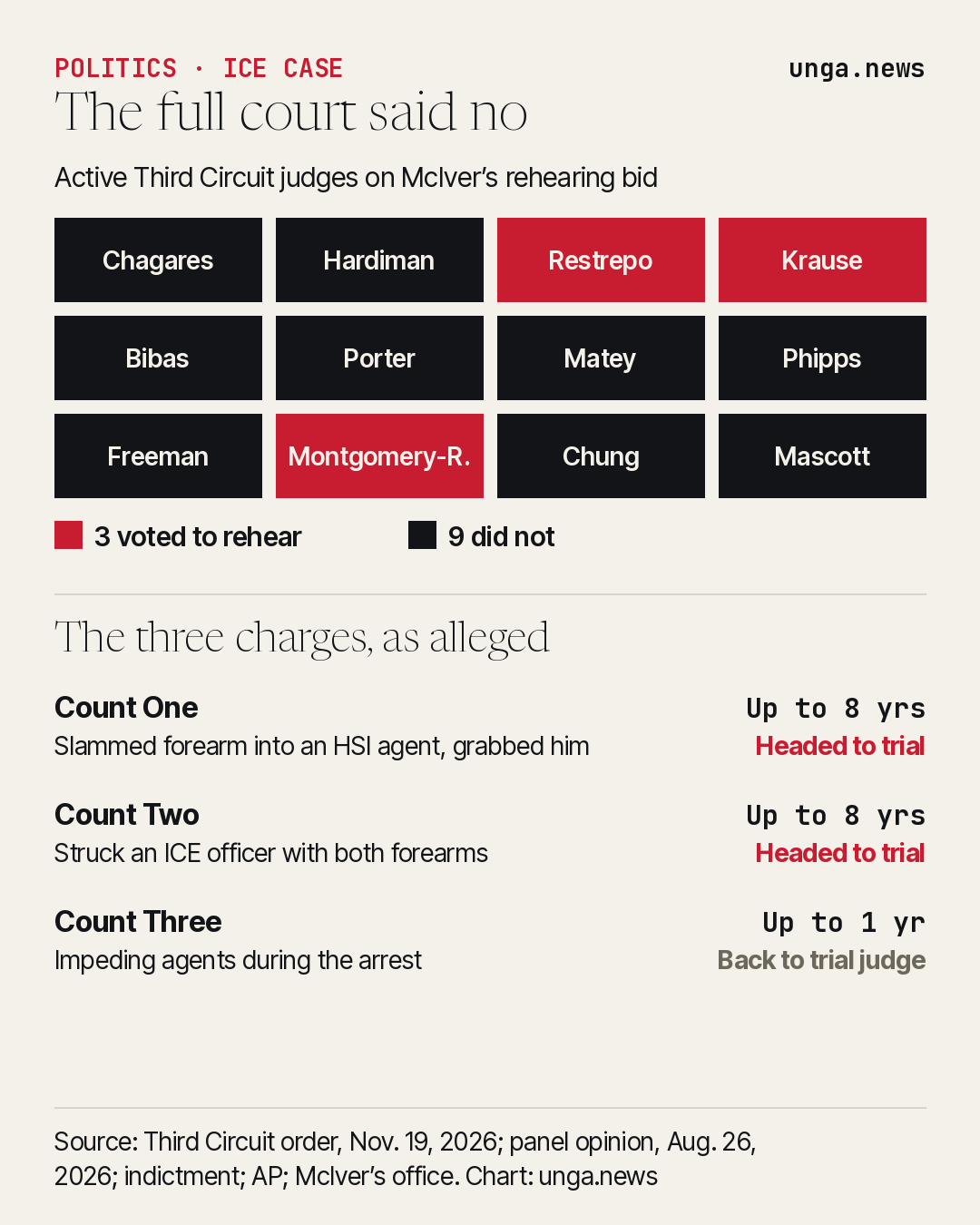
Only three of the circuit’s 12 active judges, L. Felipe Restrepo, Cheryl Ann Krause and Tamika Montgomery-Reeves, voted to take the case up again. The rest let the August decision stand. That means the two counts accusing McIver of physically hitting officers head back to U.S. District Judge Jamel Semper in Newark and toward a jury. She is presumed innocent, and she has pleaded not guilty.
What the grand jury says happened at the gate
The facts come from the indictment a federal grand jury in Newark returned in June 2025, which the appeals court accepted as true for purposes of her motion. McIver and two other House Democrats showed up unannounced at Delaney Hall for an oversight inspection. While they waited inside, Newark Mayor Ras Baraka and his security detail came through the gate. The top Homeland Security Investigations agent in New Jersey told the mayor he was not allowed on the property and would be arrested if he stayed.
When agents moved in to make that arrest, someone in the crowd yelled “circle the mayor.” Protesters and the three members of Congress closed around Baraka. Surveillance video, the court wrote, shows McIver placing herself between the mayor and the agent. The indictment says she then “slammed her forearm into the body” of that agent and “reached out and tried to restrain” him “by forcibly grabbing him.” That is Count One.
Count Two covers what came next. As the officers walked the handcuffed mayor back through a dense crowd, McIver headed for the secured area too. Prosecutors allege she “pushed past” an ICE deportation officer “while using each of her forearms to forcibly strike” him. Count Three is broader, charging her with impeding the agents throughout the arrest.
Each of the first two counts involves alleged physical contact with an officer and carries up to eight years in federal prison. The third carries up to one. McIver’s office puts her total exposure at 17 years.
Shoving an officer is not a legislative act
McIver’s legal team leaned hard on the Speech or Debate Clause, the part of the Constitution that keeps the executive branch from prosecuting members of Congress for their legislative work. Her argument was that the whole visit was oversight, so everything she did that day was protected.
The panel didn’t buy it. Judge Cindy Chung, writing for herself and Judge Stephanos Bibas in the August opinion, said the court looks at the specific act being charged, not the whole trip. “The acts of pushing past and forcibly striking someone are unambiguously non-legislative,” she wrote. “They are not integral to the legislative process.” A federal law guarantees members of Congress entry to DHS detention centers for oversight, but Chung noted the indictment doesn’t charge McIver for walking in. It charges her for how she allegedly got there.
Even the judge most sympathetic to McIver started from the same place. Judge Thomas Ambro, who dissented in part, opened his opinion with five words: “Members of Congress are not above the law.” He agreed Count One had nothing to do with oversight. He wanted more fact-finding on Count Two and would have let her dig into whether the case was political payback. On Count Three, all three judges sent it back to Semper to sort out which conduct it actually covers, since prosecutors said at argument it reaches “essentially all” of her efforts to stop the arrest, some of them inside the gate.
The panel also threw out the part of her appeal claiming selective and vindictive prosecution, ruling it had no jurisdiction to hear that before trial. Semper had already rejected those claims, finding she had not shown any personal animus by prosecutors.
A one-paragraph answer
McIver asked for rehearing by the panel and by the full court. Thursday’s order, signed by Chung, disposed of both in a single sentence: no judge who joined the decision asked to rehear it, and “a majority of the judges of the circuit in regular service” did not vote for rehearing, so the petition “is denied.” A footnote lists Restrepo, Krause and Montgomery-Reeves as the three who would have granted it. Ambro, a senior judge, voted only on the panel question.
That’s the whole thing. No new opinion, no long dissent. For a case her side has billed as a landmark test of congressional power, the full court didn’t see a question worth another round.
Her response
McIver answered within hours on 𝕏 and in a statement from her office, calling it a “disappointing decision” and blaming a “weaponized Department of Justice.” She said she and her lawyers “are looking at every possible option for what comes next,” which could include asking the Supreme Court to step in.
McIver on 𝕏, Nov. 19, 2026, after the full Third Circuit denied rehearing.
— @RepLaMonica View on 𝕏
Her statement also claims she is being prosecuted “for doing her job.” A district judge, a three-judge panel and now the full appeals court have weighed that argument, and at every level the courts drew a line between the oversight visit and the alleged blows. Oversight is the job. Putting hands on an officer making an arrest isn’t, and the law that protects ICE and HSI agents from being shoved while they work doesn’t carry an exemption for elected officials.
The officers at that gate were doing what their badges require: carrying out an arrest that, according to the court record, had been authorized by the Deputy Attorney General. Whatever anyone thinks of Delaney Hall or the arrest of a sitting mayor, the answer was never supposed to be a crowd closing around agents with a member of Congress in the middle of it.
Now a Newark jury will get to hear the evidence, including the surveillance footage the court has already described. McIver will get her day in court, with every protection any other defendant gets. She just won’t get one that nobody else gets.
Sources
- U.S. Court of Appeals for the Third Circuit — United States v. McIver, Nos. 25-3573 & 26-1122, Sur Petition for Rehearing (Nov. 19, 2026), via Courthouse News
- U.S. Court of Appeals for the Third Circuit — United States v. McIver, precedential opinion (Aug. 26, 2026)
- U.S. District Court, D.N.J. — Indictment, United States v. LaMonica McIver, No. 2:25-cr-00388 (June 2025), via New Jersey Monitor
- Office of Rep. LaMonica McIver — McIver Speaks on Major Third Circuit Decision to Allow Case to Proceed
- Rep. LaMonica McIver on 𝕏 — Rep. LaMonica McIver on 𝕏 — “Today’s decision by the Third Circuit…”
- AP — Rep. McIver indicted on charges from skirmish at New Jersey immigration center
- Politico — Appeals court deals another setback to Rep. LaMonica McIver in assault case