

Big Oil Sat on Your Gas Savings Until After You Voted
Wholesale gasoline got about 40 cents cheaper in October, but drivers saw a nickel before the vote. The data shows where the savings stalled, and why it deserves answers.
Gas got a lot cheaper in October. Just not for you. Bulk wholesale gasoline fell about 40 cents a gallon from September to October, but the average pump price fell about a nickel. The data shows most of those savings stalled before they reached the gas station, at the wholesale level where refiners and their suppliers set the price. Drivers didn’t see the big drop until after they voted.
Nobody has proven that the timing was deliberate. But the numbers are hard to explain, and President Trump was already asking the Justice Department about this exact pattern in June.
Start with October. In the federal government’s own spot price data, bulk wholesale gasoline averaged 39 cents a gallon less in October than in September on the Gulf Coast, 40 cents less in New York Harbor and 39 cents less in Los Angeles. The national average at the pump, from the Energy Information Administration’s weekly survey, fell from $4.355 to $4.310. That is 4.5 cents.
Monthly averages can exaggerate a gap when prices spike late in a month, and September had a spike. So check it week by week. Gulf Coast wholesale gas averaged $3.95 a gallon the week of Sept. 21 and $3.15 the week of Oct. 26, a 79-cent drop. The pump fell 31 cents from Sept. 28 to Nov. 2. Same story.
A pass-through that ran far below normal
I ran every five-week stretch since 2005 in which wholesale gas fell at least 40 cents, using EIA’s weekly numbers. In a typical stretch, the pump picked up about 63% of the drop. During the 2014 shale glut it picked up 79%. During the summer 2022 slide, 78%. Earlier this year, as prices came down from their wartime peak, it ran between 53% and 111%.
In the five weeks before the vote, it ran 30% to 40%. Only about one stretch in eight since 2005 has been that slow.
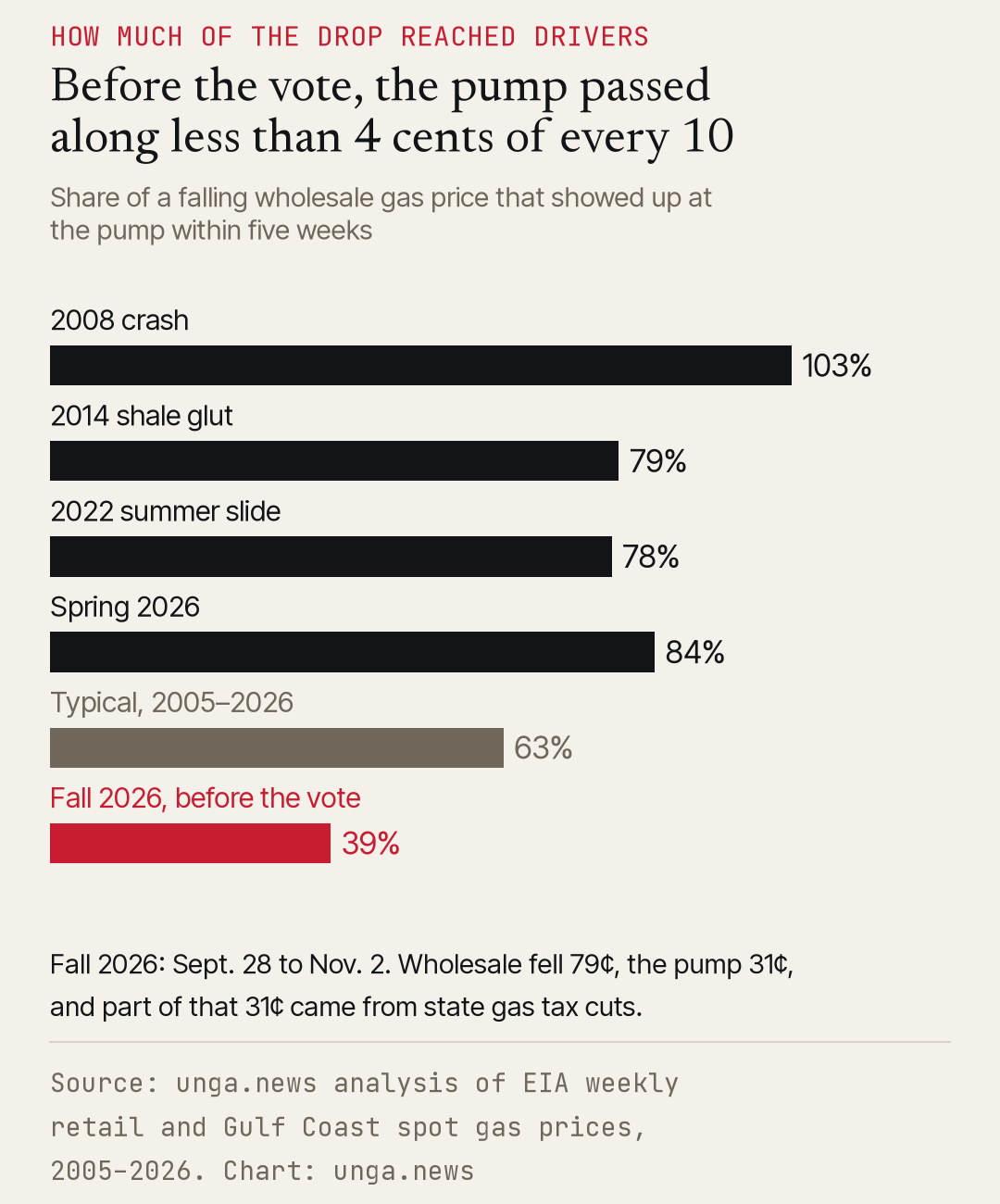
It is worse than that number looks, because part of the pump’s small decline came from state governments, not the fuel business. Georgia Gov. Brian Kemp suspended the state gas tax by executive order starting Sept. 29 and has extended it through Nov. 30. Ohio Gov. Mike DeWine signed House Bill 519 on Oct. 1, cutting the state’s 38.5-cent gas tax to a hundredth of a cent from Oct. 4 through Jan. 2. Ohio’s law requires retailers to pass the full savings to drivers. North Carolina suspended its state gas tax by law from Oct. 10 through Nov. 30. Those cuts took roughly 4 cents off the national average on their own, by my rough estimate. Take them out and the industry passed along even less.
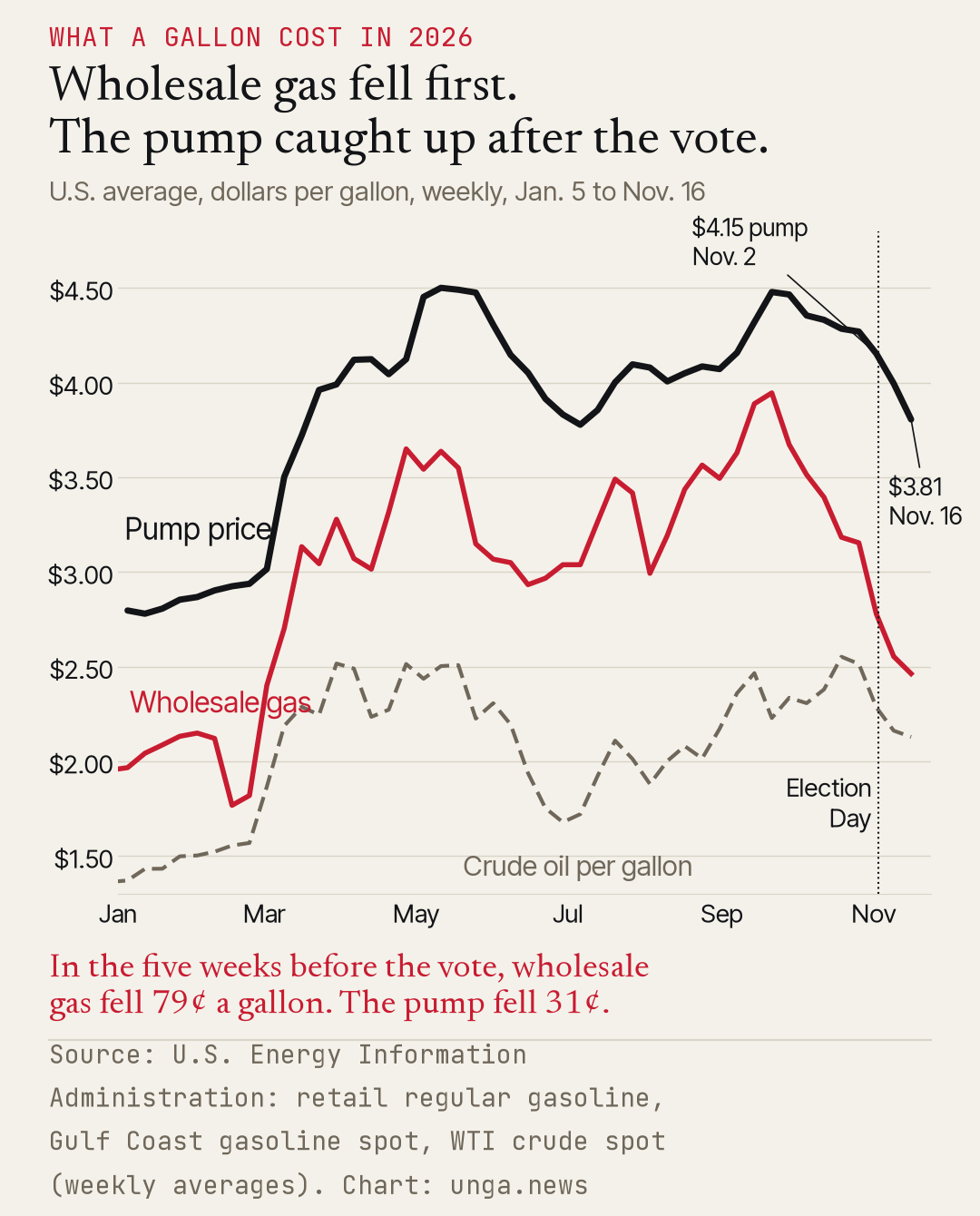
The savings stalled before they reached the station
An earlier version of this report blamed most of that gap on gas stations. The station data points somewhere else.
Upside, which tracks fuel sales at stations across the country, found that the price the average station paid for a gallon of regular fell only 9.6 cents in October. Station profit margins rose about 7 cents a gallon. Upside said that gain “roughly cancels out” the 6.8-cent squeeze stations took in September.
Bulk wholesale fell about 40 cents. What stations paid at the terminal fell less than 10. Terminal prices are set by refiners and the wholesale suppliers that sell to stations. One caveat: Upside’s station sample and EIA’s bulk spot prices are different data sets, and terminal prices normally trail the bulk market by a few days. Even so, a 30-cent difference over a month is too big to wave off, and nobody has explained it.
Battleground states got hit 12 days out
On Oct. 20, ExxonMobil shut a 50,000-barrel-a-day gasoline unit at its Joliet, Illinois, refinery, according to Wood Mackenzie, as reported by Reuters. “We’re working to resolve an operational issue,” an Exxon spokesperson said. The same refinery had already been down for two weeks after a power outage in September.
Michigan’s average hit $4.74 on Oct. 22, up from $4.59 the day before, and Ohio jumped from $4.05 to $4.34, according to GasBuddy figures cited by Bloomberg. Both states had tight Senate races. Nothing public shows the outage was anything but a breakdown. It still landed on Midwest drivers in the last two weeks of the campaign.
Refiners had a record quarter
Valero earned a refining margin of $39.24 a barrel in the third quarter, up from $13.14 a year earlier. Its chief operating officer, Gary Simmons, told analysts the company had “high confidence that this current crack spread environment is very sustainable.” Exxon’s refining margins were $50.30 a barrel. Chevron made $4.9 billion from refining and marketing. The Federal Reserve Bank of Kansas City reported Nov. 5 that refiners’ gasoline margins were still about double last year’s and now make up about 30% of the price of a gallon, compared with less than 20% historically.
Trump flagged it in June
“The big Oil Companies are not dropping their price at the pump commensurate with the sharply lower prices they are paying for Oil,” President Trump posted on June 23. “In other words, customers are being ‘gouged.’ I have instructed the DOJ to immediately start looking into this.” On July 3, the Justice Department and the Federal Trade Commission urged state attorneys general to go after companies “manipulating retail prices or colluding with their competitors.” The same pattern Trump called out in June showed up again in October.
Why crude fell when it did
The oil market had built a war premium around the calendar. CNBC reported that Trump had said he would not attack Iran before the midterms, and traders priced in the chance of a strike after the vote, pushing crude up more than 10% in October.
That premium started coming out before anyone voted. On Monday, Nov. 2, U.S. crude fell 7.4% to $96.46 a barrel and Brent fell 7.6% to $104.77. Trump said Iran wants to “make a deal and that could happen,” Secretary of State Marco Rubio said Trump would prefer a peaceful solution, and Iran’s president said Tehran would seek dialogue. Brent fell another 8.7% on Nov. 4 as traders bet the war was winding down. Meanwhile, Gulf oil was flowing again, and the International Energy Agency reported Nov. 13 that the world had moved into a surplus for the first time since the war began.
The pump then fell 35 cents in the two weeks after Nov. 3, the biggest post-election drop in EIA’s weekly records going back to 1990. AAA had the national average at $3.66 on Saturday.
What hasn’t been proven
No regulator, court or company document has shown that oil companies coordinated prices or timed them to the election. The Justice Department and the FTC have not named a target. A California class action accuses five refiners of padding a state clean-fuel cost, which is a separate issue, and the refiners have asked the court to dismiss it.
Some facts cut the other way. U.S. refineries ran at 92.5% to 98% of capacity every week from August to November, above the five-year average, and gasoline stockpiles sat below normal until after the vote. OPEC+ kept its output plan unchanged on Nov. 1. And according to OpenSecrets figures reported by HEATED, the oil and gas industry sent 97% of its federal midterm money to Republicans and conservative groups.
None of that explains why a 40-cent drop in bulk gasoline turned into a nickel at the pump, or why terminal prices lagged the way they did. Trump’s Justice Department has already asked the states to look. The price data says they should start with the terminal.
Sources
- U.S. Energy Information Administration — Weekly U.S. Regular All Formulations Retail Gasoline Prices
- U.S. Energy Information Administration — Spot Prices: Gulf Coast, New York Harbor and Los Angeles gasoline; WTI and Brent (daily)
- Upside — Tracking retail fuel trends: October 2026 (Nov. 10, 2026)
- Georgia Department of Revenue — 2026 Suspension of Georgia Motor Fuel Taxes - FAQs
- Ohio Department of Taxation — Guidance for 90-Day Motor Fuel Tax Holiday in Ohio (House Bill 519) (Oct. 2, 2026)
- North Carolina Department of Revenue — Temporary Suspension of Motor Fuel Excise Tax (Session Law 2026-62) (Oct. 12, 2026)
- Reuters via BOE Report — Exxon shuts catalytic reformer at 275,000-bpd Joliet refinery, Wood Mackenzie says (Oct. 21, 2026)
- Bloomberg — Michigan, Ohio Gas Prices Spike Further Amid Refinery Breakdown (Oct. 22, 2026)
- Valero Energy — Valero Energy Reports Third Quarter 2026 Results
- Yahoo Finance — Valero (VLO) Q3 2026 Earnings Call Transcript
- ExxonMobil — ExxonMobil Announces Third-Quarter 2026 Results
- Chevron — Chevron Reports Third Quarter 2026 Results
- RTÉ — US oil giants report profit surge again on Iran war (Exxon refining margin) (Oct. 30, 2026)
- Federal Reserve Bank of Kansas City — Downstream Bottlenecks in the Oil Supply Chain Are Contributing to Historically High Refinery Margins and Fuel Prices (Nov. 5, 2026)
- Donald J. Trump on Truth Social — “The big Oil Companies are not dropping their price at the pump…” (June 23, 2026)
- U.S. Department of Justice — Justice Department and Federal Trade Commission Issue Call to Action to State Attorneys General (July 3, 2026)
- CNBC — Crude oil prices sell off more than 7% on Iran peace talk hopes ahead of U.S. midterms (Nov. 2, 2026)
- MarketWatch — Oil prices settle sharply lower, see biggest 3-day drop in more than 6 years (Nov. 4, 2026)
- International Energy Agency — Oil Market Report, November 2026 (Nov. 13, 2026)
- AAA — Gas Prices: national average, Nov. 21, 2026
- U.S. Energy Information Administration — Weekly refinery utilization and gasoline stocks
- OPEC — Seven OPEC+ countries reaffirm commitment to market stability (Nov. 1, 2026)
- HEATED (OpenSecrets data) — A very expensive night for Big Oil (Nov. 4, 2026)
- U.S. District Court, N.D. Cal. — Herold v. Chevron U.S.A. et al., First Amended Class Action Complaint (No. 3:25-cv-10282)