

Georgia Conservatives Want to Rein In the Governor’s Office Before a Democrat Moves In
The Freedom Caucus wants lawmakers back for a special session to set limits on the governor and redraw the maps. Kemp has said no, and the petition math comes up short.
Georgia’s conservatives have less than two months before Keisha Lance Bottoms takes the oath as governor, and the state House Freedom Caucus wants to use them. On Wednesday, caucus chairwoman Rep. Charlice Byrd called for lawmakers to come back to the Gold Dome in a special session to put limits on the governor’s office before Bottoms moves in, and to redraw the state’s legislative maps while Republicans still hold the pen.
“Georgia is facing the prospect of an incoming radical leftist Governor,” Byrd said in a statement. She argued that the executive branch in Georgia carries “extensive power,” and that the new maps are a legal necessity after the U.S. Supreme Court’s decision in Louisiana v. Callais. “We should address these issues now to prevent Gov.-elect Bottoms, who has proven not to be an effective executive, from abusing the powers of the Governor’s office, we should redraw our racially gerrymandered legislative maps to ensure they are fair and legal,” she said.
It is a blunt pitch, and it puts Byrd’s caucus squarely at odds with the most powerful Republican in the state.
Kemp already shut the front door
Outgoing Gov. Brian Kemp answered this question two weeks ago, the morning after the election. “The voters of our state have spoken,” Kemp said on Nov. 4, according to the Georgia Recorder. “As long as I’m governor, we will always respect the results of secure, accessible, and fair elections, and also abide by the laws and constitution of our state. I will not be calling a special session of the Georgia General Assembly in order to curtail executive branch powers or debate redistricting changes.”
Kemp did leave one window open. He said there are “budgetary issues that may need to be addressed before the convening of the regular session in January,” and that his office would “continue to monitor and evaluate this situation.” He didn’t say what those issues were. Bottoms told reporters the same day that Kemp hadn’t spelled them out to her either, and she called it “his prerogative” as the sitting governor. “There’s one governor at a time,” she said.
Behind Kemp’s caution is real money. The Legislature passed an income tax cut this year that dropped the rate to 4.99% from 5.19%, with more cuts down to 3.99% if the economy cooperates. The governor’s budget office said in May that the package left a $1.3 billion gap, and Kemp trimmed about $300 million to cover part of it. The state still holds $8.7 billion in rainy day reserves, down from $14.6 billion in January, according to the State Accounting Office’s October report. That is a cushion a new administration will be eager to spend, and exactly the kind of thing fiscal conservatives would like locked down before the handoff.
The back door needs Democratic signatures
Georgia gives lawmakers a second route. If the governor won’t call them back, the General Assembly can force a special session with a petition signed by three-fifths of the members of each chamber. That sounds doable for a party that controls both houses today. The math says otherwise.
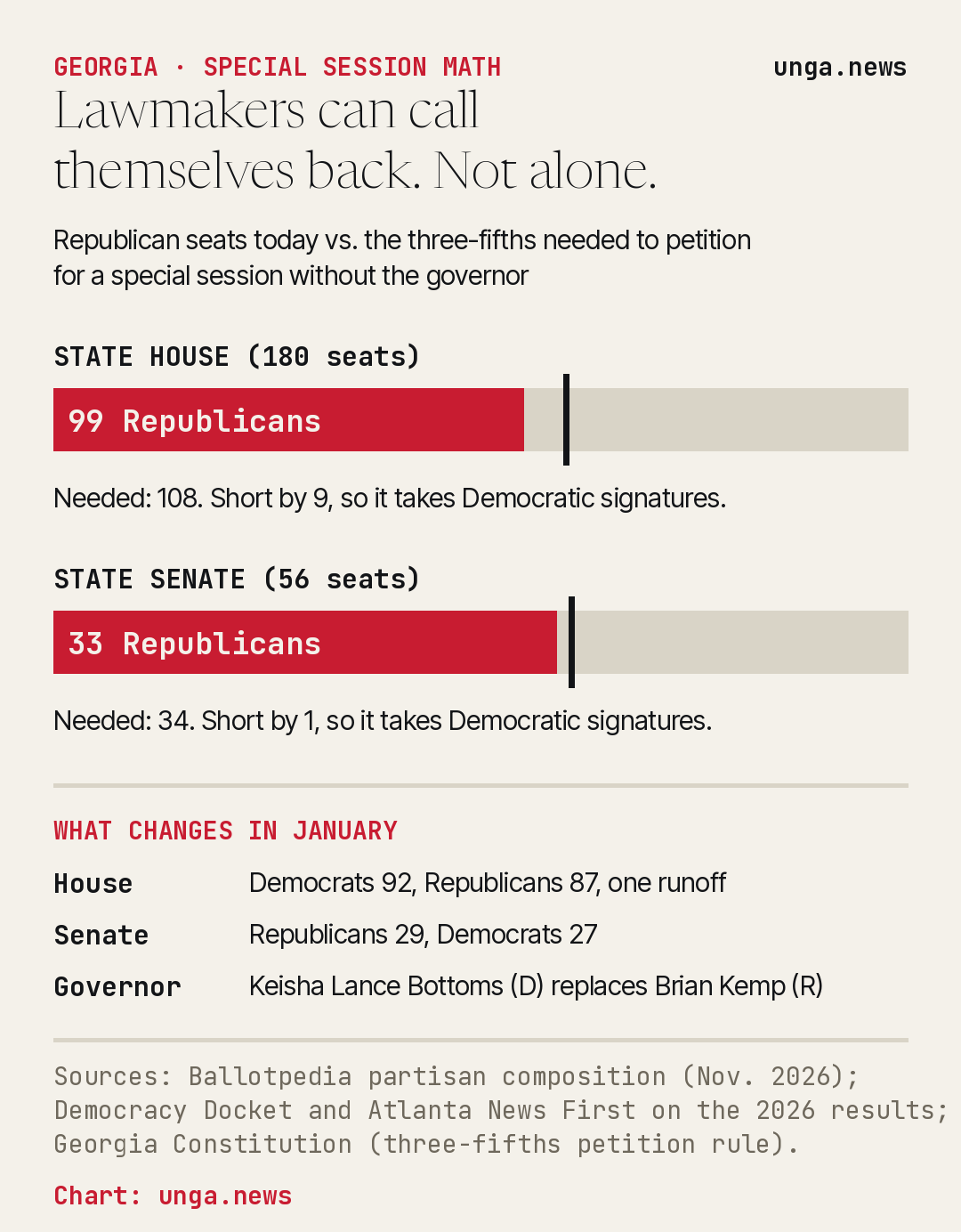
Three-fifths of the 180-member House is 108. Republicans hold 99 seats right now, with 80 Democrats and one seat vacant, according to Ballotpedia’s November count. In the 56-member Senate, the bar is 34, and Republicans hold 33. So even if every Republican in both chambers signed on, Byrd would need nine House Democrats and one Senate Democrat to join a petition aimed at limiting a Democratic governor. That is not going to happen, which means the only realistic path to a session still runs through Kemp’s desk.
The calendar makes it tighter. When the new Legislature is seated in January, the House flips to a 92–87 Democratic majority with one seat headed to a runoff, and the Senate Republican edge shrinks to 29–27. Democrats also won the lieutenant governor, attorney general and secretary of state races. Whatever conservatives want written into law about the governor’s powers, the lame-duck weeks are the only time they’ll have the votes to pass it on their own.
Why the maps keep coming back
The redistricting half of Byrd’s request has a longer history. After the Supreme Court’s ruling in Callais earlier this year narrowed how Section 2 of the Voting Rights Act applies to district lines, Kemp called a summer special session that was partly meant to redraw maps for 2028. House Speaker Jon Burns slowed it down. In a June letter to Kemp, Burns wrote that because the process “has the potential to impact every voter, it deserves the same responsible, fact-driven approach that guides every policy we consider as lawmakers, especially as we seek to understand the full implications of the U.S. Supreme Court’s decision in Louisiana v. Callais.” The session ended without new maps.
Byrd’s argument is that the job was left half done. She calls the current legislative lines “racially gerrymandered” and says new maps are needed to make them “fair and legal” under the Court’s ruling. Opponents will call it an attempt to undo an election. Both sides know the same thing: once Democrats run the House and the governor’s office, a Republican-drawn map is off the table for years.
A test for Georgia’s right
This is the same fight that played out in North Carolina and Wisconsin, where outgoing Republican legislatures moved to trim the powers of incoming Democratic governors. In Georgia it has become a family argument inside the GOP. Kemp, who built his brand on clean elections and steady budgets, is betting that respecting the handoff is the stronger long-term play. The Freedom Caucus is betting that conservatives will regret every power they leave sitting in the governor’s office for a Democrat to use.
Bottoms, for her part, has been careful. She has kept her early comments about Kemp polite and has avoided promising sweeping changes on day one, even as Democrats in the Legislature talk openly about their wish list.
For now, Byrd has the microphone and Kemp has the gavel. Unless the governor decides those unnamed budget issues are worth a December trip back to Atlanta, the Freedom Caucus will be making its case to a Legislature that won’t be in session until Bottoms is already on the way in. And if Kemp does call one for the budget, expect Byrd’s caucus to push hard to put everything else on the agenda too.
Sources
- Democracy Docket — Georgia lawmakers want to strip incoming Democratic governor of power (Nov. 18, 2026), quoting Rep. Charlice Byrd’s statement
- Georgia Recorder — Kemp won’t call Georgia lawmakers back to redraw maps or to curb executive powers (Nov. 4, 2026)
- Atlanta Journal-Constitution — Georgia Gov. Brian Kemp says he won’t call special session to redraw maps
- Ballotpedia — Georgia General Assembly: current partisan composition (Nov. 2026)
- Atlanta News First — Georgia Democrats flip state House, Republicans hold Senate majority (Nov. 4, 2026)
- Atlanta Journal-Constitution — Keisha Lance Bottoms treads carefully as Democrats eye sweeping changes