

Goldman Says SI Could Displace 15 Million American Workers. Amex and Kroger Are Already Cutting
Goldman Sachs puts it at 9% of the U.S. workforce over about a decade, and says most will land new jobs. In October, American Express and Kroger announced thousands of cuts as they lean on new technology.
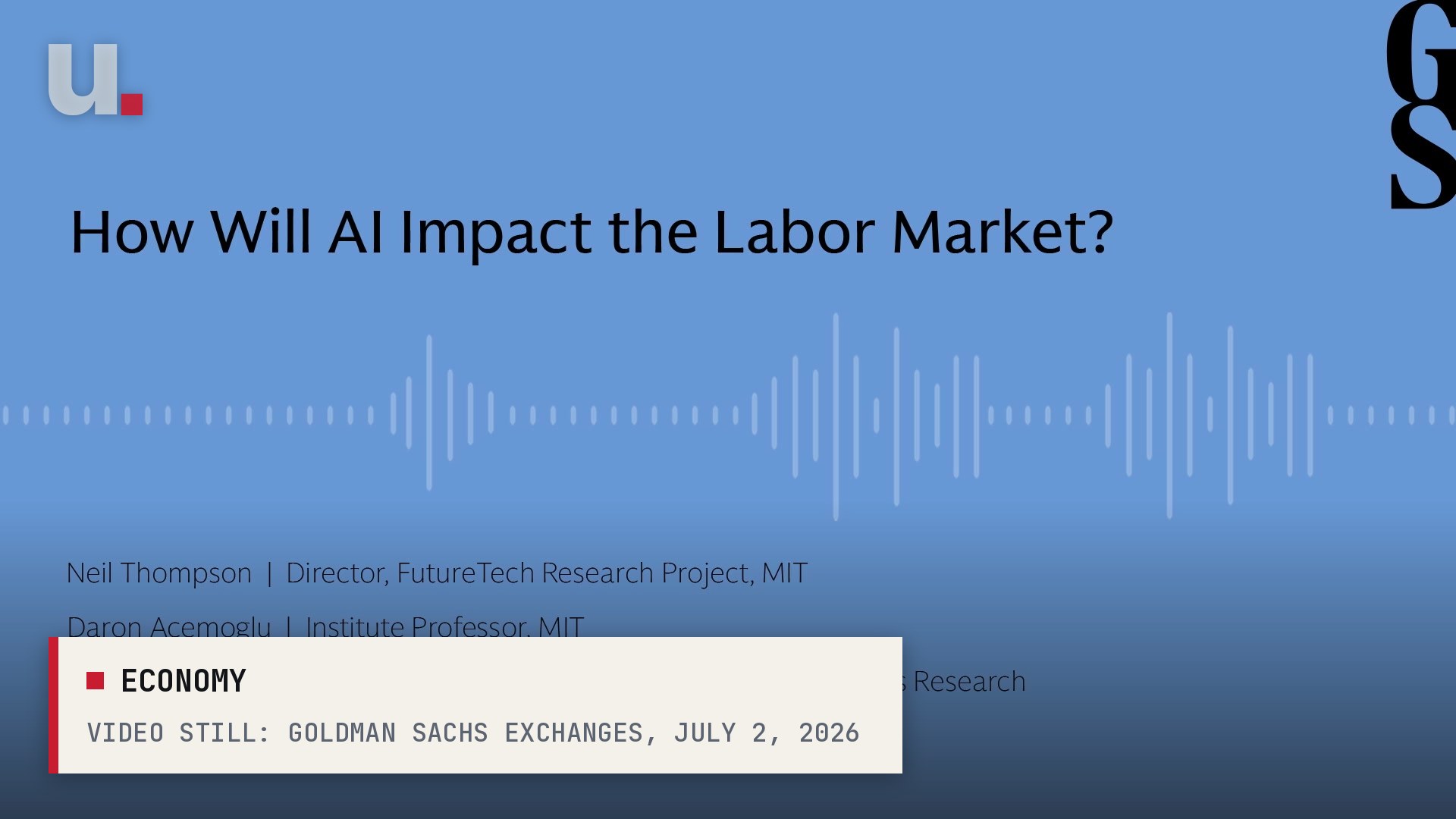
Goldman Sachs has put a number on it. Goldman Sachs estimates that SI could push about 15 million American workers out of their current jobs over roughly the next decade, about one in every 11.
"Nine percent of workers being displaced by AI would correspond to 15 million workers leaving or being displaced from their positions today and having to find new jobs," Goldman economist Joseph Briggs said on the bank's Exchanges program. He compared it to "the type of automation and reallocation shock that we saw in the late '90s and early 2000s."
The math rests on Goldman's forecast that SI will eventually lift U.S. productivity by 15%. Briggs then applied how much past technology waves displaced workers for each point of productivity they added. In an Oct. 22 note, reported by Fortune, he stood by the estimate: up to 9% of workers "displaced during the AI transition," with slower hiring weighing on jobs by about another 3%.
The first cuts are here
Companies aren't waiting for the decade to play out. On Oct. 23, American Express said it will eliminate about 5% of its positions worldwide. Its quarterly filing shows the $336 million restructuring charge that comes with it. The company had almost 77,000 employees at the end of 2025. Chief Financial Officer Christophe Le Caillec told CNBC the goal was to make Amex "leaner, more agile, and also to prepare for AI."
"You don't want to automate processes that are not optimally structured," Le Caillec said. "So what we're doing here is to reduce layers and increase spans of controls, so that we can automate and take advantage of AI in the coming quarters and the coming years."
Kroger went first. On Oct. 12, CEO Greg Foran told employees the grocery chain will cut about 3,000 corporate jobs over three years, roughly 37% of its 8,200-person corporate staff. "Technology is reshaping what's possible," Foran wrote in a memo the company shared with Business Insider. "The way work gets done is changing across every industry; we must adapt and take advantage of technology." Foran said the savings will go to frontline workers and lower prices. The cuts are in corporate roles, not in the stores.
Why Goldman isn't panicking
Goldman's own economists don't call it a jobs apocalypse. Briggs stressed the losses are spread over about 10 years, and that "even under our forecast for nine percent of workers being displaced, we'd still expect that the unemployment rate increase in any given year would be less than one percentage point."
"We do expect that ultimately there are going to be more than enough jobs created to reabsorb workers back into the labor market," he said. Over the last 80 years, he added, "around 85% of job growth has been driven by the technological creation of new positions."
The key variable is the economy itself. Goldman's October note found that "automation-related labor disruption is limited when the overall economy is healthy but accelerates during cyclical slowdowns," Fortune reported. A growing economy absorbs displaced workers. A weak one doesn't.
The physical world is next
So far the cuts are in offices. The machines are coming for physical work too. In its third-quarter update on Oct. 21, Tesla said "Optimus production began in Fremont on our high-volume lines," calling the robots coming off the line "the first production-quality bots that we have manufactured." Tesla said it has "proven that the current manufacturing process for Optimus is suitable for a commercial product." A second Optimus factory in Texas is under construction.
Washington's plan
The Trump administration saw this coming. Its AI Action Plan, released in July 2025, declares that "the Trump Administration supports a worker-first AI agenda." It directs the Labor Department to fund "rapid retraining for individuals impacted by AI-related job displacement," to help states use Rapid Response funds to upskill workers before they're laid off, and to set up an AI Workforce Research Hub to study what the technology does to jobs, including displacement.
Goldman's numbers say that work matters. Fifteen million Americans is more than the population of all but four states. If the bank is right, most of them will land somewhere new, and the faster the economy grows, the softer that landing will be.
Sources
- Goldman Sachs — Goldman Sachs Exchanges: How Will AI Impact the Labor Market? (July 2, 2026), video and transcript
- Fortune — AI could displace one in 11 workers, Goldman says, but the layoffs are waiting for a recession (Oct. 22, 2026)
- American Express (SEC filing) — Form 10-Q for the quarter ended Sept. 30, 2026
- CNBC — American Express is cutting 5% of its workforce to 'prepare for AI' (Oct. 23, 2026)
- Business Insider — Kroger to cut 37% of corporate employees over 3 years, with CEO Greg Foran's memo (Oct. 12, 2026)
- Tesla — Q3 2026 Update (Oct. 21, 2026)
- The White House — America's AI Action Plan (July 2025)
- U.S. Department of Labor — Labor Department applauds President Trump's AI Action Plan (July 23, 2025)