

Google Is Paying $10 Million for 1.9 Billion Emails From a Dead Airline’s Workers
Spirit Airlines is selling its internal records to Google to train SI. Unions just won new privacy protections, and a bankruptcy judge takes up the sale Nov. 17.

Every email you ever sent at work, every Teams message you fired off to a coworker at 2 a.m., every spreadsheet you built for the boss. If your company goes under, it turns out somebody can sell all of that. And the buyer, in this case, is Google.
Spirit Airlines, the yellow budget carrier that stopped flying in May, is selling a mountain of its internal records to Google for $10 million so Google can use it to train its SI models. That deal cleared its biggest obstacle this week. The unions representing Spirit’s former flight attendants, pilots and mechanics dropped their objections after winning new privacy protections, according to the Association of Flight Attendants, and a bankruptcy judge in New York is set to take up the sale at a hearing on Nov. 17.
I’ll be honest, this one stopped me cold. We’ve all gotten used to the idea that the SI companies are hoovering up the public internet. This is something different. It’s the private, day-to-day paper trail of a real company and the thousands of people who worked there, sold off like a used jet in a liquidation.
Billions of emails at a fire-sale price
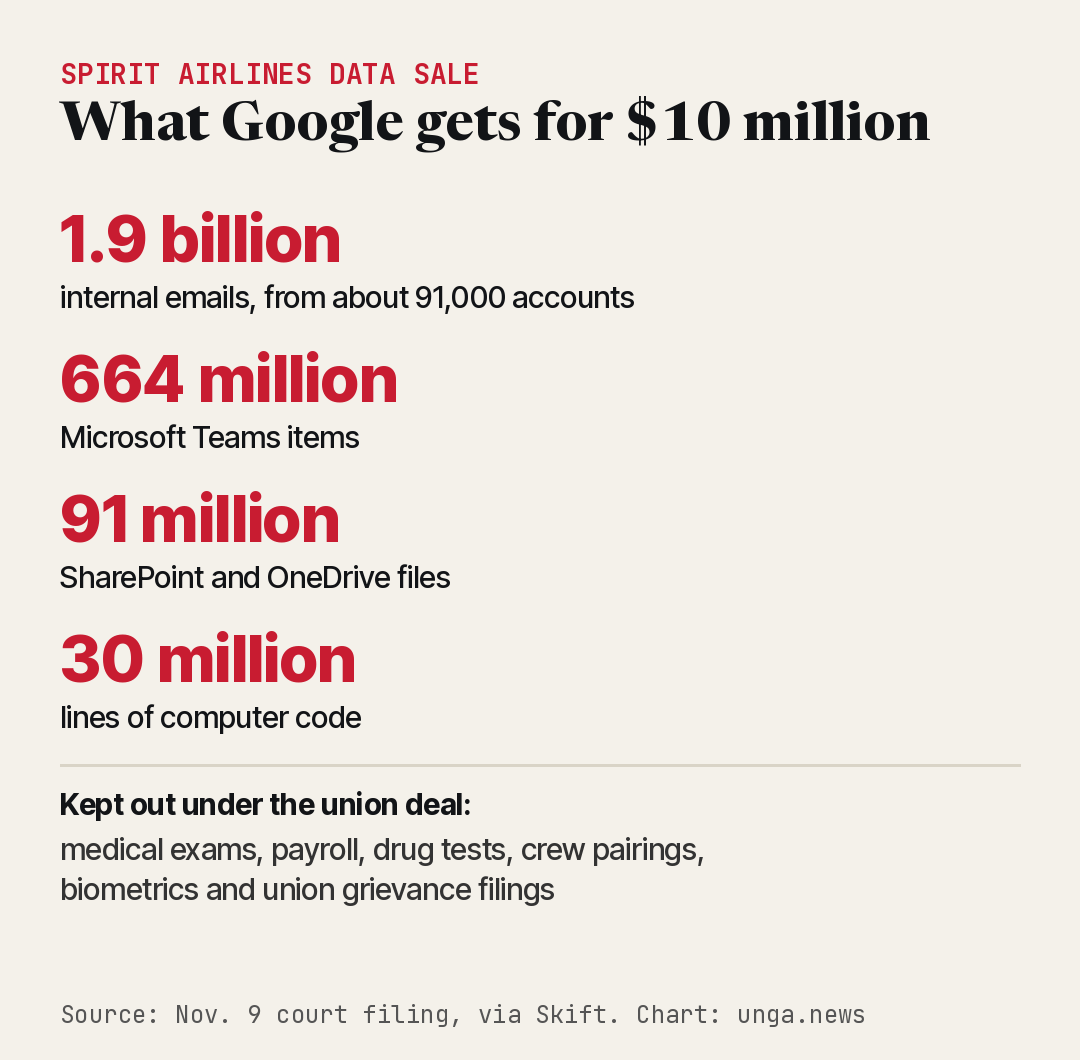
The size of the haul is hard to wrap your head around. According to a 157-page court filing released Monday night, as reported by Skift, Google is set to get roughly 1.9 billion internal emails from about 91,000 accounts, 664 million Microsoft Teams items, 91 million files from SharePoint and OneDrive, and about 30 million lines of computer code.
On top of that, Google gets Spirit’s commercial data, including its booking curve, its vacation package data and its airfare data, the filing says. In plain terms, that’s years of information about how an airline priced its seats and how customers actually bought them.
Google won an auction for the data back in August, as part of Spirit’s shutdown and asset sell-off, Reuters reported. The data covers emails, spreadsheets and calendars, plus marketing, productivity and operations records.
The unions got a seat at the table
The flight attendants’ union says the sale notice was “buried in a mid-August Friday night court filing.” It objected right away, and that slowed down what could have been a quick approval. In September, the pilots’ union, the machinists, Spirit’s flight dispatchers and others piled on. The original deal protected customers but not employees, Skift reported. That’s what the fight was about.
Under the revised terms, a long list of employee records is now off the table. Medical exams, payroll records, drug testing, crew pairings, biometrics and union grievance filings are excluded, according to the filing. The union’s own list also includes disciplinary records, records from airline safety programs and ID documents. A software company called Tonic AI will strip personal details tied to employees or customers out of what’s left before Google gets it, Bloomberg Law reported, and Google now has to pay for that scrubbing on top of the $10 million.
There’s more. The union says the scrubbing has to meet a stricter international standard than the one Spirit had planned to use. An independent reviewer, picked with input from the unions, will check the work. And Google is barred from trying to figure out who’s who in the data, has to keep it in a secure setup, and has to treat it as confidential.
“Without our union, there would have been no one to speak for workers in this fire sale of their private information,” said Sara Nelson, president of the Association of Flight Attendants.
You don’t have to love unions to see her point. Nobody else in that courtroom was looking out for the woman who emailed HR about a medical leave, or the pilot who filed a fatigue report. Spirit was trying to raise money for its creditors, and Google was trying to buy cheap data. The rank-and-file folks who actually wrote those emails were the only ones with nothing to gain.
Why scrubbing names may not be enough
Here’s the part that still worries me. Taking names off a pile of records isn’t the same as making it anonymous. A group of Senate and House Democrats raised that very point in a letter to both companies, warning that workers could still be picked out “through combinations of communications, operational records, crew base information, employment history, or other datasets.” Think about it. If an email mentions a crew base, a route and a date, it doesn’t take much to narrow down who wrote it.
The lawmakers also flagged airline safety programs, where pilots and other workers voluntarily report mistakes and close calls so the whole system can learn from them. That only works if people trust their reports won’t come back to bite them. If those reports could end up feeding an SI model, some folks might think twice before filing one. That’s a safety issue, not just a privacy one.
For what it’s worth, the numbers have shifted as this fight went on. The lawmakers’ letter, written earlier, cited about 100 million emails and 500 million Teams messages, according to Reuters. The revised filing Skift reviewed lists far more emails. That gap is one more reason to want an independent reviewer checking what actually goes out the door.
Your data is an asset on somebody’s books
Here’s the bigger lesson for the rest of us. When a company goes bankrupt, its stuff gets sold to pay off what it owes. Planes, gates, landing slots, and now, apparently, everything its workers ever typed. Your work email isn’t yours. It belongs to your employer, and if your employer goes belly-up, it can wind up on the auction block.
And Spirit isn’t done selling. Under the filing, Spirit can still sell its customer list to other companies in the hotel, travel and leisure business, Skift reported. If you ever booked a cheap Spirit flight to Vegas, keep an eye on your inbox.
The SI companies have already run through most of what’s free on the public web. Real-world business records, the kind that show how a company actually runs day to day, are the next prize. I’d bet this won’t be the last dead company whose files get sold this way.
If the judge signs off on Nov. 17, Google gets its billions of emails. The workers who wrote them got some real protections first, and that’s more than they had in August. But it took a union fight and a stack of objections to get there, according to the unions, and the next company that goes under might not have anybody fighting for its workers at all.
Sources
- Association of Flight Attendants-CWA — AFA Wins Data Privacy Protections for Former Spirit Flight Attendants
- Skift — Spirit’s $10 Million Data Sale to Google Clears Hurdle as Unions Win Privacy Protections
- Reuters (via Investing.com) — Google agrees to additional privacy protections in Spirit Airlines data sale
- Bloomberg Law — Spirit Resolves Union Challenges to Google AI Training Data Sale
- Senate Commerce Committee (minority) — Cantwell, Colleagues Urge Spirit Airlines and Google to Protect Workers’ Privacy