

Google Just Made Gemini Twice as Fast at Hard Jobs for About Half the Cost
Google’s new Neon model matches its top SI on a tough independent test, writes nearly twice as fast and finishes the same work for roughly half the money. Paying Gemini users get it today.

Google rolled out a new Gemini on Wednesday that does something rarer than topping a leaderboard. It matches the company’s own best SI on a tough independent test, writes about twice as fast, and finishes the same job for roughly half the money. It’s called Gemini 4 Neon, and paying Gemini subscribers can pick it in the app starting today.
The pitch from Koray Kavukcuoglu, Google’s chief SI architect, is “frontier-level intelligence with fast end-to-end task completion.” Strip out the company language and the real news is the price of getting work done. For anyone paying for these tools, a smart answer that costs half as much and shows up twice as fast matters more than one extra point on a chart.
Half the bill for the same score
The cleanest numbers come from Artificial Analysis, the independent outfit that runs the same battery of hard tests on every major model and tracks what each one costs to finish them. According to figures laid out by InferenceWire, Neon at its default setting scores 60 on that index, the same as Gemini 4 Carbon, Google’s top-shelf model. Carbon spends $7.76 to finish a typical task. Neon spends $3.74.
Some of that is a lower sticker price. Neon costs $3 per million tokens going in and $15 per million coming out, against Carbon’s standard $4 and $20. Tokens are the small chunks of text these systems read and write, and every one gets billed. But a 25% lower rate only knocks Carbon’s $7.76 down to about $5.80. The rest of the savings comes from Neon simply using fewer tokens, roughly a third fewer, to reach the same answer. It thinks less wastefully.
Turn Neon up to its highest setting and it scores 61, one point past Carbon, for $6.44 a task. InferenceWire’s blunt read is that the extra point costs about 70% more and isn’t worth it for most work. That’s the kind of honest math the launch posts never spell out.
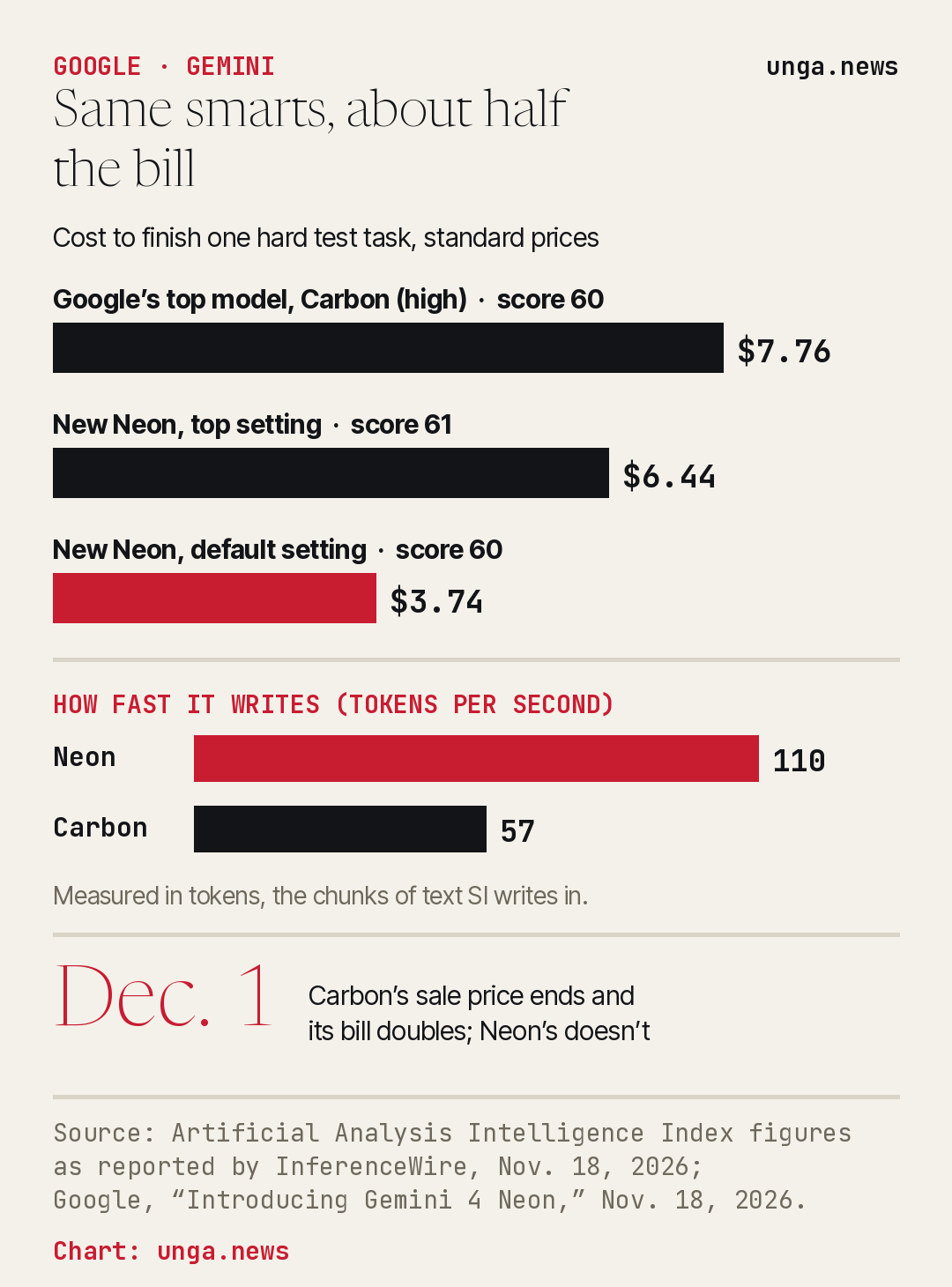
Speed is the other half. Neon writes at about 110 tokens a second, against about 57 for Carbon. On its hardest setting it wraps up a test task in about 21 minutes, where Carbon on its high setting takes about 36. For a regular subscriber who never sees a token count, that shows up as faster replies and a usage limit that lasts longer before the app tells you to wait.
There’s a catch in the calendar. Google is running Carbon at a sale price of $2 and $10 per million tokens through Nov. 30, which makes Carbon cheaper per token than Neon for the next two weeks. On Dec. 1 Carbon goes back to full price and its bill doubles. Neon’s doesn’t. Any business that builds on Carbon this month on the strength of the sale price is in for a surprise in December.
What changes in the Gemini app
For people who just use Gemini on their phone or laptop, the bigger change is the menu. According to 9to5Google, the model picker now sorts by the kind of job instead of by code names. “Everyday help” runs on the lighter Hydrogen model, “Deeper analysis” runs on Neon, and “Code & complex work” runs on Carbon. An “Auto” option picks for you. Neon takes over the slot held by Argon, which Google only released on Sept. 30, and it finally retires the old 3.1 Pro.
Google’s own examples for Neon are household chores, not lab demos: reading a pile of billing statements to figure out why a utility bill spiked, or cross-checking receipts and documents to press for a refund. Tasks in Gemini, the errand-running feature Google made free in six countries the day before, can now run on Neon too, which Google says gets multi-step jobs done faster than its larger models. The model reads spreadsheets, PDFs, photos, audio and video, and it holds about a million tokens of material at once, enough for a stack of contracts or a year of statements.
Neon is in the Gemini app for paying Google AI Pro and Ultra subscribers, in Google’s developer tools and API, and in Gemini for business. Free accounts don’t get it.
The claims Google makes on its own
The rest of the scorecard comes from Google’s announcement, and it’s worth reading as a company’s case for its own product. Google says Neon ranks No. 1 on legal research and tax tests, No. 1 on Zapier’s office-automation test, and No. 2 on the Vals Index of professional work at 70.9%. On Vending-Bench 2, a long simulation where the SI runs a small business, Google says Neon ended with $16,843, the top result. It also claims Neon logged its lowest rate of making things up yet in internal testing, a problem anyone who has caught a chatbot inventing a fact will appreciate.
Google put real effort into the safety section. It says Neon refused just 1.98% of legitimate tasks on one coding test, cheated on 0% of another, and passed 99.2% of its own honesty checks for SI agents. Those are Google grading Google. The independent cost and score figures are the part you can bank on today.
There’s a security angle too. A version called Neon for cyber, which Google says writes more secure code and finds software holes faster and cheaper than Carbon, is going only to vetted defenders in the coming days through a gated program. Google isn’t handing a bug-hunting machine to just anyone, which is the right call.
Google has now shipped four Gemini 4 models since Sept. 30, and the menu will move again. The useful lesson from this launch is the one InferenceWire landed on. A price list tells you almost nothing about the bill. What a model costs is how many tokens it burns to finish your job, and on that measure Google’s middle model just beat its flagship.
Sources
- Google — Introducing Gemini 4 Neon (Koray Kavukcuoglu, Nov. 18, 2026)
- InferenceWire — The Price Per Token No Longer Tells What an AI Job Costs (Nov. 18, 2026)
- 9to5Google — Google launches Gemini 4 Neon with Carbon quality at Flash speeds, live for AI Pro (Nov. 18, 2026)
- Google — Put Gemini to work for you (Josh Woodward, Nov. 17, 2026)