

Google Just Made Gemini’s Errand-Running Free. It Can Call Shops and Check Out for You.
Gemini’s Tasks mode no longer needs a paid plan in six countries. In the U.S., it can now phone businesses, take orders by text and pay with Google Pay, with a spending cap you set.

Google just took the paywall off the part of Gemini that does chores. Starting today, the app’s Tasks mode, which used to require a paid SI Pro plan, is free for what Google calls “hundreds of millions of people” in the United States, Japan, South Korea, Canada, Australia and India. In the U.S., Google is also switching on the features that reach into the real world: Gemini can phone businesses for you, check out with Google Pay, take orders by text message and read emails you forward to it.
We recently reported that Google Maps would start calling shops to find you an appointment. Today’s move is bigger. That calling skill now lives inside a general assistant that can also shop, sort your bills and keep your calendar, and the price of entry for the basic version just dropped to zero.
Flip one switch
Using it is simple. Open the Gemini app, and above the prompt box (below it on the web) you’ll see two choices, Chat and Task. Chat is the chatbot you already know. Task hands the job off, and Gemini works on it in the background and reports back when it’s done. According to 9to5Google, this is the feature Google first called Spark and pitched as a 24/7 personal agent before folding it into the main app in October.
In the U.S., you can also forward emails to gemini@google.com, or text Gemini after verifying your phone number under Settings, then Channels. You need a U.S. number with an eligible carrier. Calling isn’t available yet in Indiana, Louisiana, Minnesota, Montana and Nebraska.
The minivan, the power bill and the Cheerios
Josh Woodward, who runs the Gemini app and Google Labs, laid out how his own family uses it in a Google blog post. These are Google’s own examples, not independent tests, but they show what the thing is meant to do.
When the check-engine light came on in the family’s 2019 Honda Odyssey, he asked Gemini to call the two nearest dealerships and find an early Friday slot. He says it called both at once, sat through the hold music, picked the shop that takes appointments and put the booking on his calendar in under five minutes. Gemini told the dealerships right away that they were talking to SI, and businesses can opt out of these calls.
After a surprise $389 electric bill, he let Gemini into the utility’s website through Google Password Manager and had it compare old statements in his email. It found the heat pump kicking on around 4 p.m., in the middle of peak pricing. Shopping for a USB-C charger, Gemini compared options, asked about wattage and color, checked out through Google Pay and turned up a discount code worth $10. And when he texted it to add lasagna, strawberries, cucumbers and ice cream to an Instacart order, plus a photo of an empty Cheerios box, it filled the cart and handed him to Instacart to finish.
Google says Gemini connects with more than 60 apps. Forward a batch of school emails, Woodward wrote, and the dates land on your calendar, with a heads-up if one clashes with basketball practice.
Who holds the purse strings
Letting software spend your money is the part that should make anyone pause, and Google built in a few brakes. Gemini is designed to ask before it clicks “Buy” and to ask questions when an instruction is unclear. You can set a hard spending cap up front. For routine things you trust, like re-adding cereal, you can choose “Always allow.” Purchases go through a payment system Google calls the Agent Payments Protocol, with digital card tokens from Mastercard and Visa, and American Express coming soon. You still earn your card’s points, cashback and purchase protections, and receipts go to Google Wallet, which is coming to iPhones starting today.
Each task runs in its own sealed-off virtual computer tied to your account and never shared with other users, Google says. It also scans web pages and search results for prompt injection, the trick where a booby-trapped site tries to hijack an SI assistant, and uses Google Safe Browsing to limit which links Gemini opens.
Google’s pitch is blunt: if your email, calendar, passwords, photos and cards already live with Google, Woodward wrote, you “don’t have to send it elsewhere.” That’s a real convenience. It also means one company sees more of your life, so check the task settings, where you can disconnect apps or delete your history.
A new engine under the hood
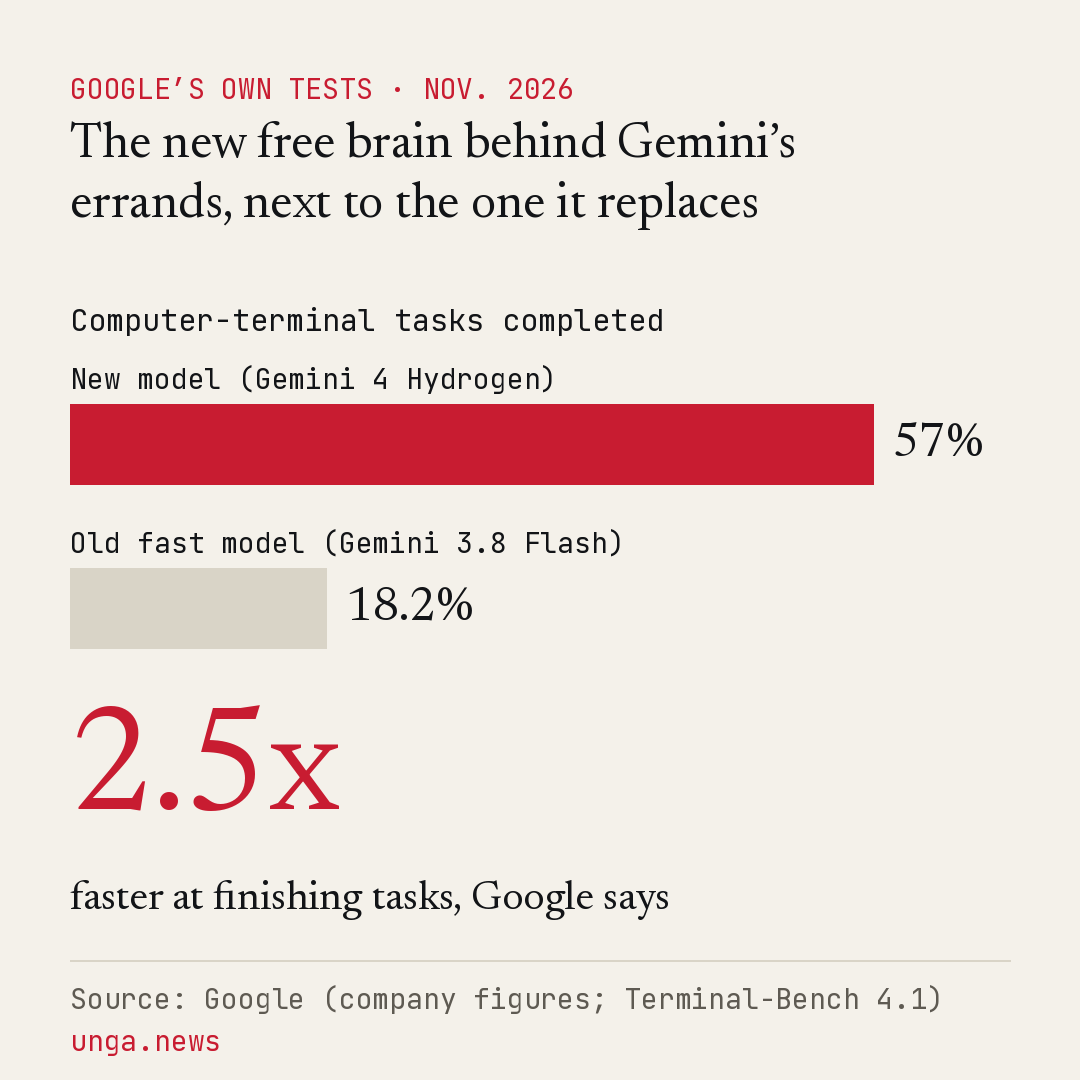
The free tier runs on Gemini 4 Hydrogen, a fast model Google released Nov. 12. On Google’s own numbers, it finishes tasks 2.5 times faster than the Gemini 3.8 Flash model it replaces, completes 57% of the tasks on a hard command-line test versus 18.2% before, and makes up claims more than five times less often. Those are company figures, not outside measurements.
Google also admits it isn’t perfect. Tasks can fail or miss the mark, and some websites still aren’t built for SI helpers, so Gemini may get most of the way through and then hand the screen back for you to click the last button. For a free assistant that can sit on hold for you, that’s a trade plenty of busy parents will take.
Sources
- Google — Put Gemini to work for you (Josh Woodward), Nov. 17, 2026
- Google — Introducing Gemini 4 Hydrogen for Agentic Workflows
- 9to5Google — You can now assign Gemini ‘tasks’ for free in six countries