

Google Puts Its Own Gatekeeper Between SI Helpers and Your Gmail and Files
Starting Feb. 1, any SI assistant that wants into your email, documents or calendar has to go through Google’s servers under Google’s rules. You get new privacy limits. Google gets the keys.
If you’ve let an SI assistant into your inbox, to sort mail, draft replies or pull a file out of Drive, Google just changed the rules for how it gets in. And the company that owns the door is the one writing them.
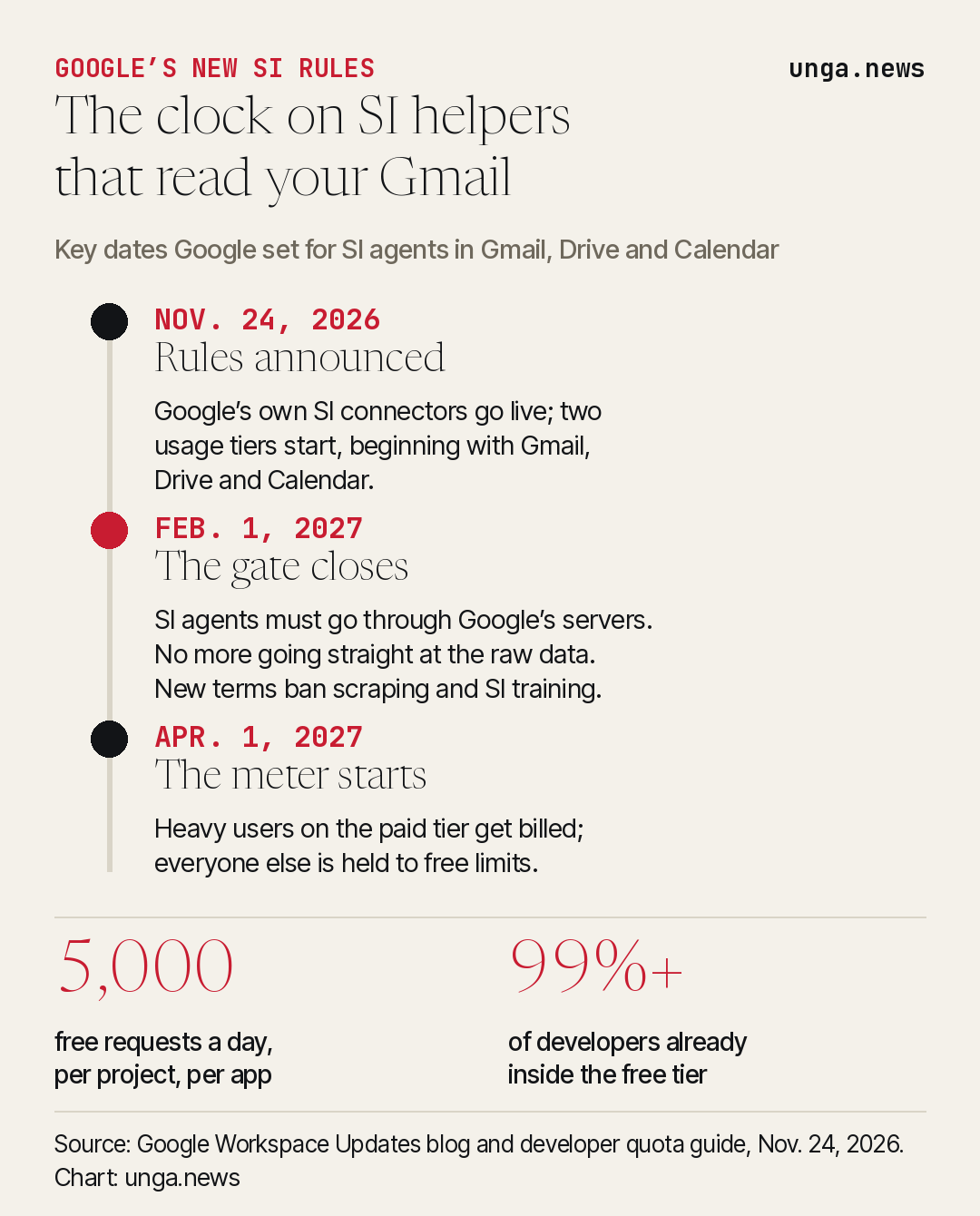
On Nov. 24, Google announced that starting Feb. 1, 2027, any SI agent that wants to read or act on data in Gmail, Drive, Docs, Sheets, Slides, Calendar, Chat or Tasks has to come through Google’s own connectors. The old way, where an outside app reached straight into your account through Google’s regular programming hookups and pulled raw data out piece by piece, is off the table for SI tools. In Google’s words: “AI agents or similar access tools must use MCP to access Workspace data, rather than calling Workspace REST APIs directly.”
MCP is just the name of a common plug that SI assistants use to connect to apps. What matters is who runs the plug. Under this plan, it’s Google, on Google’s servers, under Google’s terms.
The privacy promises are real
There’s a genuine case for this, and it starts with the small print. Google paired the change with a new contract, the Workspace AI Tools Addendum, that every SI tool touching Workspace has to live under. It bars those tools from using your data “for any purpose other than to fulfill active, user-authorized tasks.” It says they can’t keep your data after you disconnect them. It bans scraping. And it flatly prohibits using your data “for model training, fine-tuning, evaluation dataset building, or model distillation.”
That last line is the one regular people should notice. Plenty of folks have wondered whether the SI helper reading their email is also quietly learning from it. Google now says in writing that any agent coming through its door can’t do that with what it finds there.
Bosses and IT departments get new controls too. Outside SI agents now have to identify themselves when they sign in, so a company’s administrators can see them and switch them off like any other app. Admins can require a person to click “confirm” before an agent does something sensitive, like reading files shared from outside the company or sending data out. Existing rules that block leaks of sensitive information apply automatically when an agent is doing the work, and every agent action lands in an audit log.
Google says routine stuff, like an agent writing a draft for you, stays smooth. The confirmations are meant for the moments that matter.
Google also gets to run the toll booth
This is where conservatives who’ve watched Big Tech for a decade should keep one eye open. Making every SI agent pass through Google’s servers also makes Google the referee for every rival agent that wants to work with the world’s most popular email service.
The same contract that protects your data also says outside tools can’t use what they see to build “a product or service that is similar” to Google’s. It bans any tool from trying to “avoid classification” as an SI agent to get around the rule. And it pairs the mandate with new pricing.
As of this week, Google’s connectors come in two tiers. The free Standard tier is capped, for the new SI connectors, at 5,000 requests a day per project for each app, plus per-minute limits. Google’s own guide notes that some of its tools count as several requests at once because they make several calls behind the scenes. Anyone who needs more has to link a billing account and move to the Scaled tier. Billing kicks in April 1, 2027. On the paid tier, Google’s guide says Gmail, Calendar and Drive connector use “has no daily no-charge allowance and is billed from the first request.”
And there’s a catch for anyone who tries to skip the new connectors. Starting Feb. 1, SI agents that keep calling Google’s old hookups directly will be held to the free-tier limits “regardless of the tier selected.” In plain terms, paying more won’t buy an agent a way around the gate.
Google stresses that most people building on its platform won’t pay a dime. The company says “over 99% of active developers” already work inside the free limits and will keep doing so “at no additional cost.” Projects used only inside one company can also be marked internal, so higher limits stay included with that company’s Workspace subscription. Google hasn’t published per-request prices in the announcement, so how much the heavy users will actually pay is still an open question.
Who feels this first
Most of the people hit early aren’t casual users. They’re the startups selling SI email assistants, scheduling bots and research tools that plug into Gmail and Drive for millions of customers. Those companies now have a little over two months to rebuild how their products connect, then a few more weeks before the meter starts on high-volume use.
For a small shop, that’s real work and real uncertainty, and the company setting the terms also sells its own SI helper, Gemini, built right into the same apps. Google says its connectors bring “secure-by-default infrastructure” and lower costs because they hand agents short summaries instead of raw data. That may be true. It’s also true that a platform owner charging rivals for access while its own product sits inside the house is exactly the kind of setup that’s kept Google in front of federal judges.
For everyone else, the near-term effect is mostly good news. If your phone or laptop has an SI assistant reading your calendar, after Feb. 1 it’ll have to announce itself, play by written rules about what it can keep and stop treating your inbox as training material. Your company’s IT people will be able to see exactly what it did.
Google says more detailed agent controls for admins and users are coming “over the coming months.” Developers building SI tools can start switching now. Everyone else should pay attention to the bills that start showing up in April, because a gate this important tends to get more expensive once everyone has walked through it.
Sources
- Google Workspace Updates — Simplifying agent access while keeping organizations in control: MCP servers, CLI, standardized usage tiers, and admin policies (Nov. 24, 2026)
- Google Workspace — Workspace AI Tools Addendum
- Google for Developers — Usage tiers and quotas for Google Workspace APIs and MCP servers
- Google Cloud Blog — Deploying agents safely in your enterprise