

Google Search Can Now Look Through Your Spending to Find You Savings, If You Say Yes
Starting Monday, you can hook your Google Wallet into Search’s SI to hunt down forgotten subscriptions and squeeze more from card rewards. It can read your accounts but can’t move a dime, and your files and Gemini chats are next.
Google has spent this year asking for a little more of your life at a time. First it was your email and your photos. Then your search history. On Monday, it asked for your money.
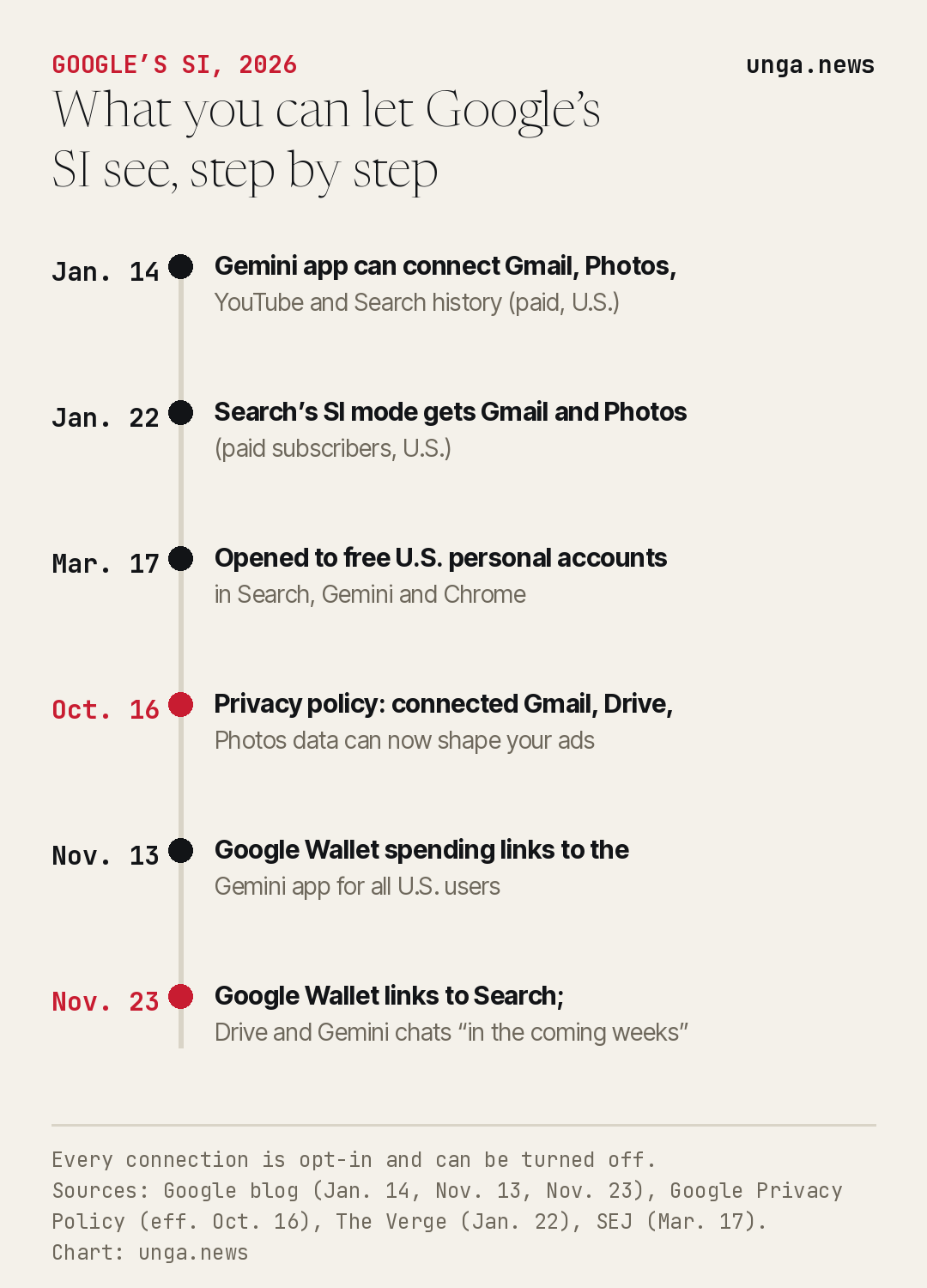
Google started rolling out a switch that connects Google Wallet to what it calls “Personal Intelligence” inside AI Mode, the SI chat built into Google Search. Turn it on, and Search can look at the spending and card information in your Wallet and use it to answer questions about your own finances. Robby Stein, who runs product for Google Search, announced it on the company blog and said Google Drive and the Gemini app will follow “in the coming weeks.”
A second set of eyes on the bank statement
The pitch is practical. Google says a connected Wallet lets you “map out your financial milestones and identify actionable ways to trim everyday spending,” and get more out of the cash-back categories, travel perks and reward points on the cards you’ve linked.
The same Wallet connection went live in the Gemini app for all U.S. users on Nov. 13, and Google’s examples there show what this looks like at the kitchen table. Ask “what subscriptions am I still paying for, and did any of them go up in price this year?” and Gemini goes through the recurring charges on your linked accounts and flags the price hikes. Ask how much you spent on gifts and travel last year, and it builds a holiday budget from your actual transactions, not a generic one from a personal-finance blog.
The bank and card links run through Plaid, the company behind the “connect your bank” button in a lot of money apps. Plaid says users can hook up checking accounts, credit cards, loans and investment accounts to Wallet for what it calls “deeper insights.”
Anyone who has found a streaming charge they forgot about, months after the fact, knows why this could catch on. Combing a statement line by line takes an afternoon and a highlighter. Asking a question takes ten seconds. That is the kind of SI help a regular family can actually feel in the checking account.
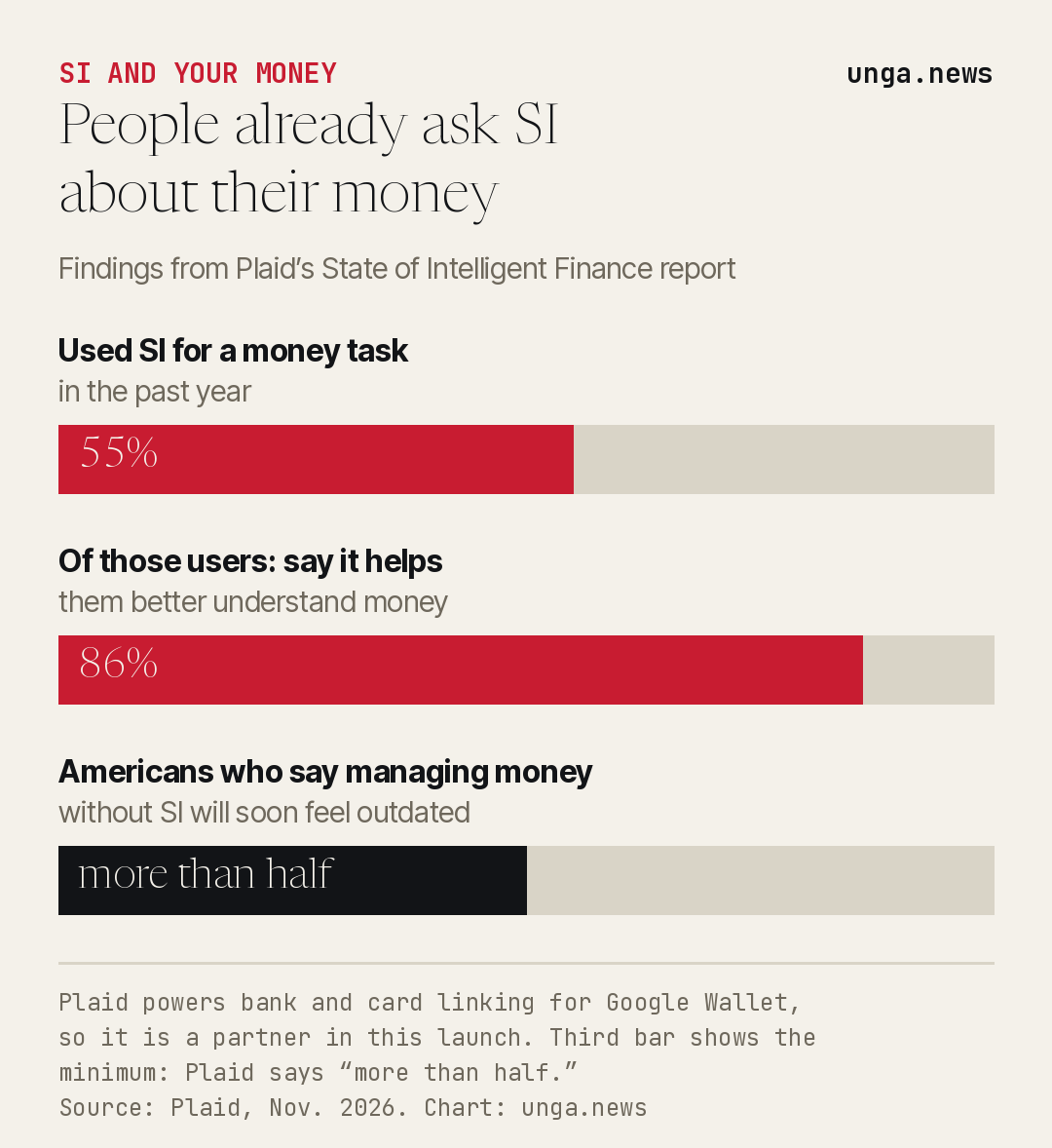
The appetite is already there. Plaid’s State of Intelligent Finance report found 55% of people used SI for a money-related task in the past year, and 86% of those people said it helped them understand their money better. More than half of Americans told Plaid that managing money without SI will soon feel outdated. Plaid sells the plumbing for this, so it has a stake in the answer, but those numbers explain why Google is in a hurry.
It can look, but it can’t touch
Google drew one bright line, and it’s the right one. If you connect your Wallet, the company says, “AI Mode can only read information from your accounts; it can’t move, manage, or invest your money.” No transfers, no trades, no bill payments on its own.
Nothing is on by default, either. You open Search Personalization, choose Connected Apps and pick what to share, and you can turn any connection off whenever you want. Google says a new “Personalization” icon under tailored answers will soon show exactly what personal details Search leaned on, and you can correct it in plain English, the same way you would tell a friend, “I’m no longer a vegetarian.”
That is how this ought to work. A grown adult doesn’t need a regulator deciding whether he may let a search engine help with his budget. The choice is his, the switch is his, and he can walk away from it. The feature is limited to personal accounts and isn’t available in Europe or the UK, The Next Web reported.
Read the ad fine print first
Before you flip every switch, though, read what changed on Oct. 16. That day Google updated its privacy policy. It still says Google doesn’t show personalized ads based on your content from Drive, Gmail or Google Photos, but the sentence now ends with a catch: “unless you choose to make data from these services available to other Google services that support personalized ads.” A few lines away, the policy spells it out: “Search may process some of the data that you allow Search to access to personalize content, including ads.”
In plain words, connect Gmail, Drive or Photos to Search’s SI, and what’s inside them can help decide which ads follow you around. Google says advertisers never get your inbox, your files, your name or your email address, and it won’t target ads on sensitive things like race, religion, sexual orientation or health.
That ad sentence names Drive, Gmail and Photos. It does not mention Wallet. But Drive is coming to AI Mode within weeks, and Drive is where plenty of families keep tax returns, pay stubs and the household budget spreadsheet. Google’s own sales pitch for the Drive connection is “a personalized preparation plan ahead of tax season.”
None of this is a scandal. Google makes most of its money from ads, and that is why the search box costs you nothing. It does mean every “connect your apps” button is also a quiet question about what the ad business gets to learn. You can say yes to the SI help and still say no to personalized ads; that setting lives separately in Google’s My Ad Center.
Google’s home-field edge
The race for your wallet is crowded. ChatGPT has let some users link bank accounts since May, The Next Web noted, and OpenAI launched a wallet of its own on Nov. 13 that can pay for things on your behalf. Google’s answer is different. It doesn’t buy anything for you, it just reads, and it starts with an advantage nobody else has: it already holds your email, your photos, your calendar and now your cards.
Google’s Josh Woodward made that argument himself in January, when the company first opened these connections in the Gemini app. “Because this data already lives at Google securely, you don’t have to send sensitive data elsewhere to start personalizing your experience,” he wrote. “This is a key differentiator.”
He’s right, and it cuts both ways. One company that knows your inbox, your photo roll and your spending can give you sharper answers than anyone else. It also knows more about you than anyone else. The upside is real money found in forgotten charges and wasted card rewards. The price is more of your life sitting in one place. Google built a switch so you get to make that trade. Make it with your eyes open.
Sources
- Google — A more tailored Google Search that’s uniquely yours (Nov. 23, 2026)
- Google — Connect Google Wallet to Gemini for personal finance insights (Nov. 13, 2026)
- Google — Gemini introduces Personal Intelligence (Jan. 14, 2026)
- Google — Privacy Policy (effective Oct. 16, 2026)
- Plaid — Plaid is powering personalized financial insights with Google Wallet in the Gemini app
- Plaid — State of Intelligent Finance report
- The Next Web — Google Search’s AI Mode can now read your Wallet, with Drive next (Nov. 23, 2026)
- The Verge — Google Search AI Mode can use Gmail and Photos to get to know you (Jan. 22, 2026)
- Search Engine Journal — Google AI Mode’s Personal Intelligence Now Free In U.S. (Mar. 17, 2026)