

Google’s $395 Smart Glasses Can Translate, Give Directions and Snap Photos. Here’s the Catch
Google, Samsung, Warby Parker and Gentle Monster opened preorders for Gemini glasses that ship December 10. They come with strict camera rules and a short list of phones that work with them.

For about a decade, smart glasses have been the gadget everyone predicted and almost nobody wore. Google learned that the hard way with Google Glass. Now it’s back for another try, and this time it brought partners who actually know how to sell glasses.
On Thursday, Google, Samsung, Warby Parker and the Korean fashion label Gentle Monster opened preorders for what they’re calling Intelligent Eyewear: regular-looking frames with Google’s Gemini assistant, a camera, speakers and microphones built in. The Warby Parker pairs start at $395. The Gentle Monster pairs run $449 to $489. They ship and land on store shelves December 10, which puts them squarely in the Christmas gift fight.
Each company has a lane. Samsung built the electronics that fit inside the frames. Google wrote the software and supplies Gemini. The two eyewear brands designed what you actually see in the mirror, 30 designs in all once you count colors and lens types, according to Samsung’s announcement.
No screen, just a voice in your ear
If you’re picturing a little display floating in front of your eye, these aren’t that. There are no screens in the lenses. You talk to the glasses by saying “Hey Gemini” or tapping the side of the frame, and the answer comes back through small open-ear speakers aimed at your ears instead of the room. The setup is a lot like the Ray-Ban Meta glasses that have been on the market for a few years.
What makes it more than a pair of earbuds on your face is the camera. Because Gemini can see what you see, Google’s pitch is that you just look at something and ask. In Google’s launch post, XR chief Shahram Izadi gives examples like asking about a street mural you’re walking past, getting a book recommendation from the shelf in front of you, or glancing at an event poster to check whether you’re free that night. You can have it add what you’re looking at to a grocery list.
Google Gemini on 𝕏, Nov. 12, 2026: “Keep your eyes up and your day moving with Gemini on intelligent eyewear.”
— @GeminiApp View on 𝕏
The practical stuff may matter more than the party tricks. Google Maps can talk you through turn-by-turn directions without you staring at your phone on a street corner. Google Translate handles live spoken translation across more than 70 languages, detecting the language on its own. You can take calls, hear your group chats read aloud, reply to messages and play music from YouTube Music, Spotify or Apple Music.
There’s a feature here that could change lives, too. Guided Vision gives spoken, back-and-forth descriptions of the world to people who are blind or have low vision, like reading small print or finding something on a shelf. Through a partnership with a company called Aira, a user can also stream what the glasses see to a trained human interpreter. Google is careful to say Guided Vision isn’t a medical device or a replacement for a white cane, and at launch it and Aira only work with Android phones.
Nine hours on a charge, if the company’s numbers hold
Here’s what the hardware looks like on paper, all from the companies’ own spec sheets.
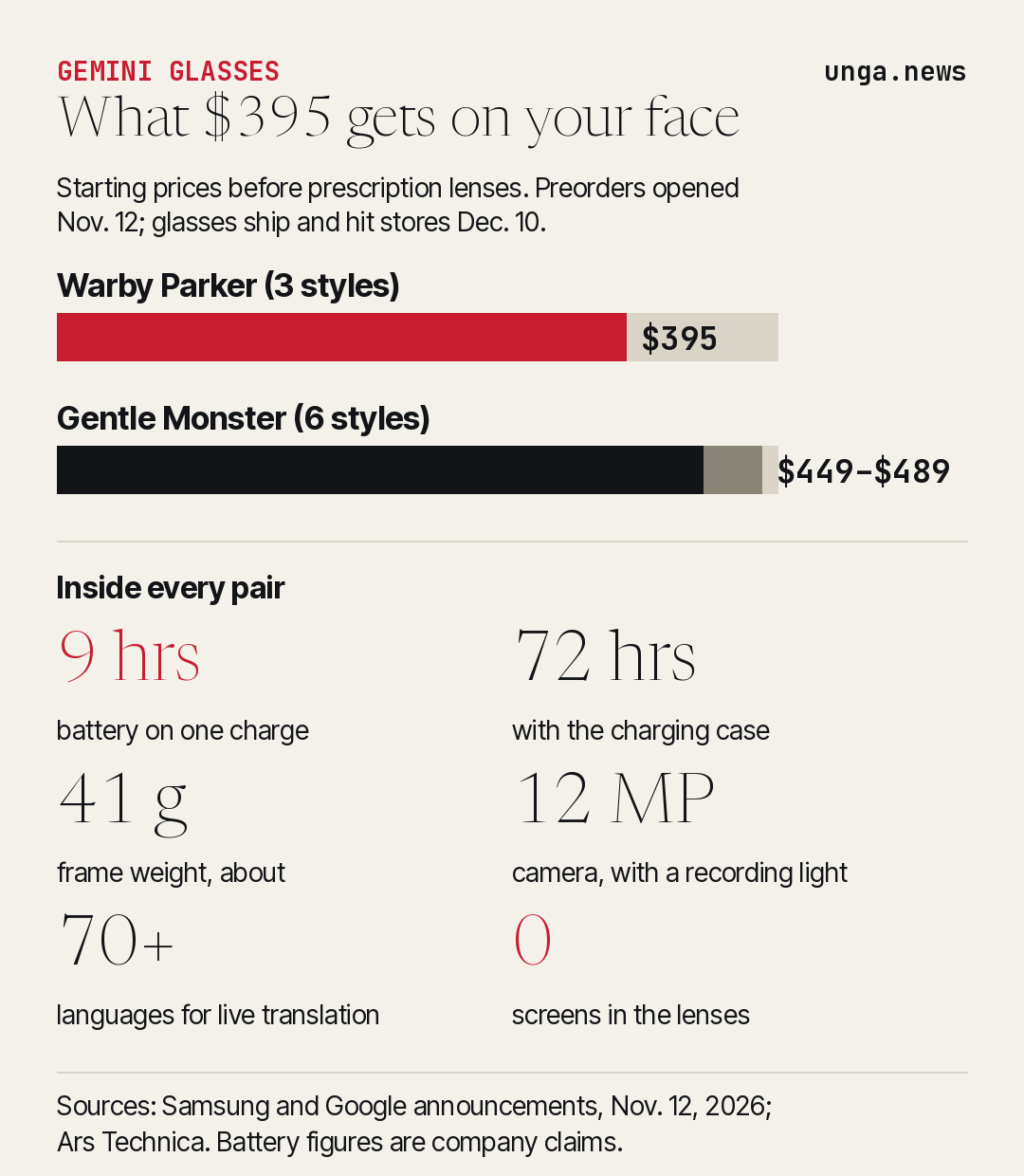
Samsung rates the battery at up to nine hours, and the case holds enough to recharge the glasses up to seven times, for about 72 hours total. The 12-megapixel camera shoots photos and video up to 3K. The frames weigh about 41 grams, which Ars Technica noted is light for a gadget but heavy for a pair of glasses, and that’s before your lenses go in. The glasses lean on your phone for part of the processing, which is how Samsung kept the frames slim.
Those prices are starting points. Prescription lenses and premium lens options will push the bill higher, and none of the companies has said how much.
The camera rules are stricter than Meta’s
Anyone who remembers the “Glasshole” years knows the real fight with face-mounted cameras isn’t technical. It’s whether the people around you trust you. Google is leaning hard on that this time, saying it designed for privacy “on both sides of the lens.”
A light on the frame turns on whenever the camera is recording. If you cover it or tamper with it, the glasses refuse to use the camera. The camera also shuts off when you take the glasses off your face, and every pair has a physical off switch so they can be plain glasses whenever you want.
Google goes further than Meta in a few places, according to Ars Technica. No app on the glasses will be allowed to livestream video to social media, not even YouTube. Real-time facial recognition isn’t allowed. When you ask Gemini about what you’re looking at, the glasses are designed to blur out bystanders’ faces before the picture gets processed. Users have to agree not to record people without consent or in sensitive places, and Google says it can remotely disable glasses belonging to people who break those rules. You also have to be 18 or older, with age verification at setup.
For the wearer, Google says what the camera sees for Gemini isn’t saved in your Gemini history and isn’t used to train its models or target ads. Data is encrypted on the glasses and on the way to Google. Ars points out two soft spots: your voice conversations with Gemini don’t get that same no-training promise, and the data isn’t encrypted once it sits on Google’s servers. Google says it’s working to bring its Private AI Compute system to the glasses, which would wall off that processing so not even Google can see it.
Check your phone before you order
The biggest catch for most families isn’t the price. It’s the phone. The glasses work with iPhone 13 Pro and newer, Google Pixel 7 and newer, and Samsung’s Galaxy S and folding Z phones running its latest software. If you carry a cheaper Galaxy or an Android phone from another brand, you’re out of luck for now. The glasses also only work with Google accounts from the United States and South Korea.
Then there’s the assistant itself. Since there’s no screen, you’re trusting whatever Gemini tells you without a way to double-check it at a glance. Ars reviewer Ryan Whitwam wrote that in his testing Gemini still regularly fumbles simple jobs like adding calendar appointments or identifying objects in a picture. That’s an annoyance on a phone. In your ear, with no screen to catch the mistake, it’s a bigger deal.
Still, this is the most serious swing Google has taken at glasses since Glass, and it’s doing it the smart way: with frames people already buy, in stores they already visit. Warby Parker is offering guided demos at more than 360 of its stores. If you’ve been curious, that’s the place to try a pair on before spending $400 on a hunch.
Sources
- Samsung Newsroom — Samsung Announces December Release for Intelligent Eyewear (Nov. 12, 2026, with specifications)
- Google — See our intelligent eyewear lineup and pre-order your pair, Shahram Izadi (Nov. 12, 2026)
- Ars Technica — Google pushes privacy angle as Gemini-powered smartglasses debut starting at $395 (Nov. 12, 2026)
- Google Gemini on 𝕏 — Gemini on intelligent eyewear announcement (Nov. 12, 2026)
- The Korea Times — Preorders open for Samsung, Google, Gentle Monster smart glasses (Nov. 12, 2026)