

Google’s New SI Hunts the Tiny DNA Changes Behind Disease, and It Finds Nearly Twice as Many
Google DeepMind’s new model can tell which single-letter DNA change matters, in which cell, and whether it turns a gene up or down. On one immune-cell test, its hit rate nearly doubled. It’s for researchers, not your doctor, for now.

Every cell in your body carries the same DNA. Your heart cells, your gut cells and the immune cells fighting off a cold all work from one instruction book. What makes them different is which pages each cell actually reads. Somewhere in those pages, a single misplaced letter can quietly push one kind of cell toward disease while leaving every other cell alone.
Google DeepMind, the search giant’s SI research lab, said Wednesday it has built a model that is much better at finding those letters. It’s called AlphaGenome 2, and in the company’s announcement DeepMind says it “identifies nearly twice as many variants that change gene expression in cells” as its own previous model, which the lab had already been calling state of the art.
A variant, in plain words, is a spot where your DNA differs from someone else’s. Most of those differences do nothing. A few change how strongly a gene gets switched on, and those are the ones scientists are hunting when they try to figure out why one family gets a disease and another doesn’t.
Same test, nearly double the hits
DeepMind tested the new model on a large public map of 28 kinds of immune cells, a dataset called TenK10K. The job was to pick out which DNA changes actually cause a gene to shift, not just which ones happen to sit near it. The old approach, the first AlphaGenome tuned on single-cell data plus other specialized tools, got 16% of them. AlphaGenome 2 got 30%. On a second question, whether a change turns a gene up or down, the score went from 23% to 43%.
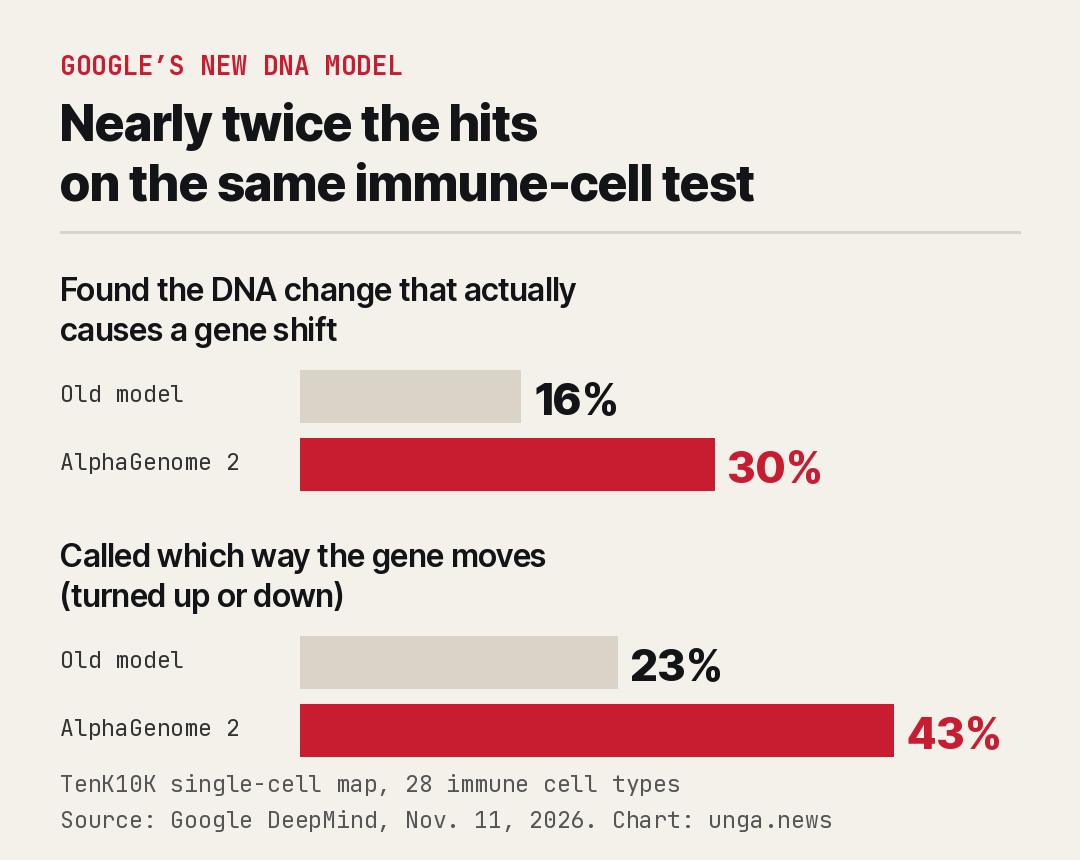
These are DeepMind’s own numbers, so treat them as a company result until outside labs check them. Even so, 30% means the model still misses most of the causal changes on that test. What changed is that the hit rate nearly doubled in one generation, and in this field that is a big jump.
The first AlphaGenome came out last year. It read a stretch of DNA a million letters long and spat out predictions for thousands of lab experiments across many tissues all at once. DeepMind admits that “spread the model’s capacity thin.” It was like asking one doctor to look at a whole hospital ward in a single glance. The new version looks at one condition at a time, a tissue, a cell type or a cell state, and keeps that target in view at every step of the math. That lets it learn that the same stretch of DNA can be read one way in a liver cell and another way in a brain cell.
It was also fed far more detail. DeepMind says it trained the model on more than 107 million individual cell profiles from human and mouse samples, across 68 tissues. The first version mostly saw averages, a blended smoothie of a whole tissue. This one sees individual cells.
One letter, one gut cell
The example DeepMind leans on is inflammatory bowel disease, the family of painful gut conditions that includes Crohn’s. A landmark 2024 study in Nature traced one inherited risk to a DNA change sitting far away from a gene called ETS2. That change cranks up ETS2 inside a specific kind of immune cell in the gut, the macrophage, and those overactive cells drive the inflammation.
Scientists needed years of lab work to nail that down. DeepMind says AlphaGenome 2, looking across the different immune cells in the gut, “reproduced this finding computationally.” It picked out the same causal change and showed it boosts ETS2 in gut macrophages while leaving other genes and cell types “largely unaffected.” Redoing a known answer is not a cure, but it shows the model can point at the right cell for the right reason, which is exactly the clue drug hunters need.
There’s a COVID example too. Given single-cell data from an mRNA vaccine study that it had never seen, the model told vaccine-activated immune T cells apart from resting ones. It also found that a DNA variant linked to severe COVID-19 disrupts gene activity more strongly once those cells are switched on.
A few dozen cells is enough
The part scientists seem most excited about is that the model doesn’t need to be retrained for every new experiment. A researcher can upload a snapshot of gene activity from just a few dozen cells, and the model folds that into its predictions for a cell state it has never encountered, such as cells changed by a disease or a vaccine.
“What makes AlphaGenome 2 exciting is how it adapts directly to new single-cell data without retraining, predicting how DNA variants act in newly profiled cell states from even a small sample of cells,” said Sarah Teichmann, a co-founder of the Human Cell Atlas project and a professor of stem cell medicine at the University of Cambridge, in DeepMind’s post.
DeepMind has also precomputed scores for thousands of DNA changes already tied to traits and diseases, from height to type 2 diabetes, across hundreds of cell and tissue types. That matters because the big gene hunts known as genome-wide association studies usually flag a broad neighborhood of DNA, not the exact house. The precomputed scores are meant to narrow the search to the likely culprit and the cell where it does its damage. Peter Donnelly, CEO of Genomics Limited, said in the post that his company plans to plug the model into its own drug-discovery platform.
Not for your doctor yet
Don’t expect this in a clinic next month. DeepMind is blunt that AlphaGenome and AlphaGenome 2 “are intended for research use only and have not been validated or approved for clinical or diagnostic purposes.” Its job is to help researchers decide which experiments are worth running, which can save years and a lot of money before a drug ever reaches a patient.
Access is limited, too. Academic and other non-commercial researchers can use it starting today through the AlphaGenome API. Drug companies and other commercial users get it only through a private preview for now. DeepMind says a set of AlphaGenome 2 add-ons is coming soon to Antigravity, Google’s agent-building platform, and the lab is collecting examples of how researchers use the model through a form that closes Nov. 30.
The paper’s author list runs from the lead scientists to DeepMind CEO Demis Hassabis and Pushmeet Kohli, one of the four names on the announcement. Their bet is simple enough to say out loud. If a machine can tell you which letter matters, in which cell, and whether it turns a gene up or down, the slow guessing part of genetics gets a lot shorter. On one immune-cell test, it got from 16% to 30% in a year.
Sources
- Google DeepMind — AlphaGenome 2: Deciphering how cells read DNA to better understand disease (Nov. 11, 2026)
- Google DeepMind — AlphaGenome: AI for better understanding the genome (first AlphaGenome release)
- Nature — A disease-associated gene desert directs macrophage inflammation through ETS2