

Google’s New SI Reads Your Medical Records and Tells You What You’ll Owe. Big Hospitals Are Already In.
Northwell, HCA and big insurers are first in line for a tool that pulls scattered records together and fights the paperwork behind your medical bills. Google hasn’t shown it lowers costs yet.

You know the routine. You fill out the forms online, then the front desk hands you a clipboard with the same forms. The nurse asks the same questions. The doctor spends half the visit staring at a screen. And weeks later, a bill shows up that nobody could have predicted.
Google says it wants to fix that. On Tuesday, Google Cloud launched Gemini for healthcare, an SI system built to plug into the record, billing and insurance software that hospitals and insurers already run, and do the busywork across all of them at once.
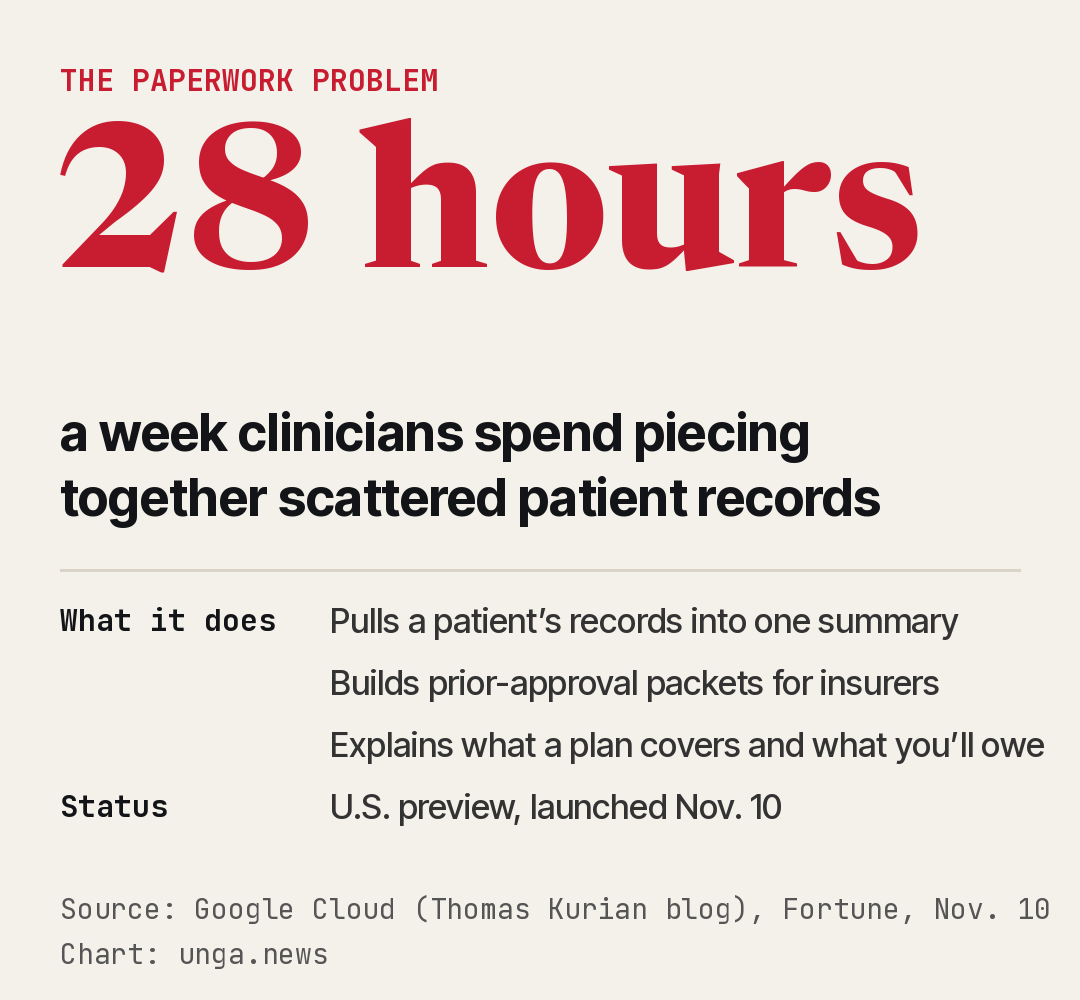
“Today, healthcare runs on fragmented data,” Google Cloud CEO Thomas Kurian wrote in the announcement. “Patient records, coverage policies, and clinical evidence remain trapped across disconnected records, claims systems, and administrative tools that don’t work together.” He said clinicians spend “nearly 28 hours a week” just reconciling that information.
Who is signing up
This is not a lab demo. According to Fortune, the launch customers include Northwell Health, New York’s largest health system, plus HCA Healthcare, Highmark Health, Optum, Blue Cross Blue Shield of Massachusetts, Hartford HealthCare and the Stanford School of Medicine. It is available now as a preview in the United States only.
The system connects to Epic and Oracle Health, the two biggest makers of hospital record software, Becker’s Hospital Review reported. It also links to federal Medicare coverage data and to medical guidelines from the American Society of Clinical Oncology and the BMJ, a leading medical journal.
What it actually does
Google describes it as an agent: you give it a goal, and it works through the steps. For doctors, that means pulling a patient’s history from different places into one summary, preparing the chart before a visit, and assembling the paperwork insurers demand before they will approve a treatment. Google says that last part means “fewer claims come back denied.”
For insurers, it checks requests against the plan’s medical rules and organizes them for the human reviewer. It also explains benefits and costs to members, using their own plan documents.
In a demo for Fortune, a Google lead asked the system what was new in an outside specialist’s report that was not already in a patient’s chart. In 35 seconds, it pulled the patient’s conditions, medications, allergies and lab results, compared them with the report, and flagged new labs and an allergy the chart had missed. Each finding linked to its source.
The money question
Here is why regular people should care. Health costs keep climbing. Fortune, citing the health research group KFF, reported that workers with employer coverage now pay $7,471 a year on average toward family premiums, up 9% from 2025. Total family premiums hit $28,303.
Much of that is paperwork. Fortune cites the American Hospital Association’s estimate that administrative costs make up 25% to 35% of U.S. health spending. The American Medical Association says each doctor handles about 40 insurance pre-approvals a week, which eats roughly 13 hours of doctor and staff time.
Northwell CEO John D’Angelo, an emergency physician by training, put it bluntly. “I have like 400 employees whose sole job is fighting the insurance denials, and we overturn over 90% of them, but that’s a big labor cost,” he told Fortune. He added: “Right now, for every 10 minutes a doctor spends with a patient, they’re 20 minutes on the computer.”
He also described the waste that comes from records that do not talk to each other. In the ER, he said, he would sometimes order a CT scan with no way of knowing whether the patient had already had four for the same condition.
The guardrails
Your medical records are about as private as data gets, so the limits matter. For now, the system can read records from Epic and Oracle Health but cannot change them, Becker’s reported. A doctor or nurse still makes every update and every decision. Google says it supports HIPAA, the federal health privacy law, with access controls and audit logs, and that customer data will not be used to train its models.
“It shouldn’t replace the doctor or the nurse, but it should give the doctor or the nurse back to the patient,” D’Angelo said.
What other coverage is missing
The cheerful version of this story skips a hard truth: the same kind of tool can help insurers too. Google is selling to the plans that deny claims and the hospitals that fight those denials. If both sides arm themselves with SI, the paperwork war could get faster without getting smaller. And Google has not published any results showing it actually lowers bills. So far, that is a hope, not a fact.
There is also the question of who you trust with your health history. This is a preview, and Google has said little publicly about pricing beyond offering per-user and pay-as-you-go plans to its business customers.
What to watch
Watch for the first hard numbers from Northwell or Highmark: fewer denials, shorter waits, or lower costs. Watch whether Google adds the ability to write into medical records, which would raise the stakes. And watch your next doctor’s visit. If that clipboard ever disappears, this might be why.
Sources
- Google Cloud — Introducing Gemini for healthcare
- Fortune — Google launches Gemini for healthcare, and hospitals like Northwell hope it lowers your medical bill
- Becker’s Hospital Review — Google launches healthcare AI agent with Epic, Oracle integrations
- Forbes via Yahoo — Google Cloud Launches Gemini For Healthcare, Unveiling New Agentic Layer And Capabilities