

Google’s Plan to Put SI Data Centers in Space Just Got a Rocket and a Date
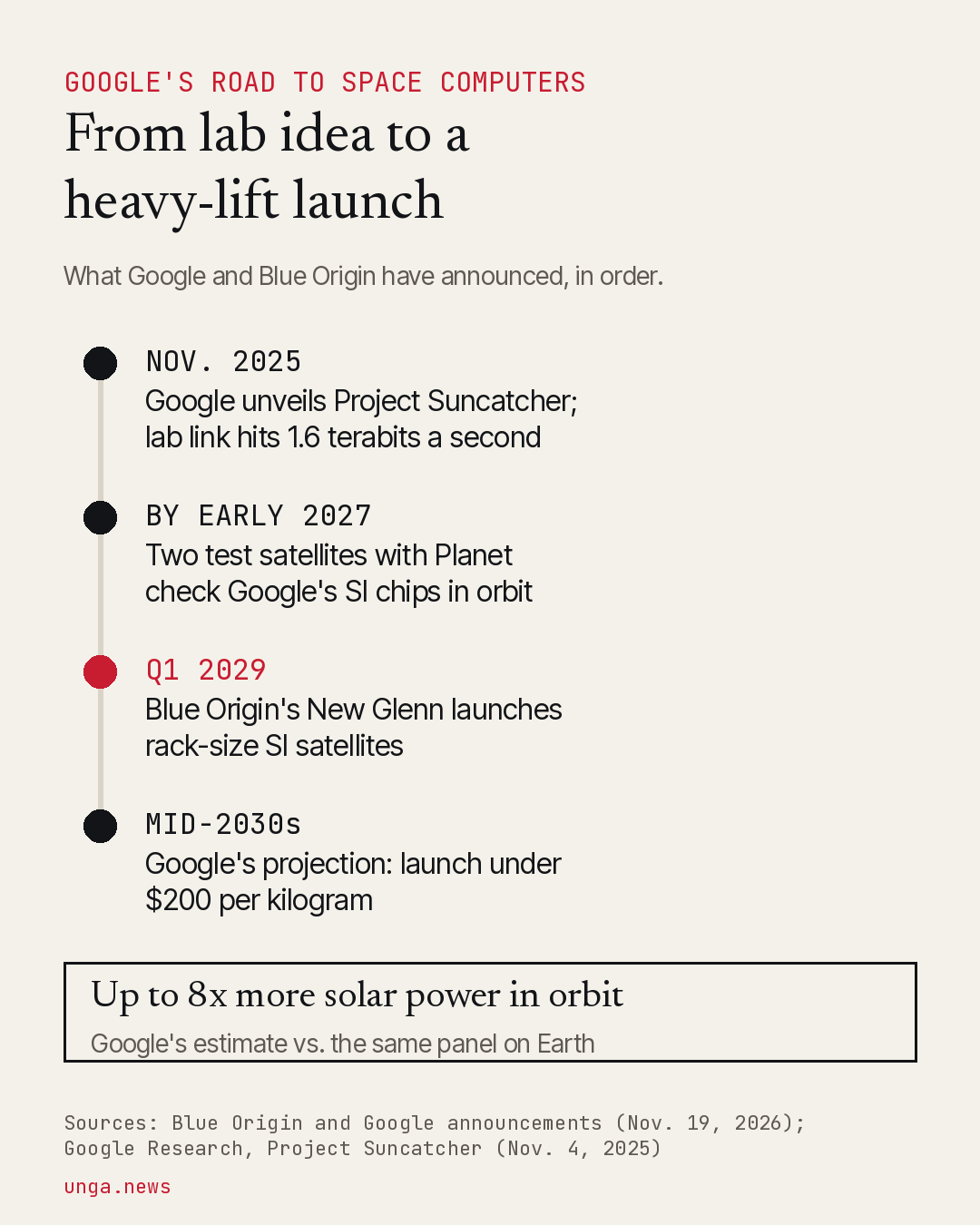
Google has booked Jeff Bezos’ New Glenn rocket for early 2029 to launch rack-size SI computers that run on nonstop sunlight in orbit.
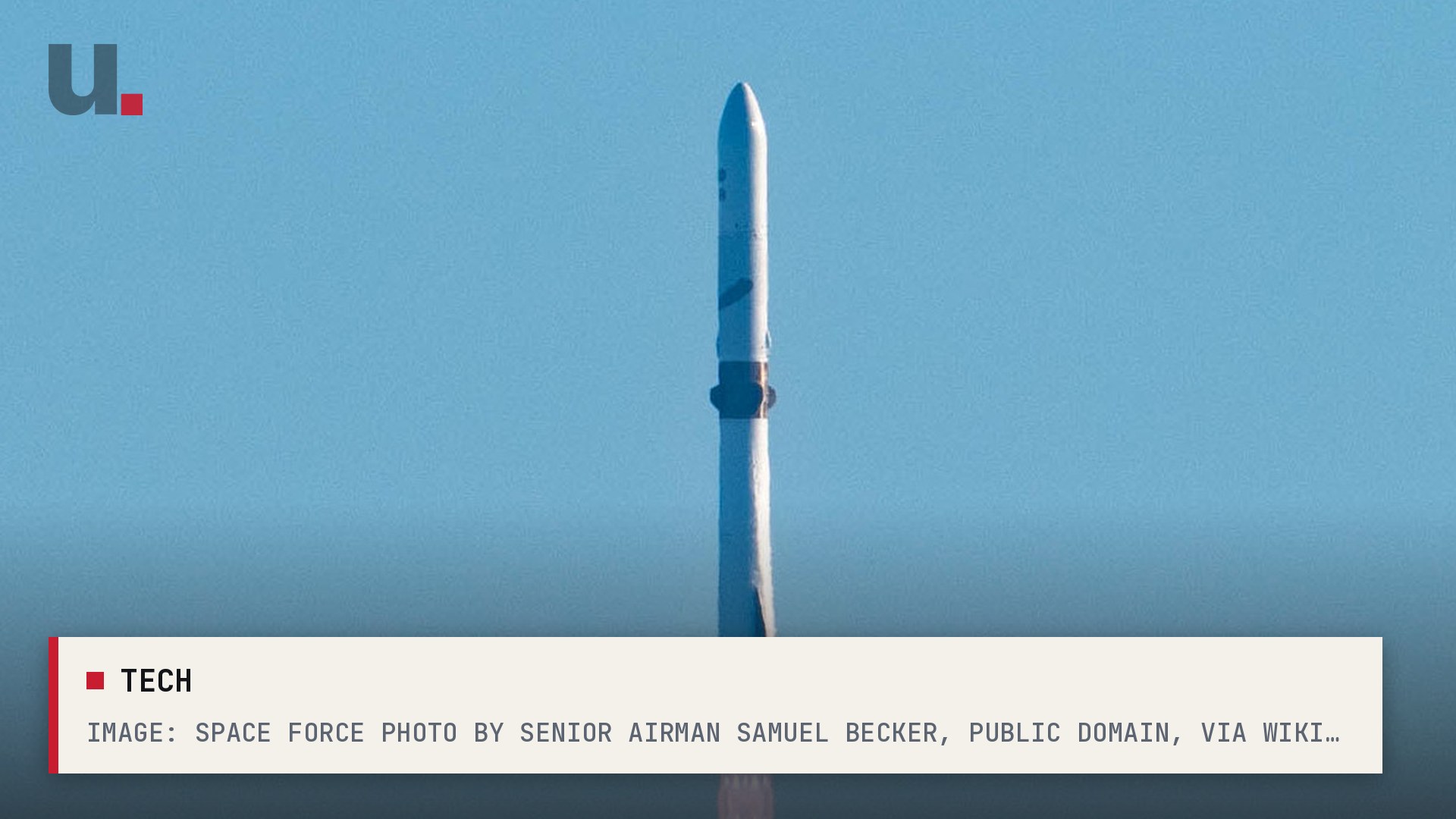
Every big SI company on Earth is hunting for the same two things: electricity and land. Google just put a date on its plan to stop fighting over either one. In the first three months of 2029, Jeff Bezos’ Blue Origin will fly a heavy-lift New Glenn rocket stuffed with Google satellites, each one carrying about as much computing power as a full rack in a data center, and park them in an orbit where the sun almost never sets.
The two companies announced the deal on Thursday. Blue Origin’s announcement calls it a launch services agreement for Project Suncatcher, which Google describes as “a long-term moonshot to scale AI infrastructure in space by tapping into the abundant solar power in orbit.” Google’s own post, signed by Suncatcher chief Travis Beals, says the flight will be its first dedicated heavy-lift launch for the project.
That matters because, until Thursday, Suncatcher was a research paper and a promise of two small test satellites. Now it has a ride big enough to carry hardware at real scale, a launch window and a partner whose rocket has already flown.
Sunlight that never clocks out
The pitch is simple enough for anyone who has ever paid a summer power bill. Google says that in the right orbit, “a solar panel can be up to 8 times more productive than on earth,” and it can “produce power nearly continuously, reducing the need for batteries.” That line comes from the company’s research write-up from November 2025, when it first unveiled the project.
The orbit Google picked for the 2029 flight is called sun-synchronous. In plain English, the satellites ride a path that keeps them lined up with the sun as the Earth turns underneath, so the panels stay in daylight most of the time. No night shift, no cloudy days and no fight with the local utility.
On the ground, the SI boom has run straight into power lines and zoning boards. Towns across the country have argued over giant server farms, their water use and what they do to electric rates. Google is betting that some of that fight can be moved a few hundred miles straight up.
Chips that had to survive a proton beam
The obvious question is whether delicate SI chips can live in space at all. Google tested that before it asked anyone for a rocket. Its team put a Trillium chip, one of its own Tensor Processing Units, in front of a 67 MeV proton beam to mimic the radiation in this kind of orbit. According to the peer-reviewed [paper](https://www.cell.com/joule/fulltext/S2542-4351(26)00362-4) in the journal Joule, the chips “survive a total ionizing dose equivalent to a 5 year mission life without permanent failures.”
That is the first published radiation test of a modern SI accelerator of this class, the paper says. The chips do still suffer random bit flips from cosmic rays, and Google says those have to be handled with error-checking and more testing on real training jobs. It is a real hurdle, and the company says so in its own paper.
The satellites also have to talk to each other fast enough to act like one big computer. Google’s answer is lasers. Its team says a bench-scale test already pushed 800 gigabits a second each way, or 1.6 terabits total, through a single pair of transceivers. To make that work in orbit, the satellites have to fly unusually close together. One design in the paper shows 81 satellites packed inside a cluster one kilometer across, with neighbors sometimes just 100 to 200 meters apart.
The math only works if rockets keep getting cheaper
None of this pencils out at old launch prices, and Google admits it. Its analysis of historical and projected prices suggests launch costs “may fall to less than $200/kg by the mid-2030s.” At that level, Google wrote, launching and running a space data center “could become roughly comparable to the reported energy costs of an equivalent terrestrial data center on a per-kilowatt/year basis.”
That is a projection, not a guarantee, and it rests on reusable rockets continuing the price slide that has already reshaped the launch business. It also explains why Google wants a big rocket. More satellites per launch means a lower cost per pound, and New Glenn was built to haul large loads.
“Project Suncatcher represents the ambitious missions New Glenn was built to support,” said Jordan Charles, Blue Origin’s senior vice president for the rocket, in the company’s release. “Its heavy-lift capacity and large payload volume give customers the flexibility to bring new capabilities to orbit.”
Test flights first, the big one in 2029
The 2029 launch is not Google’s first step into orbit. When it unveiled Suncatcher, the company said its next move was a learning mission with Planet, the satellite imaging company, to launch two prototype satellites “by early 2027.” Those will test Google’s chips and laser links in space on a much smaller scale. Google’s new post says the Blue Origin flight “builds on our ongoing work with other satellite and launch partners.”
SpaceNews, which reported the deal Thursday, describes the payload as a set of prototype data center satellites. So this is still a test, just a much bigger one, and Google calls the whole effort a moonshot in the same family as its self-driving cars and quantum computers.
Google still has plenty to prove. Cooling hot chips in a vacuum is hard. Beaming huge amounts of data down to the ground is hard. Fixing a broken server is a lot easier in Iowa than 400 miles above it. Google lists thermal management, ground communications and reliability in orbit as open problems in its own research.
But for anyone tired of hearing that the next SI data center is coming to a field near them, Thursday’s deal was the clearest sign yet that the biggest companies are serious about building some of that power plant in the sky instead. Google picked the rocket, picked the orbit and picked the year. Now it has about three years to show the hardware works.
Sources
- Blue Origin — Google Selects Blue Origin’s New Glenn for Project Suncatcher (Nov. 19, 2026)
- Google — We’re partnering with Blue Origin on our first heavy-lift Project Suncatcher launch (Nov. 19, 2026)
- Google Research — Exploring a space-based, scalable AI infrastructure system design (Nov. 4, 2025)
- Google — Meet Project Suncatcher, a research moonshot to scale machine learning compute in space (Nov. 4, 2025)
- Joule — Toward a future space-based, highly scalable AI infrastructure system design
- SpaceNews — New Glenn to launch Project Suncatcher data center satellites for Google (Nov. 19, 2026)