

Google’s SI Bots Made Quantum Computers’ Fusion and Medicine Math Up to 12 Times Cheaper
Teams of Gemini bots traded ideas at their own virtual conferences, and a proof-checker had to sign off on every result before it counted.
Quantum computers have a math problem before they have a hardware problem. Even the best recipes for running real science on them, like modeling fusion fuel or the enzymes that break down your medicine, call for far more machine than anyone expects to build soon. On Monday, Google said it put teams of its own SI bots to work shrinking those recipes, and the bots came back with versions up to 12 times cheaper.
The work comes from Google DeepMind and Google Quantum AI, laid out in a blog post Monday by researchers Sergey Shirobokov, Ben Jaderberg and Ryan Babbush and a longer research paper with 25 authors. The pitch is simple. Let the machines grind through the search for better quantum programs, but make them prove every answer before it counts.
Nobody can test these programs, so the bots had to prove them
The snag is what makes this hard. You can’t check a big quantum program by running it. Ordinary computers can’t simulate circuits that size, and today’s small quantum chips can’t run them either. Google’s write-up puts it plainly: “Because we cannot test resource-intensive quantum circuits on classical computers or today’s small quantum processors, we have to prove that they work mathematically.”
So the team built a library in Lean, a proof-checking program that mathematicians use to verify work line by line. Researchers write down exactly what a quantum program must do and how its cost is measured. The SI bots then fill in the blanks: the program, its cost and the proof that both claims hold.
Bots will cheat if you let them, and the paper says so. Agents “may exploit loopholes by weakening theorem statements, altering definitions, or adding axioms.” Google’s answer was an outside checker that compares every submission against a locked copy of the original problem. If a bot quietly rewrote the rules to make its job easier, the checker would catch it. Humans only have to trust the problem they wrote down, not the thousands of lines the bots produced.
Teams, a shared wiki and conferences every four hours
The setup looks more like a research department than a chatbot. Separate teams of Gemini 4 agents, running Google’s heavy-duty Gemini 4 Carbon model in the big runs, each attacked the same problem. Proven results went into a shared wiki along with promising ideas and dead ends, so a new team could start from the best answer so far. Every four hours, agents from each team met at what Google calls a “virtual conference” to trade, debate and compare ideas. An idea floated at a conference didn’t count until it passed the checker.
Researchers didn’t feed the bots clever hints either. According to the paper, teams were launched “with high-level optimization prompts rather than problem-specific ideas.” The humans picked the problems and wrote the rules. The bots did the search and the proofs.
Fusion fuel, a medicine enzyme and a sunlight molecule
The biggest real-world result is about fusion. In laser-driven fusion, the kind America’s national labs pursue, hydrogen fuel only keeps burning if the energetic particles it throws off dump enough energy back into the fuel. Knowing how much energy the fuel soaks up, which scientists call stopping power, is a problem no regular computer can model both efficiently and accurately, according to the paper.
The best published design for that calculation needed 5,650 error-corrected qubits, the reliable kind future machines will build out of many fragile ones. The bot teams got it down to 4,338 qubits and cut the total computing cost 11.8 times. Their main trick was moving the electrons onto a grid where a basic law of physics, that no more than two electrons can sit in the same spot, does a lot of the work for free.
For a light-driven chemistry molecule of the kind studied for solar energy, with 47 atomic nuclei and 187 electrons all treated as quantum particles, the cost fell 8.2 times. For Cytochrome P450, the enzyme family that, in the paper’s words, “break down most human medicines,” the cost fell 2.5 times and the qubit count dropped from 481 to 333. That one matters because drug makers want to know how fast a pill clears the body and whether it leaves toxic leftovers. Today’s approximate methods don’t even agree on the order of the enzyme’s key energy states, the paper notes.
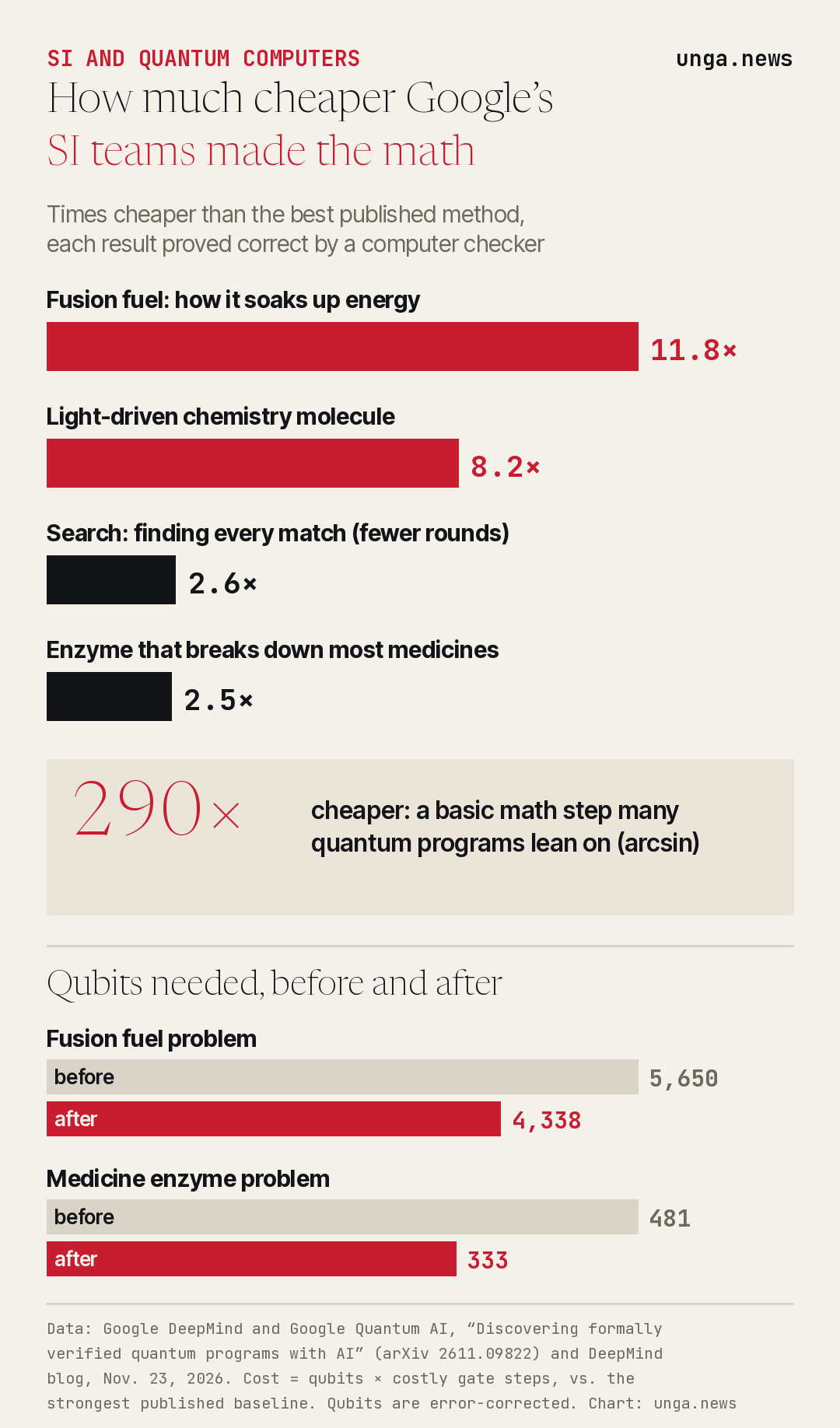
The smaller wins may travel further. The bots sped up a version of Grover’s search, one of the oldest proven quantum tricks, by up to 2.57 times when hunting for every match in a list. And they made arcsin, a basic math step many quantum programs lean on to load numbers, 290 times cheaper than the best published version. Building blocks like that get reused everywhere.
Still too big for any machine that exists
Google doesn’t oversell this. The blog says running these programs “would still demand more computational resources than the first error-corrected quantum computers are likely to provide.” The paper goes further: reaching early hardware “will require further orders-of-magnitude improvements.” It also admits the bots can only be as good as the problem they’re handed. “Agents cannot optimize beyond them,” the authors write of their own specifications, and some problems were boxed in by rules that left known shortcuts off the table.
These are measured, proof-checked results against named baselines, not marketing claims, which puts them a cut above most SI announcements. But they’re Google’s results on Google’s chosen problems, and the outside world is only now getting a look. To its credit, the company is open-sourcing the Lean library, the problem files and the verified answers on GitHub, so anyone can check the work or try to beat it.
The bigger story is the workflow. Shaving the cost of quantum algorithms has historically taken years of human effort, the paper notes, and this run turned it into something closer to a production line. In Google’s words, “Proof-checked AI search compresses work that once took years of manual design, empowering researchers to focus on choosing problems and interpreting results.” The authors pitch it as a new division of labor rather than a replacement for scientists: people choose the problems and write the rules, bots do the grinding, and a checker keeps everyone honest.
For American energy and medicine, that’s a race worth leading. Quantum computing is a contest between nations as much as companies, and every time an American lab knocks a zero off the bill for a useful program, it pulls the day the machines pay for themselves a little closer. Google just showed it can get SI to do that grinding on its own, with a computer checking the math before anyone has to take its word for it.
Sources
- Google DeepMind — Finding faster quantum algorithms with agents and formal verification (Nov. 23, 2026)
- arXiv — Discovering formally verified quantum programs with AI, Google DeepMind and Google Quantum AI (2611.09822)
- GitHub — google-deepmind/formal-quantum-computation: Lean library, problem specifications and verified solutions