

Google’s SI Just Proved the Code Guarding Billions of Private Texts Works. It Took Four Weeks.
DeepMind says its machines mathematically checked the real code behind Signal’s encryption, a job that usually takes experts years, and even caught two old bugs planted back in. No outside team has checked it yet.
Every time you send a private message on Signal, or a text on Google Messages, you are trusting code you will never see. That code is supposed to scramble your words so only the person on the other end can read them. On Tuesday, Google’s SI lab said it had done something no one, human or machine, had ever done before: mathematically prove that the actual code running on phones keeps that promise.
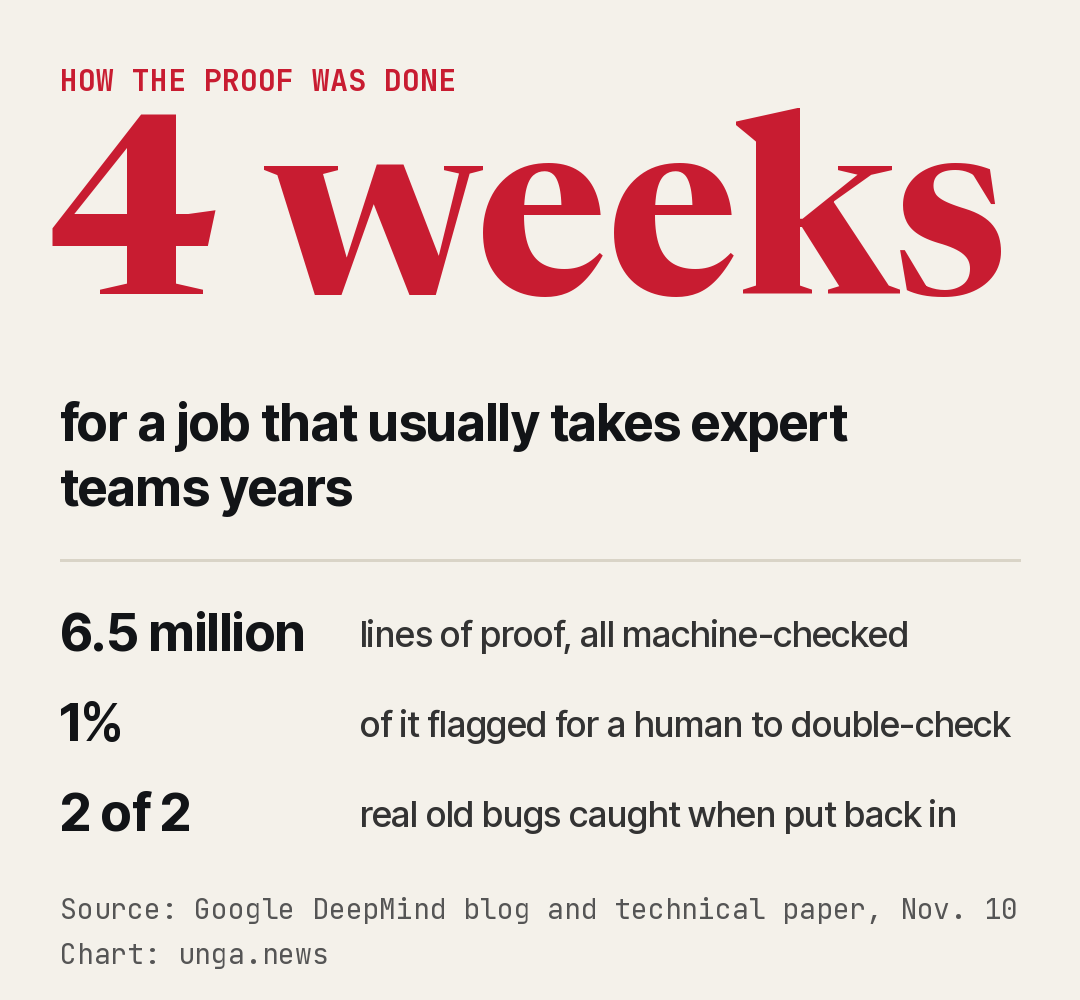
In a blog post from Google DeepMind, the lab said its researchers “guided AI agents to mathematically prove key security properties of the actual code underlying the Signal protocol, the technology that protects billions of private conversations in apps like Signal and Google Messages.” The system that did it is called AlphaProof Code, and the whole job took four weeks.
DeepMind says that kind of work “historically takes expert teams years.”
What “proving” code actually means
Most software is tested, not proven. Programmers run it, poke at it, and fix what breaks. That catches a lot, but it can never show there is no hole left. The hackers who break into phones and messaging apps make their living in exactly those leftover gaps.
Formal verification is the gold standard. Instead of testing, you write down in strict math what the code must always do, then prove, step by step, that it does. A computer checks every step, so there is no room for a tired human to wave something through. DeepMind calls it “the highest standard of security assurance,” and also admits it is “difficult and often labor-intensive.” That is why almost nobody does it for real-world apps.
Here is the part that matters. Researchers have studied and checked the Signal design on paper for years. What no one had done was prove that the code actually compiled and shipped to phones matched that design. As DeepMind put it, “real-world vulnerabilities often hide in the gap between design and implementation.” A perfect blueprint does not help if the builder left a window unlatched.
How the machines did it
According to the technical paper, the work split the way a research team would. Human experts worked with SI models to turn Signal’s security goals into precise math, and the humans signed off on every one of those rules. Then a team of SI agents, running on Google’s Gemini models, wrote the proofs.
They produced about 6.5 million lines of proof in Lean, a programming language built for checking math. Those proofs rest on roughly 26,000 lines of rules and machine descriptions that people do have to trust. Nothing counted until Lean itself checked it. A separate “gatekeeper” agent accepted a proof only if it matched a held-back copy of the approved rules, so the SI could not quietly prove an easier problem and call it done.
The agents then audited their own work and flagged spots that deserved a human look. DeepMind says that came to about one percent of the total. The researchers say the proofs reach all the way down to the machine code, the raw instructions an ARM-based phone chip actually runs.
What did they prove? In plain words: a snoop cannot read your messages, a stranger cannot pretend to be your contact, and if someone briefly gets into your phone, your older messages stay safe, and newer ones become safe again once the intruder is gone. The proofs also cover Signal’s newer handshake, built to hold up against future quantum computers.
The test that should make you trust it more
Anyone can claim a system works. The better question is whether it can tell good code from bad. So the team took two real bugs that Signal had fixed in the past and put them back into a walled-off copy of the code. In both cases, DeepMind says, the system produced a machine-checked proof that the buggy version was insecure.
That matters because a checker that says “all clear” to everything is worthless. This one caught the planted problems.
What it does not mean
Let’s be honest about the limits, because the headlines will not be. This does not mean every part of Signal, or every messaging app, is now proven bulletproof. The proof covers specific security promises in Signal’s core code library, version 0.105.4, not the whole app on your phone. Apps like WhatsApp use Signal’s design, but their own code is separate, as tech outlet DIYAI pointed out.
The work also leans on assumptions. The Register noted that part of the result “assumes perfect cryptography,” meaning it trusts that the underlying scrambling math holds. And so far, this is Google grading Google. DeepMind has published its paper and says it is open-sourcing the proof files, but no outside team has yet reported checking the method. That will be the real test.
Why regular people should care
There is a bigger story here than one app. America runs on code: power grids, banks, hospitals, the phones in our pockets. Hostile governments and criminal gangs spend fortunes hunting for one bad line. Proving code correct has always been too slow and too expensive to use on most of it. If SI can cut that job from years to weeks, it could close holes before the bad guys ever find them.
The same tools could, of course, help attackers hunt for weaknesses. That is the race now. DeepMind says this work is a milestone toward a “grand challenge” set out in April 2026. The lab claims it is “the first time AI has been used to formally verify a widely deployed cryptographic protocol at this depth,” and the first time a protocol this widely used has been verified this way “by any method, with or without AI.”
What to watch
Three things. First, whether outside experts dig into the open proof files and agree with Google’s claims. Second, whether Google offers this as a service to other companies; there is no product or price yet. Third, whether banks, hospitals and Washington start demanding proof, not promises, for the code that guards their secrets. If they do, Tuesday will look like the day that started.
Sources
- Google DeepMind — Formal Verification of Signal’s Protocol with Gemini
- Google DeepMind — AlphaProof Code: Verifying Signal’s Security at the Machine-Code Level (technical paper)
- The Register — Google DeepMind melds humans and AI agents to vet Signal’s secure messaging techniques
- DIYAI — Google DeepMind uses AlphaProof Code to verify Signal Protocol code
- Automatica Press — DeepMind AI agents formally verify Signal protocol cryptographic code