

Google’s Smartest SI Took Apart a 1994 Video Game and Rebuilt It for the Web in One Try
DeepMind chief Demis Hassabis says Gemini 4 Carbon pulled his old Theme Park game out of its original program files, added a new ride and rebuilt it in a browser. Now a cheaper sibling is already answering on Google’s servers.
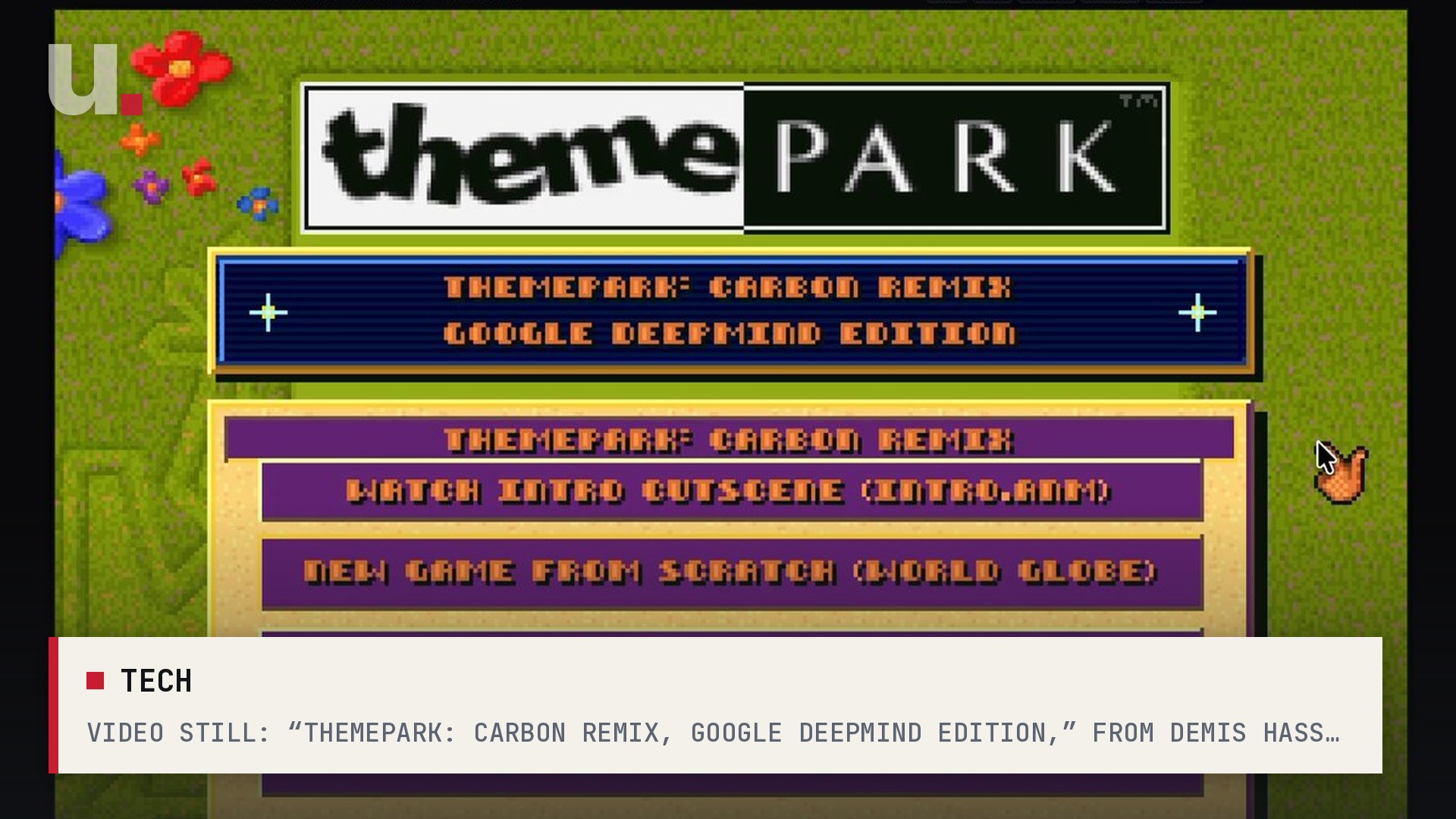
In 1994, a teenage programmer helped build a computer game called Theme Park, where you laid out roller coasters, hired janitors and decided how much salt went on the fries. This week, Google says its newest SI took the finished game files from that same disc, worked out how they run, added a new ride and rebuilt the whole thing to play in a web browser in one try.
The teenager grew up to be Demis Hassabis, who now runs Google DeepMind and shared a Nobel Prize in 2024 for SI that predicts protein shapes. The model is Gemini 4 Carbon, which Google opened to paying developers, businesses and its top-tier subscribers on Nov. 10.
“Carbon reverse engineers my original Theme Park binaries, adds a new DeepMind themed ride, and ports it to the web in one shot,” Hassabis wrote on 𝕏. “Kind of mindblowing to see!”
Demis Hassabis on 𝕏, Nov. 10, 2026: “Carbon reverse engineers my original Theme Park binaries, adds a new DeepMind themed ride, and ports it to the web in one shot.”
— @demishassabis View on 𝕏
A game he wrote as a teenager
The word that matters in his post is binaries. Those are the finished program files a computer actually runs, the raw machine instructions, not the readable code a programmer types. Pulling a working game back out of them is slow, painstaking detective work. People who keep old games alive spend months or years on it.
In his 59-second video, the title screen reads “Themepark: Carbon Remix, Google DeepMind Edition,” with menu choices to watch the original intro, start a new park or load the old Bullfrog demo park. Bullfrog was the British studio that made the game. Electronic Arts bought it in 1995, so the game itself belongs to EA, not Google. Later clips show pixel guests walking a concrete path, a build menu with prices like “Concrete Path $100” and a striped ride booth waiting for its line.
Hassabis has done this experiment before, and that’s the useful part. Last November, when Google launched Gemini 3, he posted that he had been “vibe coding” at night and “recreated a testbed of my game Theme Park” in “a matter of hours,” describing what he wanted and letting the model write it. That was a fresh imitation built from his memory and his prompts. A year later, he says the new model worked from the original files instead and got there in a single attempt.
Two cautions. This is a demo from the man whose company built the model, posted on launch day. Nobody outside Google has rerun it, and “one shot” doesn’t say how long the model worked, how many tokens it burned or how much cleanup came after. Still, the leap in ambition from one year to the next is the story Google wants people to see.
Why Google thinks it can win on price
Google pitches Carbon as its strongest model for long, multi-step work: big coding jobs, debugging, science problems and computer security. In its launch post, Google DeepMind’s Koray Kavukcuoglu wrote that Carbon is “using more tokens” than the earlier Gemini 4 Argon “to explore thoroughly, reason deeply, and run extended verification loops.” In plain terms, it thinks longer and checks its own work more before it answers.
Google says it ranks first on three outside tests run by other companies, including Cursor’s coding test and Zapier’s test of office automation, “at more than 2X lower cost per task compared to the next best external model.” That cost claim is Google’s own math. One piece did come from outside: Cursor, the popular coding app, said on launch day that Carbon at high effort was “the top model on CursorBench at 60.4%,” its in-house test of real coding tasks.
The price is where Google is pressing. Through Nov. 30, developers pay an introductory $2 per million tokens going in and $10 per million coming out. On Dec. 1, that doubles to $4 and $20. A million tokens is roughly a few thick novels’ worth of text. Regular people can try Carbon in the Gemini app and in Google Search’s AI Mode, but only on Google AI Ultra, the company’s most expensive plan.
Google also held Carbon back before the wide launch. When it announced the model on Oct. 28, Google said it was taking “a deliberate approach to rollout,” first giving it to computer-security defenders through a program it calls Fairwind and joining the government’s voluntary testing before release. That announcement claimed Carbon led a top independent ranking of overall smarts and topped tests for finding and patching software holes. Those security skills are why Google went slow.
Another one is already answering calls
Carbon may not have the spotlight long. Overnight, an account that watches company servers for unreleased models, AI Tracker Bot, reported that it had sent a request to “gemini-4-hydrogen” on Google’s cloud service and got a real answer back: “I am Gemini 4 Hydrogen, a large language model built by Google.”
The account added that Hydrogen “isn’t in Google’s Vertex model catalog yet, and Google hasn’t announced it.” Another tracker, Stats Wire, had reported a day earlier that code references match Hydrogen to Google’s fast, cheaper “Flash” line, with an even lighter version called Helix. A later post claimed Hydrogen had appeared in Google Cloud’s price list at $1.50 per million tokens in and $7.50 out. Google hasn’t confirmed any of it, so treat those numbers as unverified until it does.
If it holds, the pattern is familiar. Google ships a big, expensive model that does the hardest work, then follows quickly with a faster, cheaper one that handles most everyday jobs. For people who use these tools, that usually means better answers inside the free and cheaper apps a few weeks later.
For now, the most memorable proof Google has offered isn’t a test score. It’s a man in his fifties watching a machine take apart a game he helped write when he was barely old enough to drive, then hand it back with a new ride. Whether Carbon can do that for code nobody at Google wrote is the test that counts, and paying customers are running it now.
Sources
- Demis Hassabis on 𝕏 — Gemini 4 Carbon reverse engineers my original Theme Park binaries, Nov. 10, 2026
- Demis Hassabis on 𝕏 — Vibe coding a Theme Park testbed with Gemini 3, Nov. 18, 2025
- Google — Gemini 4 Carbon is now available
- Google — Gemini 4 Carbon: our next frontier model (Oct. 28, 2026)
- Google AI Studio — Gemini 4 Carbon: Developer Guide
- Cursor (repost by Demis Hassabis) on 𝕏 — Gemini 4 Carbon is now available in Cursor, Nov. 10, 2026
- AI Tracker Bot on 𝕏 — Gemini 4 Hydrogen has returned 200 on Google Vertex API, Nov. 12, 2026
- Stats Wire on 𝕏 — Gemini 4 Hydrogen (Flash) and Gemini 4 Helix (Flash-Lite), Nov. 11, 2026