

Governors Tell Congress: Police the Biggest SI, but Leave Kids and Scams to the States
Republican governors Mike Braun and Spencer Cox helped write a bipartisan plan that leaves kids, scams and jobs to the states and warns against rules that favor Big Tech.
For two years, the loudest voices on SI regulation have been tech billionaires, Washington staffers and a handful of blue-state legislatures writing rules for the whole country. On Sunday, the governors walked into the room. The National Governors Association released a plan that hands Washington one narrow job, keeping watch over the most powerful SI systems, and leaves almost everything that touches ordinary families with the states.
The plan comes from the association’s Governors Council to Secure American AI Dominance, a bipartisan group led by two Republicans, Indiana Gov. Mike Braun and Utah Gov. Spencer Cox, and two Democrats, Maryland Gov. Wes Moore and North Carolina Gov. Josh Stein. The group says it wrote the principles to “inform the incoming Congress as it develops an AI framework consistent with federalism principles.” Translation: when Congress writes a national SI law next year, the governors want their fingerprints on it.
A short list for Washington, a long one for the states
The three-page statement is built in three parts. Five principles apply to everybody. Five are aimed at the federal government. Fourteen are aimed at the states.
Washington’s list is the kind of work only a national government can do. Congress should set “a risk-based framework” for frontier models, meaning “the most advanced, general-purpose AI models whose risks and reach are national in scale.” Those models should be “evaluated or audited by independent experts,” and their developers should report “security breaches and significant safety incidents to federal authorities and affected states.” The federal government should also guard critical systems like banks, power and cyber defenses against SI threats, lead talks with other countries, and keep America ahead in research and development.
The fifth federal item is the one governors care about most. “Any attempt to preempt state laws should be approached cautiously and include meaningful input from a representative cross-section of states,” the statement says. Governors will judge any federal override against the association’s standing “Principles of Federalism” policy.
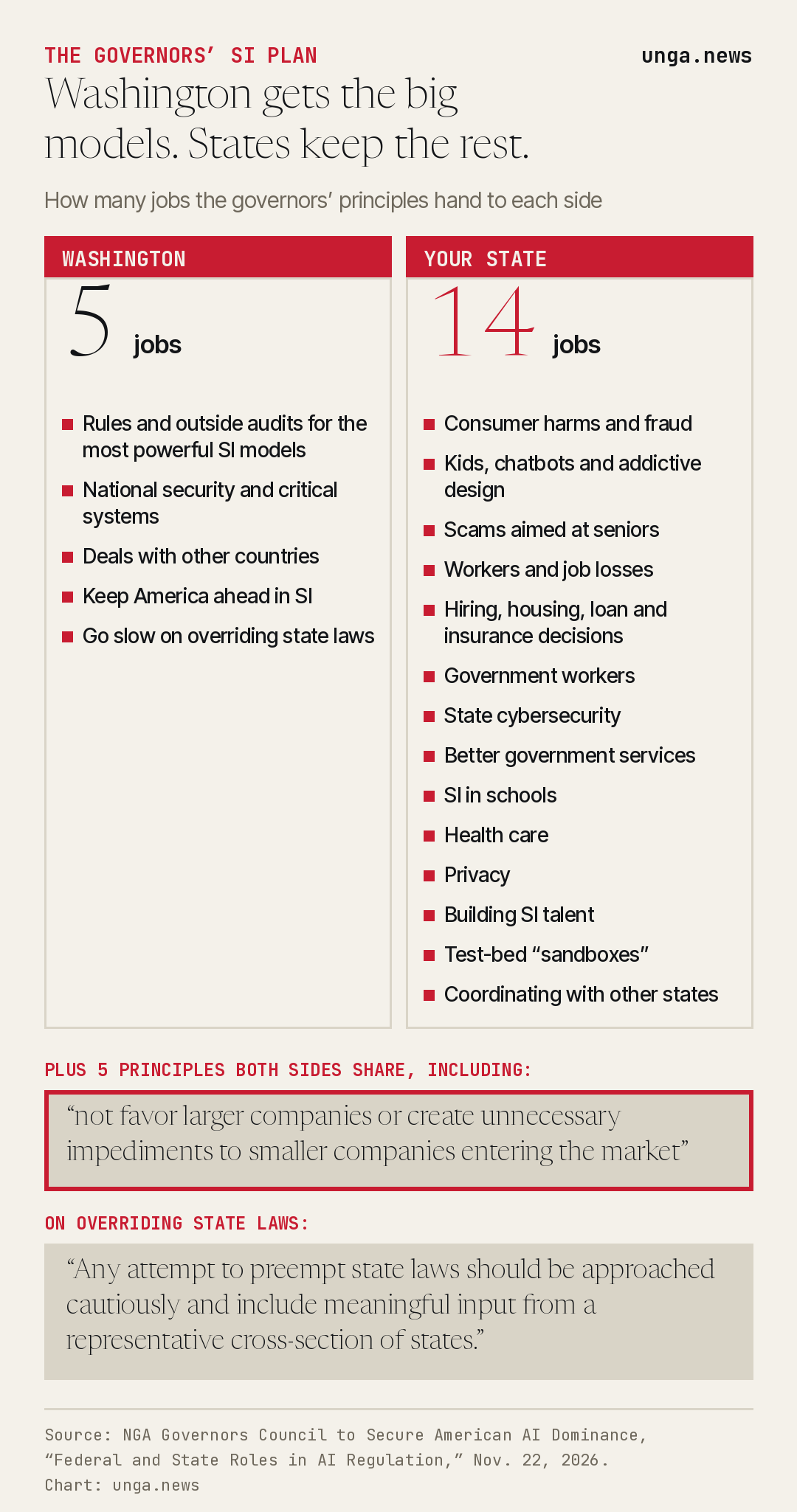
The states keep the jobs closest to home: fraud and impersonation, scams aimed at older Americans, kids and “companion applications,” workers facing job changes, privacy, SI in schools, health care and state cybersecurity. The plan also says states should decide how SI is used in their own government offices.
Kids, scams and the little guy
Conservatives will find a lot to like here. The plan puts protecting children from “addictive design, chatbots and companion applications” in the hands of the people closest to families, not a federal agency. It goes after SI-powered scams, with “particular attention to older adults.” And one line could have been written by a small-business owner tired of watching Big Tech write the rules: laws should “not favor larger companies or create unnecessary impediments to smaller companies entering the market.”
There’s a reason that matters. Heavy rulebooks are cheap for trillion-dollar companies with armies of lawyers and deadly for the startup in a garage. The governors also tell states to look at “sandboxes,” test zones where new SI tools can be tried under lighter rules. Utah built one of the first in 2024 with its own SI policy office and learning lab, and Cox signed that law.
Braun framed the whole thing around jobs and paychecks. “Artificial intelligence has great potential to generate economic growth, create more high-quality jobs, increase wages and make government services more efficient,” he said. “Both the federal government and the states have a responsibility to promote innovation and protect the public from harm, and this framework strikes the right balance to ensure both succeed.”
Cox went straight at the false choice Washington likes to sell. “We don’t have to choose between innovation and safety,” he said. “Governors are ready to work with Congress and the White House on a national AI strategy.”
Closer to the White House than the headlines suggest
The Trump White House laid down its own marker back in March. Its National Policy Framework for Artificial Intelligence asked Congress for “a minimally burdensome national standard” instead of “fifty discordant ones,” so a patchwork of state rules can’t slow America down in the race with China. That framework also respects federalism. It leaves states their police powers to protect children, prevent fraud and protect consumers, their zoning authority over data centers, and full control over their own use of SI.
Line those carve-outs up against the governors’ state list and much of it matches: kids, fraud, consumers, government use. Both sides want one national approach to the biggest models. Where they part is on how far the override reaches. The White House says states should not regulate SI development at all because it is “an inherently interstate phenomenon with key foreign policy and national security implications.” The governors want a seat at the table before any state law gets wiped out. That’s a negotiating gap, not a war.
The fine print worth watching
Not every line will sit well on the right. The state list calls for safeguards on SI used in “housing, employment, lending, insurance and access to essential services,” including rules on “unlawful discrimination.” That is the same territory as Colorado’s 2024 SI law, which the state ended up delaying after businesses, and even Democratic Gov. Jared Polis, raised alarms about its cost and reach. Rules like that can turn into a paperwork machine fast. The plan also mentions “applicable collective bargaining obligations” for public workers, language public-sector unions will welcome.
The plan itself admits it is a starting point. It writes no law, sets no deadlines and doesn’t define which models count as frontier. NGA chief executive Brandon Tatum said “no federal AI policy will be effective without governors’ input,” and the council says it will keep working with every state and territory on common definitions and standards.
Still, the shape of the deal is visible now. Washington handles the handful of giant models that could touch national security. States handle the scam call to Grandma, the chatbot talking to a 13-year-old and the small company trying to compete. For a party that has preached the Tenth Amendment for decades, that’s a framework Republicans can work with, and two Republican governors helped write it.
Sources
- National Governors Association — Governors Call for AI Action (press release, Nov. 22, 2026)
- National Governors Association — Federal and State Roles in AI Regulation: Governors Council to Secure American AI Dominance Working Group Statement of Principles (Nov. 2026)
- The White House — National Policy Framework for Artificial Intelligence: Legislative Recommendations (Mar. 20, 2026)
- Bloomberg Law — Governors Call for Federal AI Rules Without Sidelining States (Nov. 22, 2026)