

Hackers Broke Into 1Password and Took Customers’ Emails. Your Saved Passwords Stayed Locked.
An attacker hijacked one 1Password employee’s work account and copied customer names and sign-in emails. The company says nobody’s vault was touched, but customers should watch for fake 1Password emails.
If you use 1Password, the company that guards the logins of millions of people and more than 200,000 businesses, the first thing to know is that your passwords were not stolen. The second thing is that a hacker now has a list of customer names and the email addresses they use to sign in. That list is exactly what scammers want.
1Password confirmed the break-in Wednesday in a post on its own blog. The company said that on Nov. 19 it began investigating signs that an attacker had taken over one employee’s corporate GitHub account. GitHub is the service where software companies store and share their code. With that one account, the attacker read 1Password’s source code and then pushed malicious code into the company’s backend systems. That planted code downloaded what 1Password calls “administrative data” about a subset of its customers.
The company didn’t say how many customers were in that subset, how the employee’s account was taken over, or how long the intruder was inside before anyone noticed. TechCrunch, which reported the breach Wednesday, said 1Password didn’t answer those questions right away.
1Password on 𝕏 — update on a security incident involving some of its backend systems; no customer vault content or the keys that protect it was affected
— @1Password View on 𝕏
The list the hacker walked away with
Here is what 1Password says was copied: customer names and sign-in email addresses, account and user ID numbers, the dates accounts were created and last used, public keys, some sign-in protocol settings, and other internal account details. The attacker also copied code from private company repositories and got into the system 1Password uses to build and ship its software. The company said that system holds infrastructure passwords and keys, and it has rotated every one that could have been exposed.
The piece that matters most for regular users is a set of tokens. When 1Password emails someone an invitation to join an account, or a link to recover a locked-out account, that email carries a token. Some of those tokens were in the stolen data. 1Password says a token can’t open an account by itself. It only works alongside a company single sign-on login or a six-digit code sent to the user’s email. The company said only a small number of users had invitations or recoveries in progress during the incident, and they’ve been notified directly.
To be safe, 1Password stretched those emailed codes from six numbers to 10 letters and numbers. That sounds minor. It isn’t.
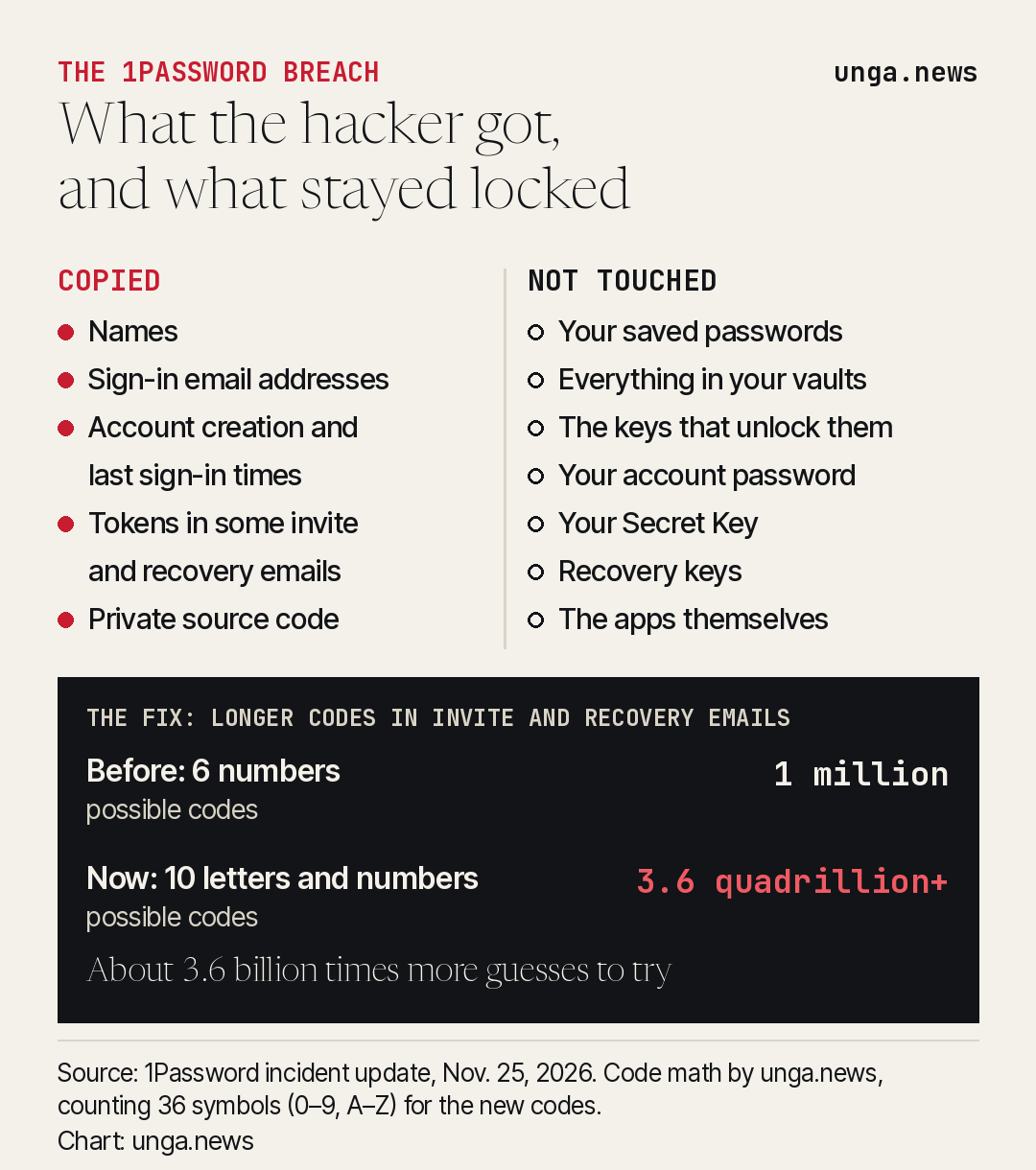
A six-digit code has 1 million possible combinations. A 10-character code using just the digits and the 26 letters has more than 3.6 quadrillion. That’s roughly 3.6 billion times more guesses a crook would have to try, which is why the company says brute-force guessing is now “practically impossible.” 1Password also said it found no sign that anyone used the stolen tokens to take over an account.
Why the vaults held
This is where 1Password’s design earned its keep. Your vault, the encrypted locker that holds your passwords, credit card numbers and notes, is scrambled with keys that only you hold. 1Password never stores your account password or the 34-character Secret Key it gives every user, so the company can’t open your vault, and neither can a hacker who gets onto its servers. “1Password is designed so that a breach of our systems can’t expose your vault contents,” the company wrote.
That isn’t a small thing. When LastPass, a rival password manager, was hacked in 2022, the attacker walked off with copies of customers’ encrypted vaults, according to LastPass’s own notice. Those vaults were still locked, but anyone with a weak master password had to worry that crooks could crack it offline at their leisure. Nothing like that happened here. The vaults never left, and the keys were never on 1Password’s servers to begin with.
It’s also a good argument for strong encryption that nobody holds a spare key to. Every so often a government official somewhere asks tech companies to build a back door into this kind of protection “just for the good guys.” A breach like this shows why that’s a bad trade. If 1Password had kept a master key for every vault, the person who hijacked one employee’s account would have had a shot at it.
The scam emails are the real danger now
The real risk going forward is in your inbox. Somebody now knows that you, by name and by email address, use 1Password. That’s everything a scammer needs to write a convincing fake. Expect emails, texts or calls that look like they come from 1Password and talk about an account invitation, a recovery request or a “security problem” that needs your password right now.
1Password’s advice is blunt. It will never contact you to ask for your account password or Secret Key. Only type them into the official app, or into the website after you’ve typed the address yourself. Your Secret Key is only needed the first time you sign in on a new device or browser. If an email asks for it out of the blue, it’s fake. Suspicious messages can go to support@1password.com.
The company said you don’t need to change anything in your account, and its apps and browser extensions are working normally. It disabled the hijacked GitHub account, revoked the stolen access, tightened controls on its code and build systems, added new alarms for this kind of attack, and brought in outside security experts to check its cleanup. It also promised to keep its blog post updated if anything changes.
For a company founded in 2005 whose whole business is trust, this is an uncomfortable week. The intruder got in the way so many do now, through one person’s work account, and still came away without the thing that matters most. The vaults stayed locked. Now customers have to make sure they don’t unlock them for a stranger who sends a convincing email.
Sources
- 1Password — Update on a security incident involving 1Password’s backend systems (Nov. 25, 2026)
- 1Password on 𝕏 — 1Password on 𝕏 — update on a recent security incident involving some backend systems
- TechCrunch — 1Password said hackers broke into its internal systems, but customer passwords are safe
- 1Password Trust Center — 1Password backend systems (November 2026)
- 1Password — Company page: 200,000+ businesses, founded 2005
- LastPass — Notice of Recent Security Incident (Dec. 22, 2022)