

Hackers Just Posted Thousands of Chase, Visa and Mastercard Customers’ Emails and Phone Numbers
A gang called n0n dumped the files after its deadline ran out. The companies say no card numbers were taken and an outside marketing vendor was the weak spot.
A hacking crew called n0n has posted the names, email addresses and some phone numbers of thousands of JPMorgan Chase, Visa and Mastercard customers online. The files went up Thursday after a 48-hour deadline the gang set for the companies ran out. None of the three says a card number was taken, and all three blame outside vendors, not their own systems.
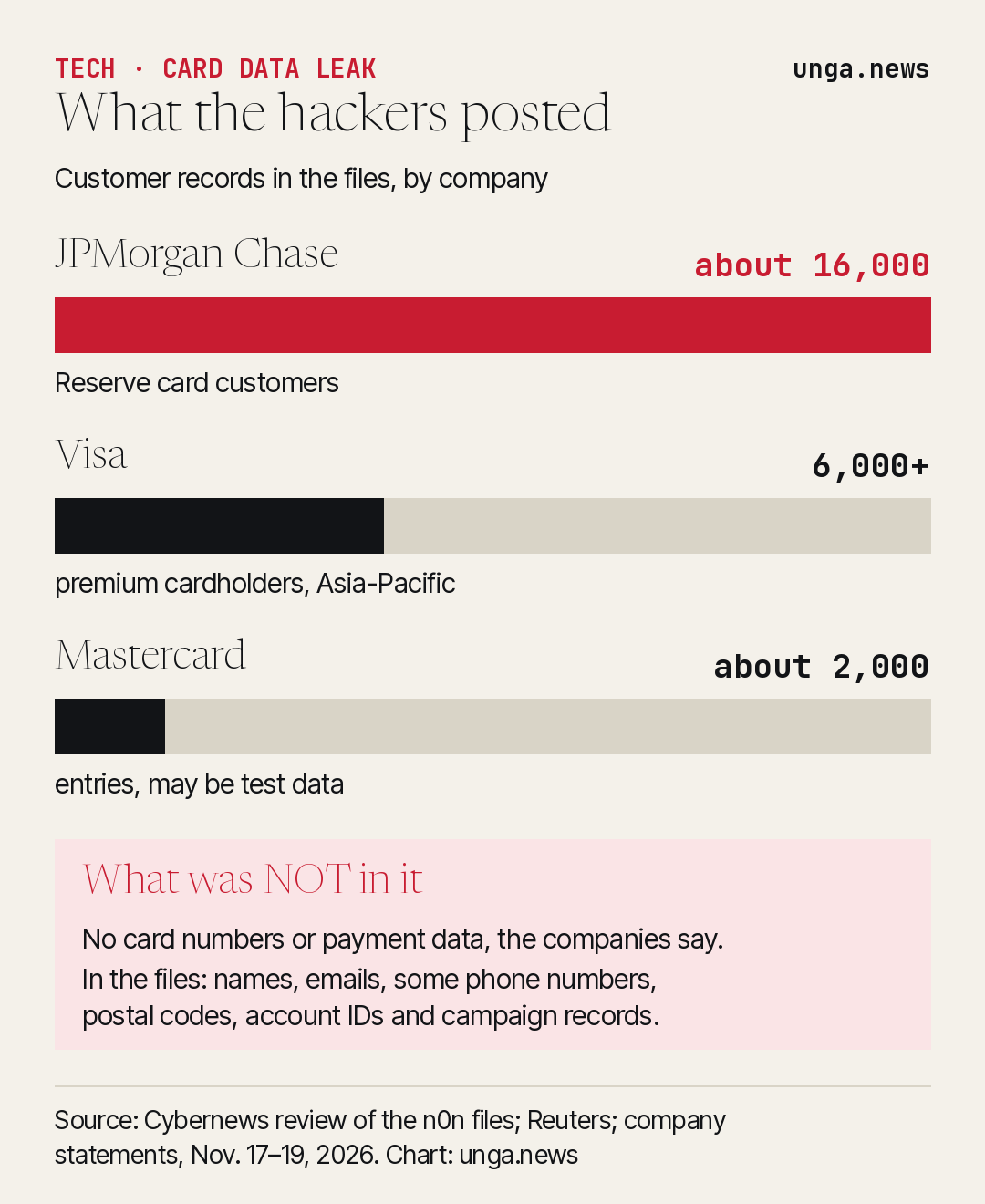
The Chase file is the one that stings. Cybernews, which went through the data, counted about 16,000 customer email addresses, some with phone numbers and account IDs, and all of them appear to belong to holders of the JPMorgan Reserve card. Newsweek reported that the invitation-only card is usually offered to clients with at least $10 million in assets at the bank. In plain terms, somebody just handed scammers a contact list of some of the richest customers at America’s biggest bank.
What the banks are saying
JPMorgan put out a short statement Thursday. “Based on our investigation so far, we believe the attackers accessed certain marketing data held by those vendors, which may include some customer names and email addresses,” a spokesperson told Reuters. The bank said it will contact affected customers directly. It also said the attack had “no connection” to the service problems some customers hit earlier this week, which Reuters reported came from a software bug that also tripped up other banks.
Reuters did its own review of the Chase file and found more than 16,000 customer email addresses, some with phone numbers and postal codes, plus what appear to be 124 bank employee email addresses. Reuters said it could not independently verify that the data is real, and JPMorgan declined to comment on the files themselves.
Visa said the claims tied to it are “associated with an incident involving a third-party service provider in Asia Pacific.” The company added: “Visa’s systems were not involved and were not impacted. No payments data such as card numbers were affected.” Cybernews counted more than 6,000 premium Visa cardholders in that set, apparently pulled from a marketing platform for dining and loyalty perks. The records Reuters reviewed covered customers in Hong Kong, Taiwan, Korea, Japan, the Philippines, Singapore, Malaysia, Australia and Macau.
Mastercard said it was recently told of an incident “at a third-party provider that resulted in the exposure of limited amount of email addresses — non-payments information — from a small subset of cardholders enrolled in a specific benefit program.” It said there is “no impact to the Mastercard payment network or the ability for people to use their cards.” Cybernews counted only about 2,000 badly formatted Mastercard entries and said they may be test data.
One vendor, three victims
No company has named the vendor, and none has said how many customers it will notify. But the three leaks look like they came from the same place. Cybernews researcher Aras Nazarovas found the same file layouts and formatting in all three sets and said they appear to have been taken from a single third party. Visa points to one provider in Asia-Pacific. JPMorgan talks about vendors, plural.
That fits how n0n seems to work. The gang first named Visa, Mastercard and JPMorgan on Nov. 16, according to a screenshot captured by the cybercrime tracker eCrime.ch and cited by Reuters. In that post, n0n claimed “hundreds of thousands of campaign interactions for tens of thousands of distinct cardmember email addresses.” That is a lot more than what showed up Thursday, which means the crew may be sitting on more. Earlier this month, Expedia, another name on n0n’s list, said attackers got in through a third-party data provider, according to Skift.
Reuters reported the group has claimed roughly 200 incidents since it showed up in September. Ransomnews, which tracks extortion sites, has logged 393 n0n entries since Sept. 18, many of them numbered placeholders with no company name attached. The Chase entry itself sat on the site for a week as “Company #150” before the gang put the bank’s name on it.
A crew that left its own door open
For a gang hitting household names, n0n has been sloppy. In September, researchers at the threat-intelligence firm SOCRadar found one of its operators running an exposed file server that anyone on the internet could browse. Inside were 1,719 files, including attack scripts, ransomware code and the crew’s extortion setup.
The files showed the operator leaning on an SI coding helper to write and fix hundreds of attack scripts, with more than $7,216 spent on model access by Oct. 22. SOCRadar was clear that a human was running the show, writing that “the evidence points to a human-directed operation supported by AI; no fully autonomous attack system was observed.”
The break-ins themselves were old-fashioned. “In every documented compromise in this investigation, access relied on weak or stolen credentials,” SOCRadar’s chief information security officer, Ensar Seker, told The Register. No fancy exploit, just passwords somebody reused or left lying around. Nothing published so far shows how the gang got into the card vendor, though.
If you carry one of these cards
Nobody is saying your card number is out there, and the companies say payments are working normally. The real risk is the phone call or email that comes next. A scammer who knows your name, your card program and your cell number can sound a lot like your bank. Chase says it will reach out to affected customers itself. If someone contacts you about this, hang up and call the number on the back of your card, or open the bank’s app on your own.
Carissa Robb of the consulting firm SolomonEdwards put the bigger problem simply to Reuters: “Customers don’t distinguish between a bank and a vendor when it comes to a cyberattack.” She said companies need to look harder at how much customer data they share with outside firms and whether those firms need it at all. For the wealthy Reserve cardholders now on a hacker’s list, that question is no longer theoretical. Their bank never got hacked. A marketing contractor did, and their phone numbers went with it.
Sources
- Reuters — JPMorgan, Visa, Mastercard say third-party vendors targeted in cyberattack
- Cybernews — Hackers leak Visa cardholders’ data after company confirms cyber incident
- ABC News — JPMorganChase, Mastercard, Visa report cyberattack on third-party service providers
- AP — A cyberattack leaks thousands of Chase customer emails and some phone numbers
- Ransomnews — n0n leaks Visa, Mastercard and JPMorgan customer data
- SOCRadar — n0n Ransomware: Inside an AI-Assisted Extortion Operation
- The Register — Crim spent $7K+ on AI services in extortion attacks, then left evidence for all to see