

Hackers Slipped Card-Stealing Code Onto CNN, Zoom and BBC Websites Through One Hidden Tool
A flaw at a website-testing company let attackers plant code on 178 major sites that skimmed cards, hijacked crypto payments and went after iPhones. Here’s what to check.
On Sunday night into Monday, people who visited CNN, Zoom, the BBC, IKEA, HSBC or Salesforce may have pulled down a piece of code built to rob them. They did nothing wrong. They didn’t click a shady link or download anything. They simply loaded a page from a brand they trust, and the page quietly ran a script that hunted for credit card numbers, swapped out cryptocurrency addresses, and on older iPhones tried to break into the phone itself.
The code didn’t come from those companies. It came through Optimizely, a tool big websites use to test different versions of a page on live visitors. Security researcher Scott Helme of Report URI checked 1,611 Optimizely scripts on Monday and found attack code in 188 of them, belonging to 178 organizations. His list reads like a tour of the internet: Zoom, the BBC, CNN, Salesforce, GitLab, IKEA, HSBC, Equifax, Air France-KLM, Ledger and Peacock. BleepingComputer confirmed the script loaded or tried to load on more sites, including Fox News, Mutual of Omaha, American Eagle, Change.org, Bitly and UNICEF USA. Helme says the real count is probably higher, because he could only check the scripts he found in time.
One weak door, hundreds of front pages
Optimizely’s own incident report, released Tuesday, spells out how it happened. An outsider found a flaw in the account signup process for Optimizely Web Experimentation. That flaw let them pose as administrator users on customer accounts without ever knowing their passwords. Once inside, they pasted their own code into a field called Project JavaScript, the box where a customer drops custom code that runs every time its pages load.
That is what made this so nasty. The poisoned code was served from Optimizely’s own servers, carrying Optimizely’s own security certificate, inside a file each website had deliberately invited onto its pages. To a browser, it looked exactly like the normal thing it was supposed to load. Even Optimizely’s main site and login page carried it.
The company says this was not a password breach and that no customer passwords were exposed. By its timeline, the first fake account was created early Monday, the first malicious code was written about seven hours later, and Optimizely spotted the activity roughly six hours after that. It blocked the attacker’s outbound code, closed the hole, and had the injected code out of every affected project before the day ended. It has hired Mandiant, Google’s incident-response firm, to investigate.
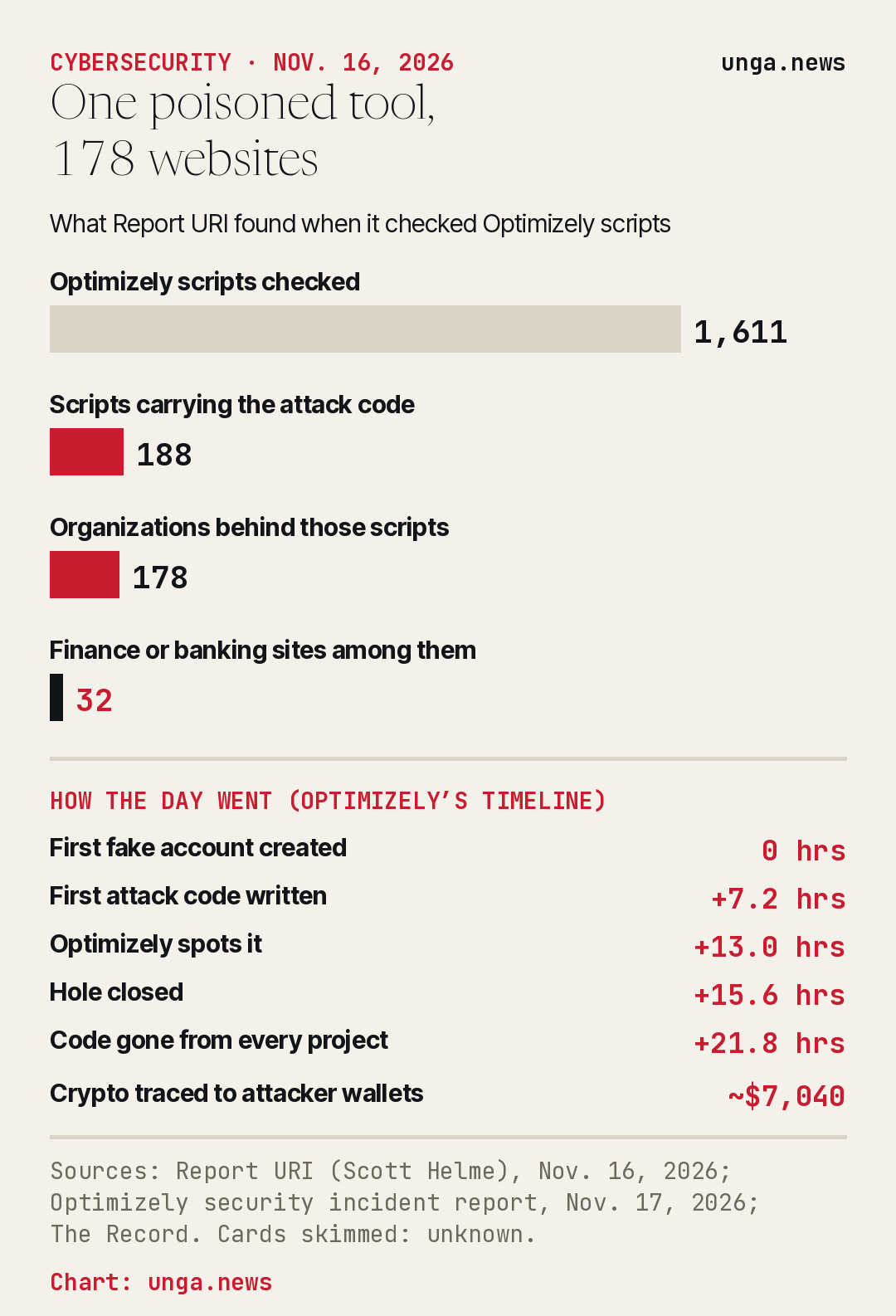
Report URI’s data suggests the attacker may have been at it a little earlier than the company’s first timestamp. Helme’s team first saw injected code in the BBC’s script several hours before Optimizely’s first logged write, and he says the same actor had already planted an earlier loader through other website tools late last week, after first showing up on Turkish sites in September.
Four ways to get robbed on one page
The payload, a file named track.js, did four jobs at once. It scanned pages for wallet addresses in nine cryptocurrencies and replaced them with the attacker’s, so a deposit or a payment went to the wrong place. According to StepSecurity’s analysis, it even rewrote addresses on the clipboard, which means copying and pasting from an infected page was no protection.
It also skimmed cards. When a site’s own form sent a card number, expiration date and security code together, the script shipped all three to the attacker’s server. When it swapped an address near payment wording, it grabbed the visitor’s cookies and a screenshot of the page too.
The fourth job was the scariest. On iPhones and iPads, the code pulled in two known hacking kits that researchers call Coruna and DarkSword. Coruna goes after iOS 13 through 17, and DarkSword goes after iOS 18. On iOS 26, the code only collected details about the device. For part of the afternoon, the attacker even added a hidden frame that reloaded affected pages every 60 seconds to keep retrying the iPhone attack.
How much did they get? Report URI traced about $7,040 in crypto into the attacker’s wallets within roughly nine hours, though StepSecurity notes some of those wallets were active before the attack, so not every dollar is proven to come from victims. The bigger unknown is cards. Helme told The Record that he has no way to see “how many credit cards were skimmed, how many cookies or screenshots were stolen, or how many iOS devices were infected before the attack was stopped.” Thirty-two of the sites were finance or banking companies.
What you should actually do
There is real good news buried in the details. Cards typed into hosted payment boxes from processors such as Stripe or Adyen were out of the script’s reach, because those boxes run separately from the store’s page. Optimizely says sites with a strict security policy blocking outside scripts were protected too. The danger was on sites that built their own card forms.
So if you bought something online Sunday night or Monday, pull up your card statement this week and look for anything you don’t recognize. If you sent crypto that day, check that it landed at the address you intended. And update your iPhone. The kits’ own notes, according to Report URI, mark iOS 18.7.3 and later and iOS 26.3 and later as patched. If your phone is a few versions behind, this is the push to fix that.
Salesforce told BleepingComputer it has switched off Optimizely scripts across its sites while it investigates. Other companies on the list have a harder job ahead: figuring out which of their pages loaded the bad script, for how long, and which customers typed a card in during that window.
The lesson for every big company is uncomfortable. You can lock down your own servers and still get burned by the third-party tool you let run on your homepage. Millions of people trusted those brands on Monday, and a signup bug at a vendor most of them have never heard of turned that trust into an attack surface.
Sources
- Report URI (Scott Helme) — World’s Largest Brands Infected With Malware Via Optimizely
- Optimizely — Security Incident Initial Report for Customers – Optimizely Web Experimentation (Nov. 17, 2026)
- BleepingComputer — Optimizely hack infected CNN, Fox News, BBC, Salesforce sites with malware
- The Record — Website management platform Optimizely confirms hackers put malicious code into customer sites
- StepSecurity — OPTIMJACK: Optimizely-Hosted Scripts Loaded a Crypto Clipper and Card Skimmer on 178 Organizations
- Ars Technica — Hundreds of websites deliver potent malware cocktail to unsuspecting visitors