

Hackers Tied to North Korea Slipped Malware Into 7,600 Coding Projects Under the Owners’ Own Names
The worm steals a programmer’s access, rewrites their old work to hide the poison, and reads its marching orders from the crypto blockchain so nobody can unplug it.

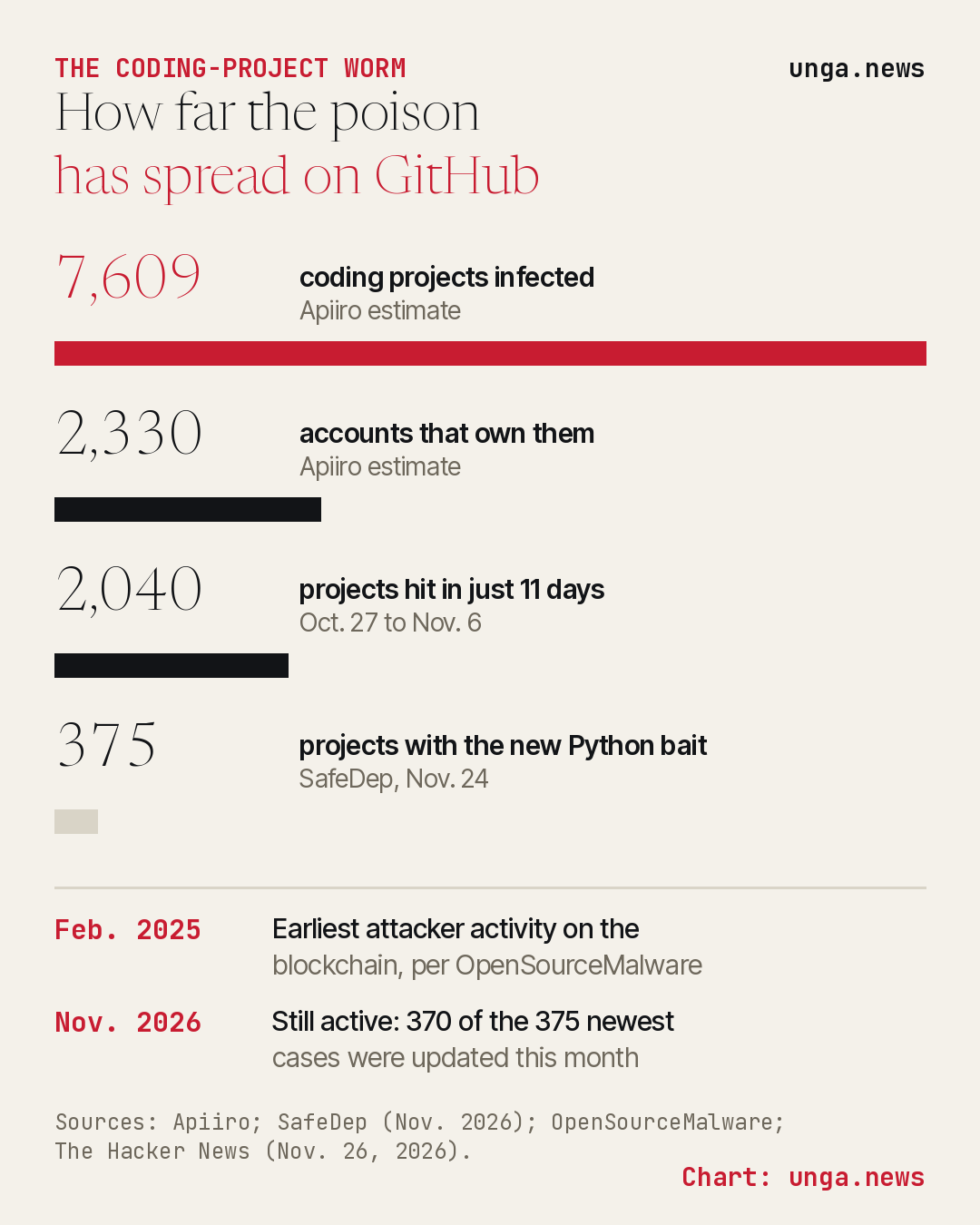
If you write code for a living, or you just tinker with it on weekends, here’s a Thanksgiving gift you didn’t want. Security researchers say a hacking campaign tied to North Korea has quietly planted malware in at least 7,609 coding projects on GitHub, the site where most of the world’s software gets built and shared.
The scary part isn’t the number. It’s the method. The hackers don’t just upload bad code under some fake name. They steal a real developer’s access, then rewrite that developer’s own past work so the poison looks like it was there all along, signed with the owner’s name, message and date.
Researchers call the campaign PolinRider. The newest wave was confirmed this week by SafeDep, a software supply-chain security firm, and laid out on Thursday by The Hacker News.
Your own name on the poison
The 7,609 figure comes from Apiiro, another security company, which counted infected projects owned by 2,330 accounts, most of them belonging to developers. About 2,040 of those projects were hit in just 11 days, from Oct. 27 to Nov. 6. Victims named so far include the open-source app framework Neutralinojs, the WordPress tool InstaWP Connect and the digital art platform fxhash.
“The worm uses stolen GitHub access to rewrite commits the developer already made, keeping the author, message and date, and adds a loader hidden after hundreds of spaces in a build config,” Apiiro researcher Shmulik Cohen said. “Building the project runs it. In the newest wave, opening the folder in VS Code is enough.”
Read that last line again. In the newest version, a programmer doesn’t have to run anything suspicious. Opening the project folder in one of the most popular code editors on earth can be enough to set it off.
Once it runs, the hidden code reaches out for a second, bigger payload. According to The Hacker News, that payload scans the computer for developer apps like GitHub Desktop, VS Code and Cursor, then tampers with the ones used most so the attackers’ code keeps running. Earlier waves installed a stealer that grabbed saved browser passwords, cookies, secret keys and crypto wallet data. Those stolen GitHub keys are how the worm jumps to the next victim.
A server you can’t unplug
SafeDep’s report, dated Nov. 24, found a new 58-line Python version of the bait in 375 public projects under 260 accounts. It hides in a small file called conftest.py, which runs automatically whenever a developer tests their code, or in a helper folder named utils.
The clever part comes next. Normally, police and security teams fight malware by finding the hackers’ command server and getting it shut down. PolinRider doesn’t write its server address into the code at all. It reads the address out of transactions on the Ethereum blockchain, the public ledger behind the second-biggest cryptocurrency.
Nobody can delete a blockchain transaction. So when one server gets knocked offline, the hackers just send a new transaction pointing to the next one. “Taking a server down changes nothing,” Cohen said. “One transaction moves every loader to the next.”
SafeDep found that the wallet it tracked sent eight transactions to itself between Oct. 24 and Nov. 11. The newest carried a 31-kilobyte chunk of hidden code. Of the 375 infected projects it found, 370 had been updated in November, which means this is live, not history.
The good news, such as it is: SafeDep found no trace of the bait in the big public package stores, PyPI and npm, that millions of programs pull from. And when the same crew tried to sneak it into a well-known open-source project, AsyncAPI Generator, through pull requests in October, the volunteer maintainers caught it and merged nothing.
They earned that win the hard way. A GitHub account called Eternity0207 opened more than 200 pull requests against open-source projects. “Each time, the payload stayed on the branch for 30-40 minutes and was then force-pushed away, so the final diff looked clean,” AsyncAPI’s maintainer said. GitHub has since suspended the account.
Older than anyone knew
Researchers at OpenSourceMalware say they traced a PolinRider attack back to May 2025, eight months before the earliest victims anyone had documented. A hijacked maintainer account pushed poisoned versions of nine software packages inside 90 minutes. “The blockchain records behind it date attacker activity back to February 2025,” researchers Paul McCarty and Jenn Gile said.
The same crew also runs fake job scams. The Hacker News described bogus hiring sites like HuntRole and AccuraSoftHire that hand programmers a “take-home assessment” laced with malware, or tell them their webcam won’t work for a video interview until they install a “driver.” That’s a cruel trick to pull on people looking for work.
Researchers say PolinRider runs alongside Contagious Interview, a long-running fake-recruiter operation that security firms have tied to North Korea. SafeDep itself doesn’t name a country, and nobody in the U.S. government has publicly pinned this specific wave on Pyongyang yet. But the playbook fits a regime that has made stealing from Western tech workers a business model.
Palo Alto Networks’ Unit 42 put it bluntly last month: “North Korean state-sponsored threat actors use open-source software registries as a primary initial access vector targeting corporate environments.” And the FBI has already publicly blamed North Korea for the roughly $1.5 billion theft from the crypto exchange Bybit in February 2025, the largest crypto heist on record.
That’s the real stake for regular Americans. The apps on your phone and the websites you use every day are stitched together from free, open-source code written by volunteers and small shops. When a hostile dictatorship can slip its code into that pipeline under an honest programmer’s name, every company that pulls from it inherits the risk.
If you code, the researchers’ advice is simple. Look for strange conftest.py files or utils folders you didn’t write, and lines padded with hundreds of blank spaces in build settings. Be suspicious of any project from a “recruiter” you’ve never met. And if your machine might be infected, assume your GitHub keys are burned. Revoke them and make new ones from a clean computer.
For everybody else, give a little credit to the unpaid volunteers who caught this crew in the act and slammed the door. They’re the front line nobody thanks.
Sources
- SafeDep — PolinRider Moves to Python with an Ethereum Calldata Loader (Nov. 2026)
- SafeDep — List of affected repositories and loader files (CSV)
- Apiiro — PolinRider: North Korea-Linked Worm Forges GitHub Commits
- The Hacker News — North Korea-Linked PolinRider Poisons Over 7,600 GitHub Repositories to Spread Malware (Nov. 26, 2026)
- FBI Internet Crime Complaint Center — North Korea Responsible for $1.5 Billion Bybit Hack (Feb. 26, 2025)