

Hackers Used a Chinese Router Maker’s Own Cloud to Plant Backdoors on Customers’ Routers
GL.iNet says the hole is closed, but infected devices stay infected. One firm found trouble on 152 of the 183 routers it checked.

A lot of people buy a small travel router so they don’t have to trust the hotel Wi-Fi. This week some of them found out the router itself was the problem. GL.iNet, the Shenzhen-based maker of popular pocket routers and remote-control boxes for computers, confirmed that hackers got in through the company’s own cloud service and planted malicious software on customers’ devices.
The company put it plainly in its Nov. 20 security notice: “An unauthorized party exploited the vulnerability to access and install malicious software on some GL.iNet routers and KVM devices.” A KVM is a little box that lets you control a computer from somewhere else, keyboard, mouse and screen included. If the hacker owns the box, the hacker may be able to reach the computer plugged into it.
GL.iNet says it fixed the cloud hole and blocked the access used in the attack, so devices can’t be newly infected that way. Then comes the line every owner should read twice: “These measures do not remove malware from devices that were already infected.” Stable firmware with security fixes for both routers and KVMs was scheduled for Sunday, Nov. 22.
The remote-control feature was the way in
GL.iNet sells convenience. Its GoodCloud service lets owners manage routers and KVMs from anywhere, without being on the same network. That same reach is what the attackers rode in on. The company hasn’t said exactly how the flaw worked, how many customers were hit or whether anything was stolen from infected devices.
Outside researchers have filled in some of the blanks. BleepingComputer reported Sunday that RemoteToHome Consulting found a likely weak spot in the GoodCloud software on the router, in a piece tied to a networking feature called AstroWarp. According to the researchers, it took values sent down from the cloud and dropped them into system commands that ran with full administrator power, without checking them first. GL.iNet hasn’t confirmed that this is the flaw the attackers used.
RemoteToHome then checked 183 GL.iNet routers it owns or manages. It found suspicious activity on 152 of them. On 24, attackers had live, top-level remote control. On 47, it found an older hidden backdoor. On 81, there was evidence that commands sent by an attacker had already run.
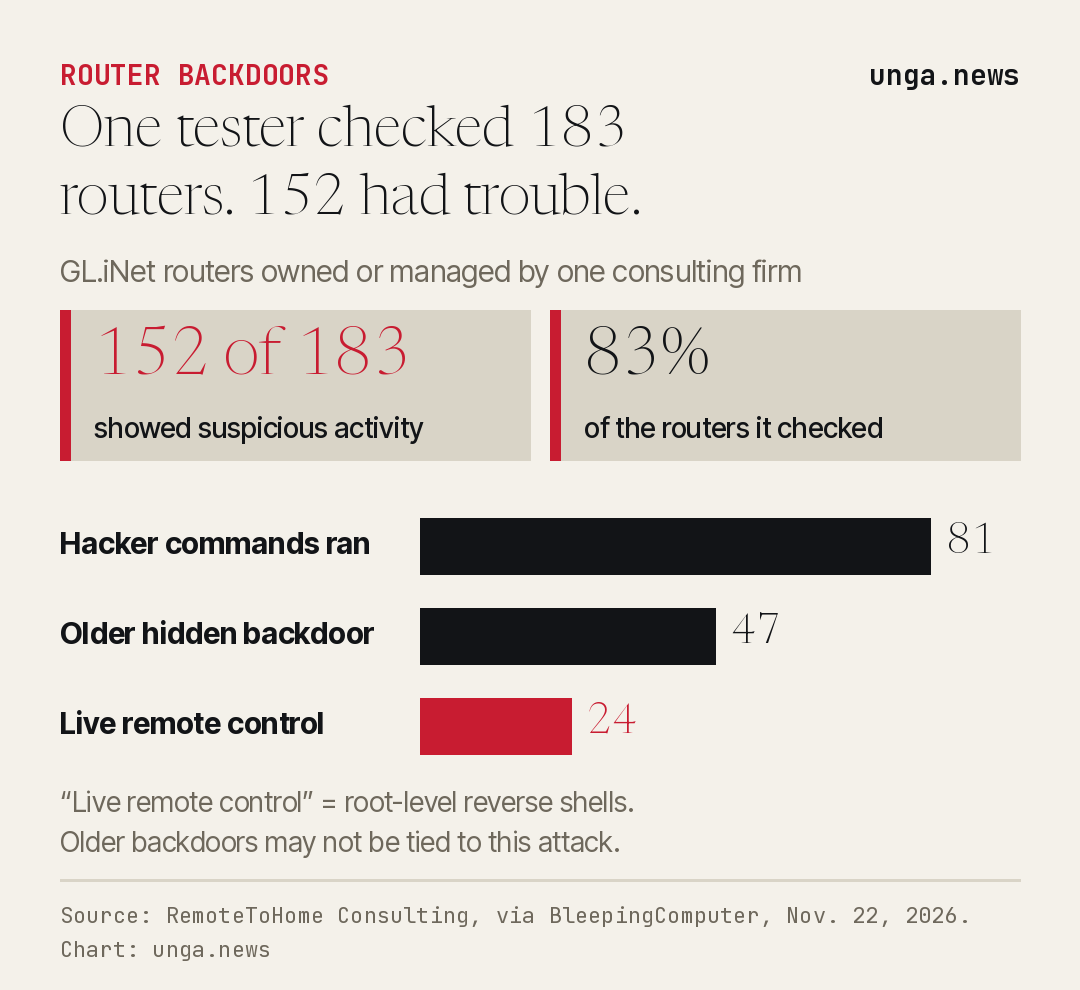
The firm cautions that its numbers may not match what other customers see, and that the older backdoor may not be connected to the November attack. Even so, 152 out of 183 is not a rounding error.
Code built to hide, with Chinese notes inside
BleepingComputer got a copy of the installer script and took it apart. It was written for GL.iNet hardware specifically. It recognizes many of the company’s models, downloads two programs named gl-helper and gb, and sets itself up to restart after a reboot. It disguises itself under the same harmless-looking process name GL.iNet told customers to hunt for. It even swaps out a standard network tool with a doctored version that hides the connections to one of the attackers’ servers, so an owner checking their own router would see nothing wrong.
The script also carries developer comments written in Chinese, describing how it stays hidden, reports back and talks to GL.iNet’s cloud software. BleepingComputer says that points to a Chinese-speaking author. Nobody has tied the attack to the Chinese government, and we won’t claim it. But Americans have heard for years that the gadgets sitting between their families and the internet deserve a hard look at who builds them and who can reach into them. Washington spent years pulling Huawei and ZTE gear out of American networks for that reason.
One owner of a compromised GL.iNet KVM shared logs showing the box downloaded the script on Nov. 19, then began talking to about 1,800 home internet addresses a day and kept contacting a cryptocurrency network’s servers. What that traffic was for is still unknown. Some infected files carried dates going back to December 2025, which raises the possibility that some devices were compromised for months, though it’s not clear the same crew was behind them.
Check it tonight, and don’t trust the quick test alone
GL.iNet’s notice walks owners through a check. On a router, sign in to the admin panel, open the advanced LuCI settings, go to the list of running processes and search for “crond -i /tmp/.log.” On a KVM, the company gives a terminal command for each model. If that text shows up, treat the device as infected. Install the security update, or reset the device to factory settings and set it up fresh. Either way, install the stable security firmware for your model as soon as it’s out.
Don’t stop there if you depend on it. Owners on GL.iNet’s own forum warn that the official check can miss infections, including other backdoors and remote-control shells. The company now links to a community-built scanner that looks deeper, though even its developers say it can’t catch everything and that malware hiding in saved settings can survive an ordinary update. The safer route, from the scanner’s developers and BleepingComputer, is to reinstall the firmware without keeping your old settings, change any passwords and access keys the device touched, and scan any computer that was plugged into an infected KVM.
And if you don’t need to manage the thing from across the country, turn the cloud feature off. A router you can control from anywhere is a router somebody else might control from anywhere too. GL.iNet says it will email the customers it identifies as affected at the address tied to their cloud account. If you own one, don’t wait for that email.
Sources
- GL.iNet — GL.iNet Security Notice 2026-11-20: Router and KVM Security Incident (updated Nov. 21, 2026)
- BleepingComputer — Hackers exploit GL.iNet cloud flaw to infect routers, KVM devices (Nov. 22, 2026)
- GL.iNet — About Us