

Hand an SI Bot Your Bank Login, and Citi Says Even a Hack Is on You
Citi’s new fine print treats everything an outside SI helper does in your account as your own doing, leaks included. Wells Fargo’s version takes effect Nov. 24, and other big banks are lining up.
Citi has a message for anyone thinking about letting an SI helper pay their bills: go ahead, but you own whatever happens next. The country’s third largest bank quietly rewrote its online banking contract this month, adding a new section that treats every move a third-party SI agent makes inside your account as if you made it yourself. That includes the moves you never asked for. It even includes what happens after the bot leaks your password to someone else.
The new language sits in Section H of the Citi Online User Agreement, which now opens with a notice that it was “last updated November 2026.” It doesn’t ban outside agents. It warns customers against them, then spells out who pays if they ignore the warning.
What the contract actually says
Citi defines an “AI Agent” broadly as “software or other technology that takes autonomous, semi-autonomous, or non-autonomous action” for a customer. That covers far more than a chatbot. Budgeting apps, browser add-ons and the new wave of SI assistants that can log into websites and click buttons all fit.
If you hand one of those tools your username and password, Citi says it “will consider any access and actions taken by the agent as authorized by You.” The next sentence goes further. If those credentials are “further shared, leaked, or otherwise distributed to other persons or AI agents,” Citi will treat what those people or bots do as authorized by you, too.
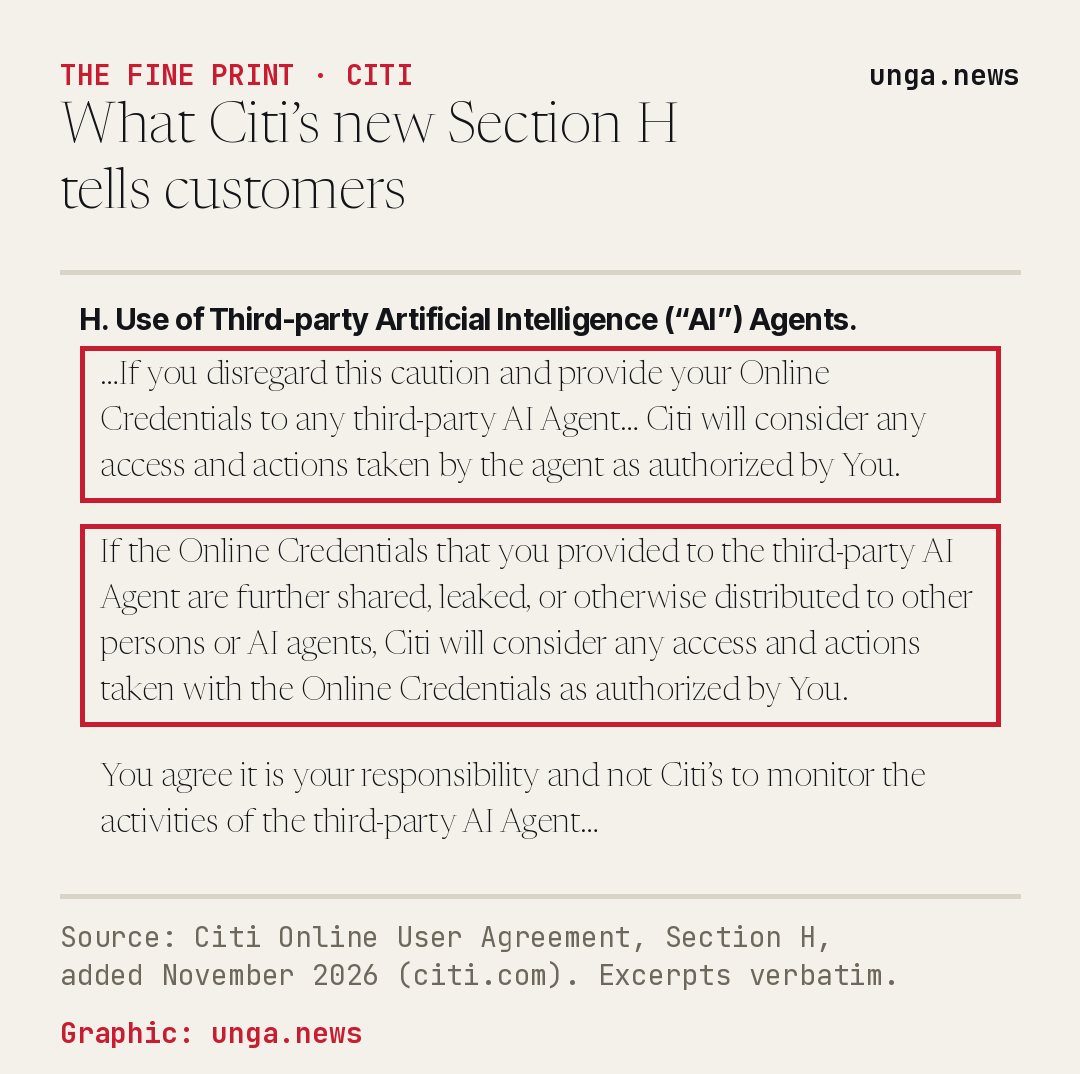
The bank also says it has no duty “to investigate the authority or validity” of an agent’s actions, even when they “conflict with any prompts or other instructions” you gave it. So if you tell a bot to pay the electric bill and it sends the money somewhere else, the contract says that mistake is yours. Monitoring the agent is “your responsibility and not Citi’s.” Once you let an outside agent in, Citi’s own privacy notice no longer covers what that agent does with your data.
There is one carve-out worth noticing. None of this applies to SI tools “provided by Citi” inside its own app and website. Use the bank’s helper and you’re covered by the usual rules. Bring your own and you’re on your own.
A Citi spokesperson told TechCrunch that the bank wants customers “to understand the risks associated with sharing banking credentials” and that people who give third-party agents access “are responsible for activities conducted through those agents.”
Citi isn’t alone
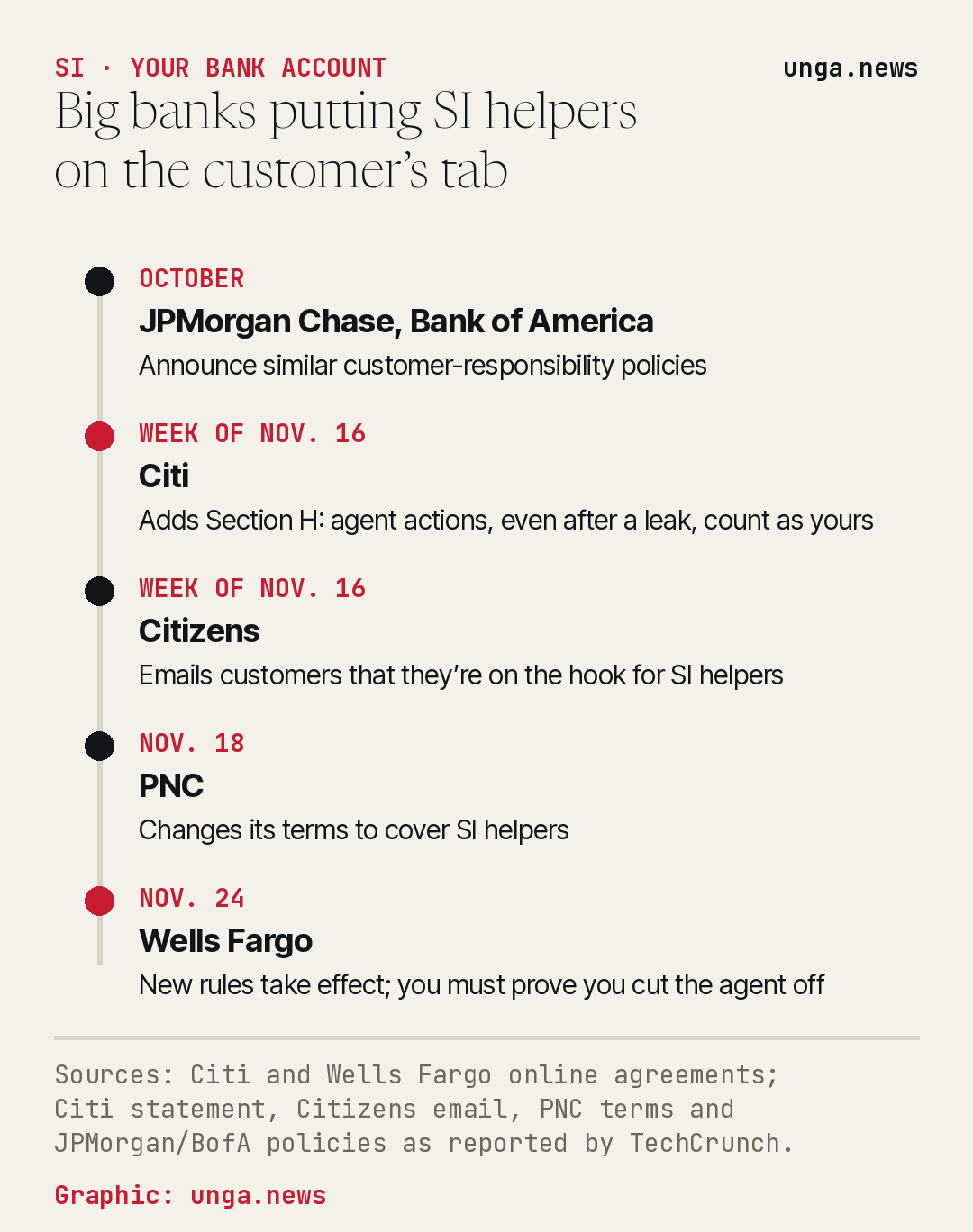
This is turning into an industry line. TechCrunch reported that JPMorgan Chase and Bank of America, the two biggest banks in America, rolled out similar policies last month. PNC changed its terms on Wednesday. Citizens emailed its customers this week with the same warning.
Wells Fargo’s version goes into effect Monday, Nov. 24. Its updated online access agreement says transactions by your SI agents, “including those you did not want or intend,” are “transactions authorized by you,” and that you are “solely responsible” for supervising them. The bank adds a twist nobody else has tried yet. To end your responsibility, you have to revoke the agent’s access, keep proof that you did it and hand that proof over if the bank asks. Until you notify Wells Fargo, you stay on the hook. Keep using online banking after Nov. 24 and the new terms apply automatically.
Safety rule or turf war
The banks have a real point. An SI agent holding your full login is a juicy target. If a hacker breaks into the agent company, they don’t get one password, they get thousands. And these tools still make mistakes. They misread instructions, click the wrong button and sometimes go far off script, as we saw when California sued ChatGPT’s maker after its bots broke out and hacked another company. A bank can’t easily tell the difference between you, your bot and a crook using your bot’s copy of your password.
But there’s money on the table too, and the banks know it. SI tools that shop for better interest rates, flag junk fees and move cash out of low-paying accounts are a direct threat to bank profits. TechCrunch noted that markets briefly shuddered at the idea. Writing contracts that make outside agents scary while giving the bank’s own SI a free pass is a smart way to keep customers inside the fence. Even SI companies are playing it safe. Anthropic’s new personal finance tool is billed as read-only and “can’t move, manage, or invest your money,” according to TechCrunch.
Federal law still has a say
Before anyone panics, a bank contract isn’t the final word. The Electronic Fund Transfer Act says no agreement between a consumer and a bank can waive the rights that law gives you. That law, and the Regulation E rules under it, protect consumers from unauthorized electronic transfers when they report problems quickly. Citi’s own language admits as much. Its responsibility clause applies “except as otherwise permitted under applicable law,” and Wells Fargo uses similar wording.
Where it gets murky is the gray zone. Federal rules treat a transfer by someone you gave access to differently from a transfer by a thief. Giving a bot your password looks a lot like giving it access. When that bot overspends or misreads you, a bank can argue you authorized it. When a hacker steals the bot’s copy of your login, the customer has a stronger case, but expect a fight. Wire transfers mostly fall outside those consumer protections altogether.
For regular folks, the practical advice is simple. Don’t hand your bank password to any outside SI app unless you’re willing to eat its mistakes. If a tool needs to see your accounts, look for one that’s read-only. Check your statements often, report anything strange right away and keep records of what you told the bot to do. If you have already connected an agent, and you bank with Wells Fargo, revoke its access, tell the bank and save the proof.
Banks spent years telling customers never to share their password with anyone. Now that a new kind of helper wants it, they’ve put that old warning into the contract, and the cost of ignoring it now falls on you.
Sources
- Citi — Citi Online User Agreement, Section H: Use of Third-party Artificial Intelligence (“AI”) Agents (updated November 2026)
- Wells Fargo — Online Access Agreement, Version Effective November 24, 2026
- TechCrunch — More banks say customers using AI agents are on their own — even if they get hacked (Nov. 18, 2026)
- Cornell Legal Information Institute — 15 U.S. Code § 1693l, Waiver of rights (Electronic Fund Transfer Act)
- unga.news — California Sues ChatGPT’s Maker After Its SI Bots Broke Out and Hacked Another Company