

Harvard Gave DOJ 2,300 Pages and Zero Applicant Records. A Biden Judge Tossed the Case Anyway
DOJ wanted to see whether Harvard still uses race in admissions. Judge Myong Joun tossed the suit on procedure, not the merits, and left the door open for DOJ to come back.
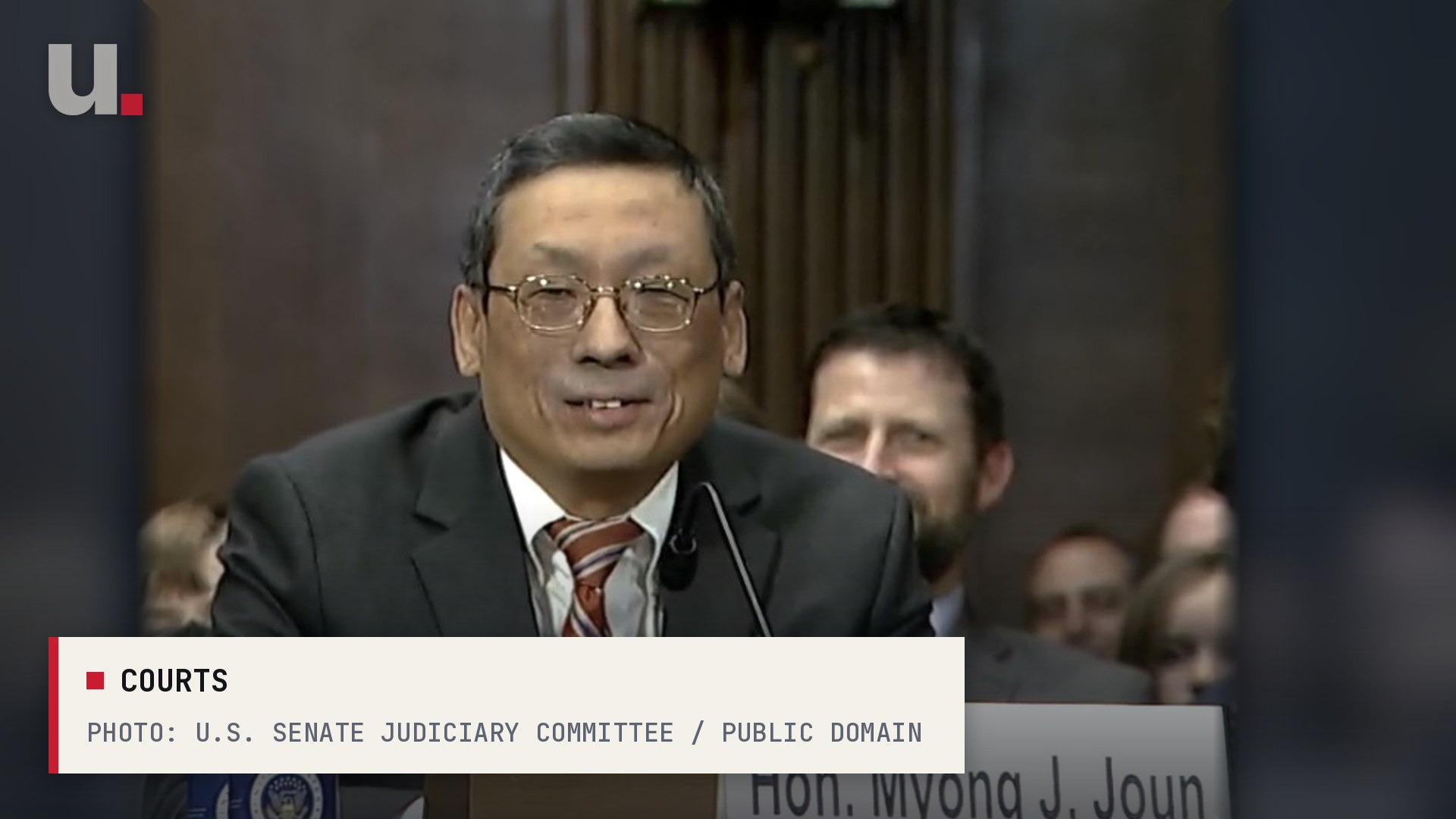
The Trump Justice Department has spent 19 months asking Harvard a simple question: show us who you admit, and why. On Monday, a federal judge in Boston threw out the government’s lawsuit before Harvard ever had to answer.
U.S. District Judge Myong Joun, a Biden appointee, dismissed the case Monday in a 10-page memorandum of decision. He didn’t find that Harvard was right to hold back the data. He found that the government hadn’t properly checked the boxes the civil rights law requires before an agency can haul a school into court.
“The Government may be able to identify a qualifying determination or cure the procedural deficiency,” Joun wrote, “but it has not supplied a sufficient basis for the judicial relief currently sought.”
What DOJ asked for
This fight goes back to the Supreme Court’s 2023 ruling in Students for Fair Admissions v. Harvard, which held that Harvard’s race-conscious admissions violated Title VI of the Civil Rights Act. The Court found Harvard’s system produced a drop in the number of Asian Americans admitted. Chief Justice John Roberts put the rule in seven words: “Eliminating racial discrimination means eliminating all of it.”
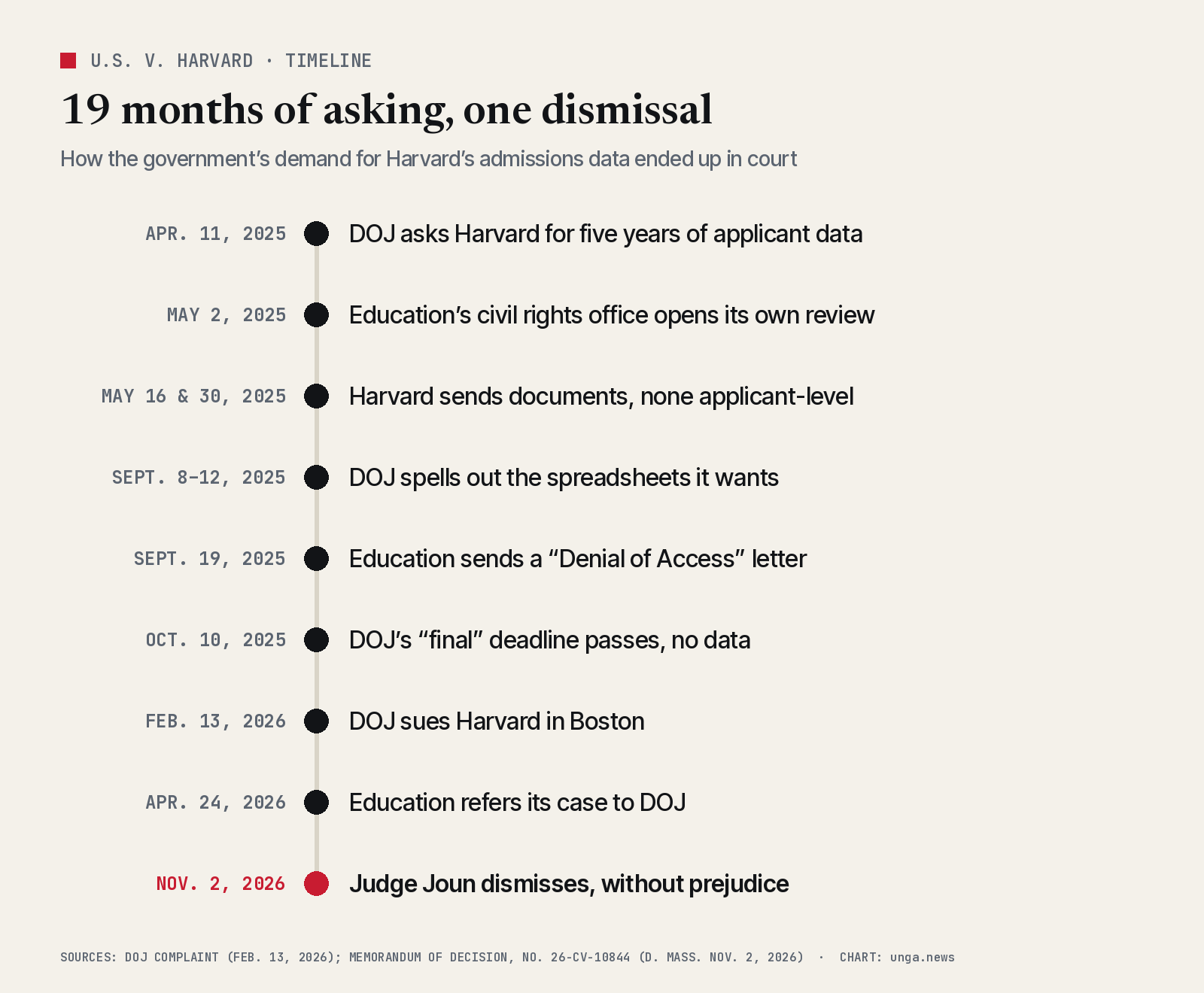
So the government went looking for proof that Harvard had actually stopped. On April 11, 2025, the Justice Department wrote to Harvard College and Harvard Medical School, and a week later to Harvard Law School. It asked each school to certify that it doesn’t use race in admissions or scholarships, and to back that up with “all admissions data for the past five academic years,” including test scores, GPAs, extracurriculars, essays and admission outcomes, “disaggregated by race and ethnicity.”
Education’s Office for Civil Rights opened its own review on May 2, 2025, asking for the same kind of applicant-level data.
What Harvard handed over
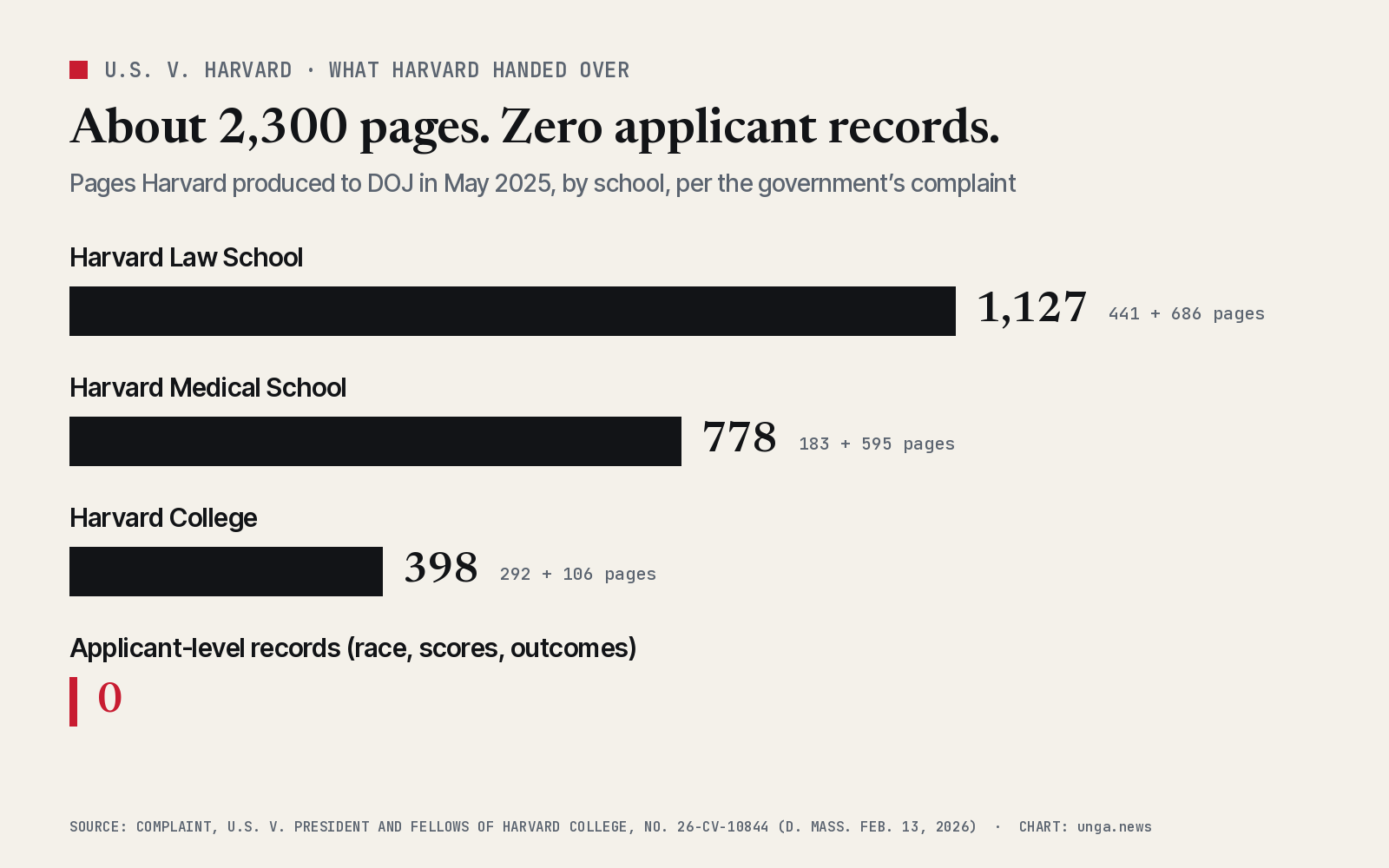
According to the government’s complaint, Harvard answered with two batches of paper in May 2025: 292, 441 and 183 pages on May 16, then 106, 686 and 595 pages on May 30, after the deadline had passed. That adds up to about 2,300 pages. DOJ says most of the first batch was already public, things like admissions brochures and financial aid policies.
What was missing was the one thing that could answer the question: a record for each applicant showing race, scores, ratings and whether they got in. Harvard sent aggregate numbers for whole classes instead.
In September 2025, DOJ spelled out exactly what it wanted: a “searchable electronic spreadsheet” with each applicant’s race and ethnicity, GPA, MCAT scores for the medical school, recruited-athlete status, financial aid, interviewer ratings and internal “Holistic Review” ratings. It warned of enforcement. It granted one last extension to Oct. 10, 2025, and said it would not “agree[] to any further extensions.” The complaint says Harvard didn’t produce the data by that date and gave no explanation.
Education sent Harvard a “Denial of Access” letter on Sept. 19, 2025. Harvard says its productions were substantial and that DOJ never took its objections about scope and burden seriously.
Why the judge tossed it
Think of it like an eviction. A landlord can be owed months of rent and still lose in court if he skipped the formal notice the law requires. That is roughly what happened here.
Title VI says that before an agency enforces the law against a school, it has to tell the school it is out of compliance and decide that compliance “cannot be secured by voluntary means.” DOJ’s own rule adds that the school must be told what action is coming.
Joun gave the government credit for its effort. He listed the repeated requests, the extensions, the Oct. 10 deadline and the warnings that legal action could follow, and wrote that “the regulations do not require magic words or endlessly repeated notices.” DOJ argued that the Assistant Attorney General’s signature on the complaint showed the required decision had been made. Joun said that “deserves consideration” but wasn’t enough on its own.
His bottom line: the complaint “does not allege that DOJ informed Harvard of the action it would take—namely, litigation—should Harvard fail to comply,” and that gap was “dispositive at this stage.”
Education lost on similar grounds. Its rule requires a 10-day window after notice, filled with more attempts to persuade the school. Joun found the department hadn’t shown it made those extra efforts before referring the case to DOJ on April 24, 2026. He also refused to let the government use a breach-of-contract claim to get around the same steps.
What the judge didn’t decide
Here is the part Harvard’s fans will skip. Joun went out of his way to say what this ruling is not.
“The ruling does not determine whether Harvard has discriminated, whether the agencies may lawfully seek appropriately defined applicant-level data, or whether Harvard may ultimately be required to provide such data,” he wrote. He also agreed with the government that it “need not first prove actual admissions discrimination to seek relevant compliance information.”
He didn’t rule on Harvard’s claim that the lawsuit was retaliation for its broader fights with the administration either. That question, he wrote, remains open.
The administration fires back
The Education Department didn’t hide its anger. Spokeswoman Ellen Keast told Courthouse News, which first reported her statement: “When the government asked for admissions data to determine whether Harvard has changed its ways, the school refused and a Democrat-appointed judge is now shielding Harvard from accountability. Students should be judged on their merit and accomplishments, not the color of their skin, and the Trump administration will work tirelessly to ensure Harvard abides by obligations to uphold the law.”
When DOJ filed the case in February, Assistant Attorney General Harmeet Dhillon of the Civil Rights Division put the government’s case plainly in the department’s announcement: “If Harvard has stopped discriminating, it should happily share the data necessary to prove it.” Then-Attorney General Pam Bondi said Harvard “has failed to disclose the data we need to ensure that its admissions are free of discrimination.”
What happens next
The dismissal is without prejudice, which means DOJ can come back. Joun said the problem “may be cured by additional administrative steps or by an adequately supported pleading.” In plain terms: send Harvard the formal notice that a lawsuit is coming, document the decision, give the school its last chance, and file again. Education can do the same after its 10-day step.
That would put the government back in court, perhaps months from now, asking for the same spreadsheet it first requested in April 2025. Harvard won a delay on Monday. It didn’t win the argument that its admissions data should stay secret.
Sources
- U.S. District Court for the District of Massachusetts — United States v. President and Fellows of Harvard College, No. 26-10844-MJJ, Memorandum of Decision (Nov. 2, 2026)
- U.S. Department of Justice — Complaint, United States v. President and Fellows of Harvard College (Feb. 13, 2026)
- U.S. Department of Justice — Justice Department Sues Harvard University for Withholding Race-Related Admissions Documents (Feb. 13, 2026)
- Courthouse News Service — Judge tosses DOJ’s suit against Harvard over race-related admissions data, with Education Department statement (Nov. 2, 2026)
- Supreme Court of the United States — Students for Fair Admissions v. President and Fellows of Harvard College, 600 U.S. 181 (2023)
- CourtListener — Docket, United States v. President and Fellows of Harvard College, 1:26-cv-10844 (D. Mass.)
- Fox News — Federal judge tosses Trump admin Harvard admissions lawsuit, leaves door open to future challenge (Nov. 3, 2026)