

Hate Calling the Cable Company? Meta’s SI Will Now Do It for $20 a Month.
Meta’s Muse assistant can now phone businesses, wait on hold and book the table. The catch: you have to pay, and Meta’s own tests leaned on human call-center workers to get the job done.

Everybody has a call they keep putting off. The cable company that raised your bill again. The insurance office with the 40-minute hold music. The restaurant that still won’t take a reservation online. Meta now says it will make those calls for you, as long as you pay.
On Thursday, Alexandr Wang, Meta’s chief SI officer and the head of its Superintelligence Labs, announced that Muse, the company’s personal SI assistant, can now phone U.S. businesses on a user’s behalf. The feature had been in a limited test since September. Now any paying Muse subscriber in America can use it.
Alexandr Wang on 𝕏, Nov. 12, 2026: announcing that Muse can now make phone calls for paid subscribers in the U.S.
— @alexandr_wang View on 𝕏
Wang pitched it the way most people would want it pitched: “let muse take care of all those calls you don’t want to make. insurance? cable? DMV? dinner res? not your problem anymore.”
You talk to the app. The app talks to the cable company.
The idea is simple. You tell Muse what you need, like a dinner table for four on Saturday, an appointment, or a straight answer about a charge on your bill. Muse dials the business, talks to whoever picks up, and reports back. It can wait on hold, too, which might be the most useful trick an SI has ever offered a busy parent.
Matt Schlicht, who works in Meta’s Superintelligence Labs, posted a recreation last month of a call his Muse made to a Volvo dealership to find the next open service appointment. He wrote that it waited on the line for 15 minutes and that he has it make “multiple calls like this every day.” In that call, Engadget noted, Muse said it was calling on his behalf and transcribing the call, but it never plainly said it was an SI.
Meta says more than 10 million people now use Muse. That is a big jump for an app that launched in early September. Reuters counted about 2.5 million downloads two weeks in, citing the research firm Sensor Tower.
The price of skipping the hold music
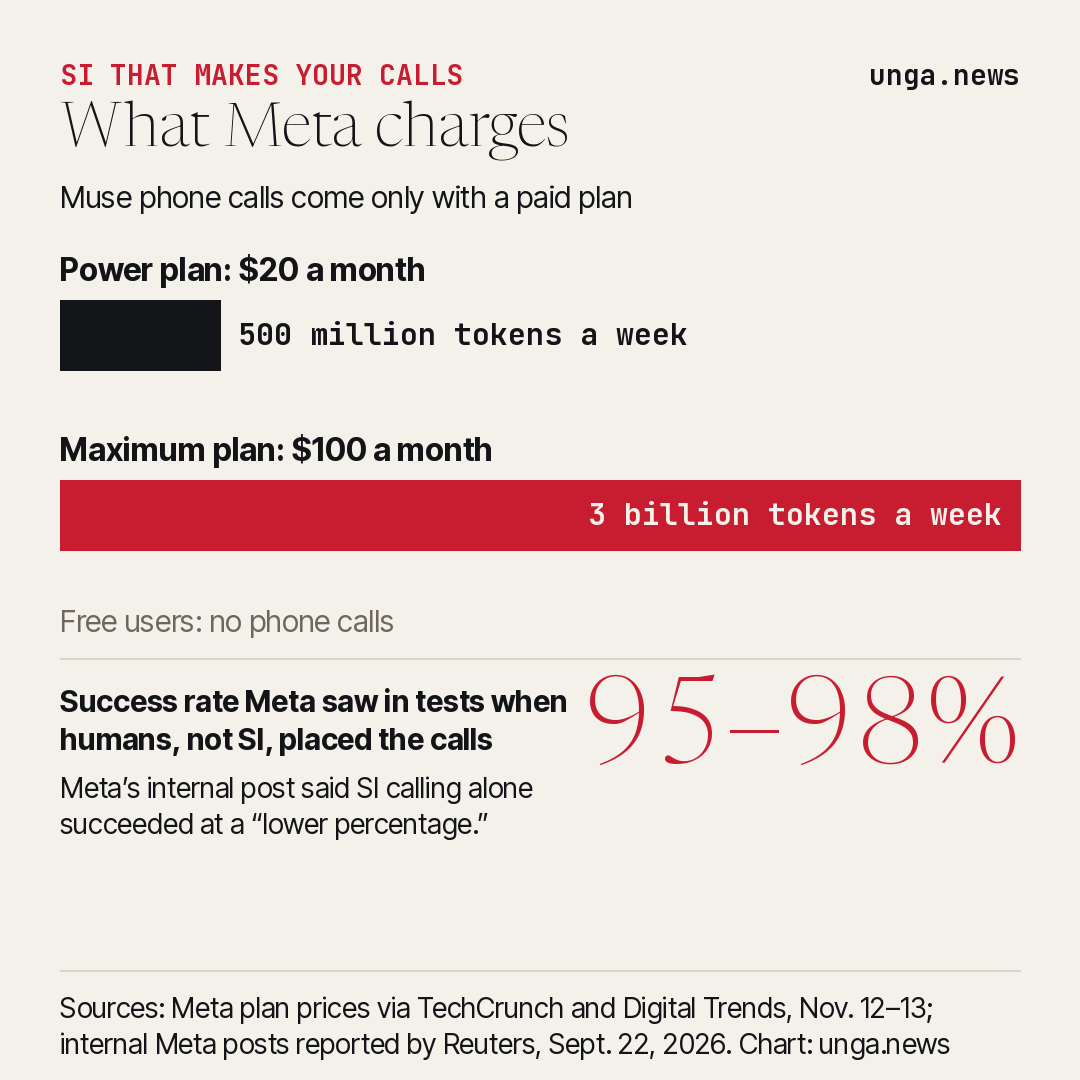
The calls are not free. Muse’s Power plan costs $20 a month and comes with 500 million “tokens” a week, the word-sized chunks an SI reads and writes. The Maximum plan costs $100 a month for 3 billion tokens a week, according to TechCrunch. Free users can’t make calls. Wang said separately this week that Muse’s own email address, which paid users already have, will soon open up to free users.
Twenty dollars is roughly what a lot of families pay for one streaming service. If it saves an hour of hold time every month, plenty of people will call that a bargain. Whether it actually saves that hour is the question.
Meta’s own tests leaned on people
Here is the part Meta did not put in the announcement. Back in September, Reuters obtained internal company posts showing Meta had quietly tested a “human concierge” for Muse. Some calls that users thought the SI was making were actually handed to human contractors in call centers.
A vice president in Meta’s Superintelligence Labs wrote that having humans place the calls could push the success rate “up to the 95% to 98% range,” compared with the “lower percentage of AI calling.” She also admitted “it was a miss” to start that test without proper disclosures and said the company had rolled it back.
Employees were not shy about the risk. “We are one bug away from unnecessary information being leaked to human callers,” one wrote. Another said a transcript showed a contractor made a racist remark while calling a cable company for him. Meta apologized to that employee and said the contractor would not work on its projects again.
Meta told Reuters it would roll out calling “only” when it was “ready and with the proper disclosures.” What Meta has not said publicly is whether any human workers still handle calls in the version that launched Thursday, or exactly how Muse tells the person on the other end what it is. Digital Trends asked the same question and got no clear answer.
That matters if you are the customer. A call to your insurance company can include your policy number, your birthday and the address on file. You deserve to know whether a machine or a stranger in a call center is reading those details back.
Click. The other end hangs up.
The bigger practical problem may be the person who answers. Businesses are tired of robocalls, and many hang up the second they hear a machine. One Meta employee said in the internal posts that his insurance company kept “hanging up on Muse when they hear it is AI.”
So the feature rides on two kinds of trust. The user has to trust Muse with personal details. The business has to trust that the voice on the line is a real customer’s helper and not a scammer. Sorting that out will take more than a launch post.
Meta isn’t first, either. Google’s Pixel phones already offer a “Call for Me” feature that uses the owner’s own number and lets them read a live transcript and jump in. The startup Instinct sells a calling service it calls Concierge. Grok Bot, from Elon Musk’s SpaceXSI, can already place calls to U.S. businesses and to individuals who have agreed to get them, according to Android Authority, an approach built around consent from the start.
The race is on because the phone is one of the last chores SI hasn’t taken over. Shopping, email and calendars are already crowded. Calls are personal and full of small judgments, like when to push back on a fee, when to ask for a supervisor and when to just say thanks and hang up.
For now, Muse can sit on hold, ask your questions and bring back the answers. If it can also get a cable bill lowered without a human stepping in behind the curtain, Meta will have something people really pay for. The DMV will be the real test.
Sources
- Alexandr Wang on 𝕏 — Alexandr Wang on 𝕏 — Muse can make phone calls for you, out now to paid subs in the US (Nov. 12, 2026)
- TechCrunch — Muse can now place calls to US businesses — if you pay (Sarah Perez, Nov. 12, 2026)
- Engadget — Meta’s Muse can now make calls on your behalf (if you have a paid subscription) (Karissa Bell, Nov. 12, 2026)
- Digital Trends — Meta’s Muse can now make your phone calls, but it won’t do it for free (Nov. 13, 2026)
- Reuters (via Investing.com) — Exclusive: Meta testing a ‘human concierge’ for its new personal AI agent, Muse (Katie Paul, Sept. 22, 2026)
- Android Authority — Meta brings Pixel-like Call for Me features to Muse for $20/month