

Hegseth Brands China's Confucius Institutes a National Security Threat After 80 Resurfaced in Disguise at 30 Colleges
The Secretary of War says the Chinese-backed campus programs Congress squeezed out came back under new names. The Pentagon used research money to shut down every one.
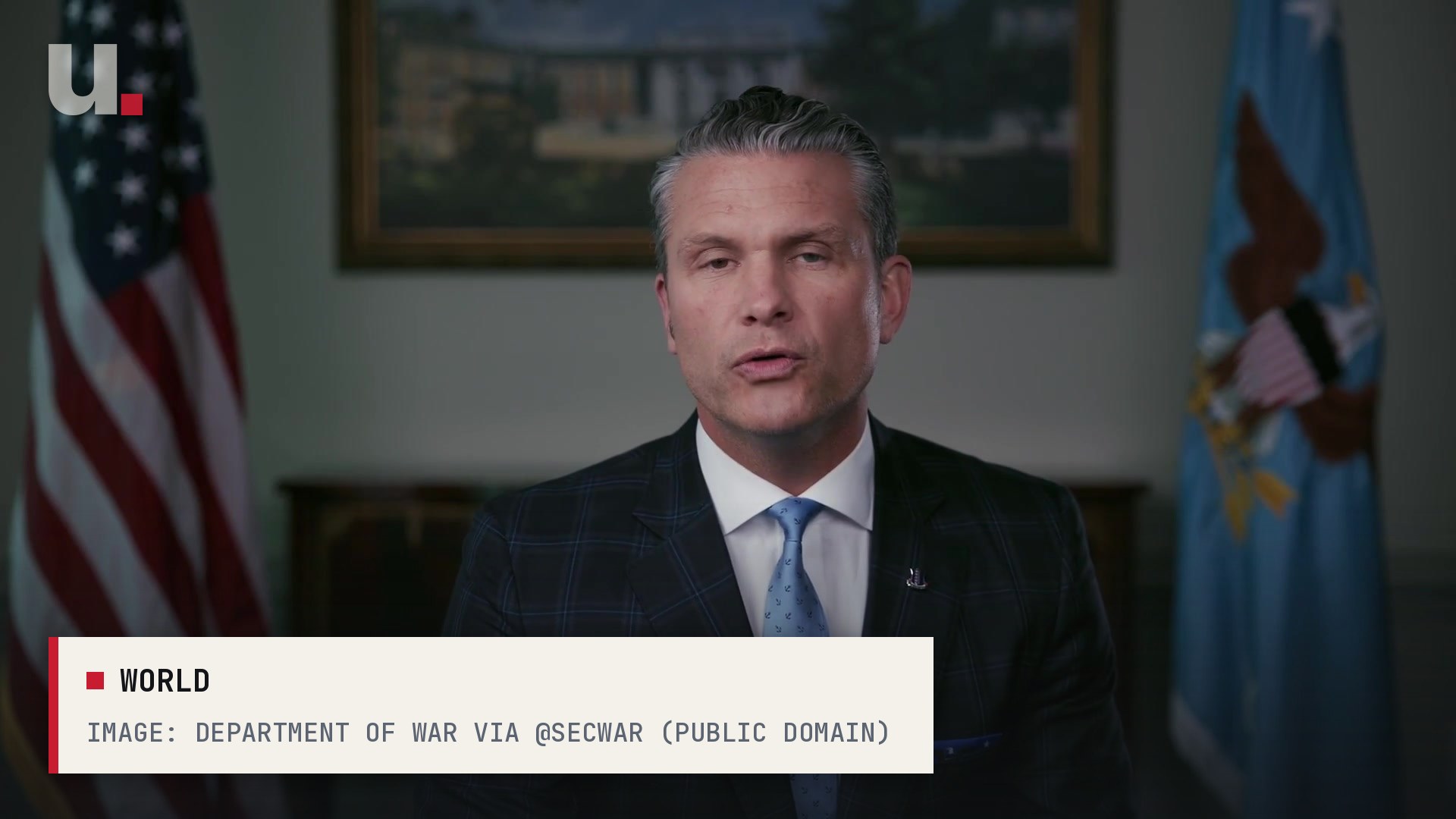
Secretary of War Pete Hegseth says China's Confucius Institutes never really left America's colleges. They just changed their names. On Friday, he announced the War Department has formally designated them a threat to U.S. national security, and said the Pentagon has already shut down 80 of them hiding at 30 universities, in a two-minute video posted to his official account on 𝕏.
"It turns out that 80 new propaganda cells across 30 universities had popped up using different names and different charters, but with the same mission: to steal intellectual property and to infiltrate the minds of American students," Hegseth said. Within the last two months, he added, the department has "systematically dismantled every single one of these organizations using the leverage that we have here at the War Department."
Secretary of War Pete Hegseth announces the Confucius Institutes designation, Oct. 23, 2026.
— @SecWar View on 𝕏
The post had passed 2.3 million views and 30,000 likes by Saturday morning. Reuters moved the story within the hour, and the Washington Examiner, The Guardian, Al Jazeera and Hong Kong's South China Morning Post followed. China's embassy in Washington did not respond to Reuters.
Same store, new sign
Hegseth framed it as the same fight he waged over DEI inside the military. "Instead of complying, promoters of this ideology just tried to rebrand it and thought they would be safe," he said. Confucius Institutes, he said, "came back disguised in new forms, just like DEI does. Just call it a different name." So the department "added these sleeper organizations to our list of institutions that threaten our national security."
Picture a shop that gets closed down, then reopens across the street under a new sign, with the same owner and the same stock. That is what critics have warned about for years, and it is what Hegseth says the Pentagon found.
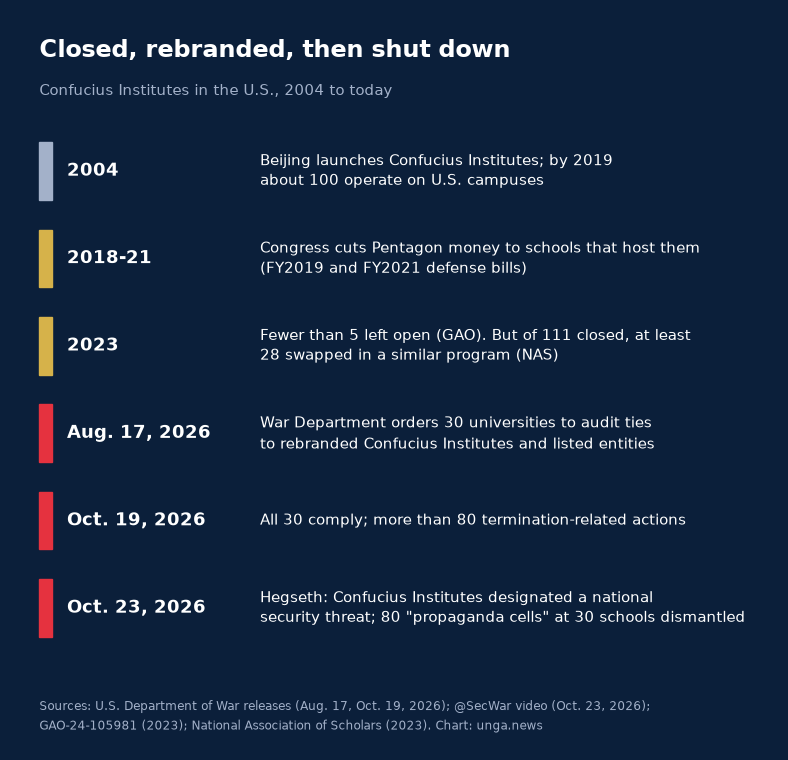
Beijing launched Confucius Institutes in 2004 as language and culture centers tied to its education ministry, and they spread to campuses worldwide, Military Times notes. By 2019 there were about 100 at U.S. schools. Then Congress cut off Pentagon money to colleges that hosted them in the 2019 and 2021 defense bills, and the count fell to fewer than five by 2023, according to the Government Accountability Office. More than 60% of schools GAO surveyed said the threat of losing federal funding weighed "to a great extent" in closing theirs.
But closing wasn't the end. The National Association of Scholars, which has tracked the institutes since 2017, counted 111 that closed or were closing and found at least 28 replaced with "a substantially similar program," while at least 58 kept close ties to their old Chinese partner. It also noted Beijing reorganized the program under a new body, the Chinese International Education Foundation.
How the Pentagon used its leverage
The leverage is research money. On Aug. 17, the War Department ordered 30 universities to review every academic, financial and research tie to "foreign entities of concern" and to "organizations associated with rebranded Confucius Institutes," and to report back by Aug. 31 or risk losing eligibility for future federal research funding, the department announced. "The Department of War has zero tolerance for academic partnerships that compromise our national security," said Emil Michael, the under secretary for research and engineering.
The department didn't name the schools, but Fox News, citing a U.S. official, published the list. It includes Harvard, MIT, Georgetown, Johns Hopkins, Duke, Cornell, NYU, UC Berkeley, UCLA, UC San Diego, the University of Texas at Austin and the University of Illinois.
On Oct. 19, the Pentagon reported back: all 30 had cut the flagged relationships, producing "more than 80 termination-related actions," including some precautionary cuts with groups not on the official list. It singled out seven schools that "went above and beyond": Oklahoma State, Penn State, UNC Chapel Hill, South Carolina, USC, UT Austin and Virginia Tech.
"I am proud that the Department of War went 30-for-30," Michael said. "Institutions that fail to meet research security standards are on notice: taxpayer dollars will not support institutions whose partnerships put the American warfighter or the Nation's technological advantage at risk."
Why it matters
The list Hegseth referred to is the Pentagon's Section 1286 list, created by Congress in 2018 to flag foreign institutions that put taxpayer-funded research at risk. Its July 2026 update named 130 institutions in China, Russia and Iran, and since fiscal 2026 the Pentagon cannot fund fundamental research that partners with any of them, Military Times reported. Landing on it is a funding problem no research university can ignore.
House China Select Committee Chairman John Moolenaar has been pushing to make that list longer. In an Oct. 1 letter to Hegseth, he asked the department to add Chinese Academy of Sciences institutes, national defense laboratories working on weapons, hypersonics and semiconductors, and 58 Chinese universities tied to Beijing's defense industry agency, warning that "gaps in coverage" leave pathways for Pentagon-funded researchers to work with China's military complex.
Hegseth's warning on Friday went beyond campuses. "Let this be a lesson to any country trying to steal our hard-earned inventions or turn our young people against their own country," he said. "We're done with that. No more and never again."
What's next
The Pentagon hasn't published the names of the 80 groups or which schools hosted them. The department says it will keep updating the Section 1286 list and assess universities that hold on to problematic ties, and Hegseth told schools to "stay vigilant" and "don't allow these influences to come back in." The move also lands weeks before President Trump's next trip to China to meet Xi Jinping, the South China Morning Post noted, a clear signal that Washington's line on Beijing's campus influence isn't up for trade.
Sources
- 𝕏 (@SecWar) — The War Department has designated Confucius Institutes as a threat to our national security
- U.S. Department of War — Department of War Orders Research Security Audits at 30 Academic Institutions (Aug. 17, 2026)
- U.S. Department of War — Department of War Announces Research Security Mitigation Results From Academic Institutions (Oct. 19, 2026)
- Reuters — Pentagon designates Confucius Institutes in US a national security threat
- Washington Examiner — Hegseth dismantles Chinese 'sleeper organizations' at universities
- Fox News — Pentagon orders 30 universities to audit foreign ties or risk funding
- Military Times — Pentagon scrutinizes foreign research ties at 30 US academic institutions
- GAO — China: With Nearly All U.S. Confucius Institutes Closed, Some Schools Sought Alternative Language Support (GAO-24-105981)
- National Association of Scholars — How Many Confucius Institutes Are in the United States?
- House Select Committee on the CCP — Chairman Moolenaar letter to Secretary Hegseth on the Section 1286 list (Oct. 1, 2026)
- South China Morning Post — 'Systematically dismantled': Hegseth's new offensive against China's Confucius Institutes
- The Guardian — Pentagon designates China-backed campus cultural centers a threat to US national security
- Al Jazeera — Pentagon designates Confucius Institutes a national security threat