

Hegseth Flew Into Caracas Unannounced and Came Back With Venezuela as a Military Partner
Ten months after U.S. forces captured Maduro, the Secretary of War signed the first U.S.–Venezuela military cooperation deal in 21 years, covering training, intelligence and equipment.
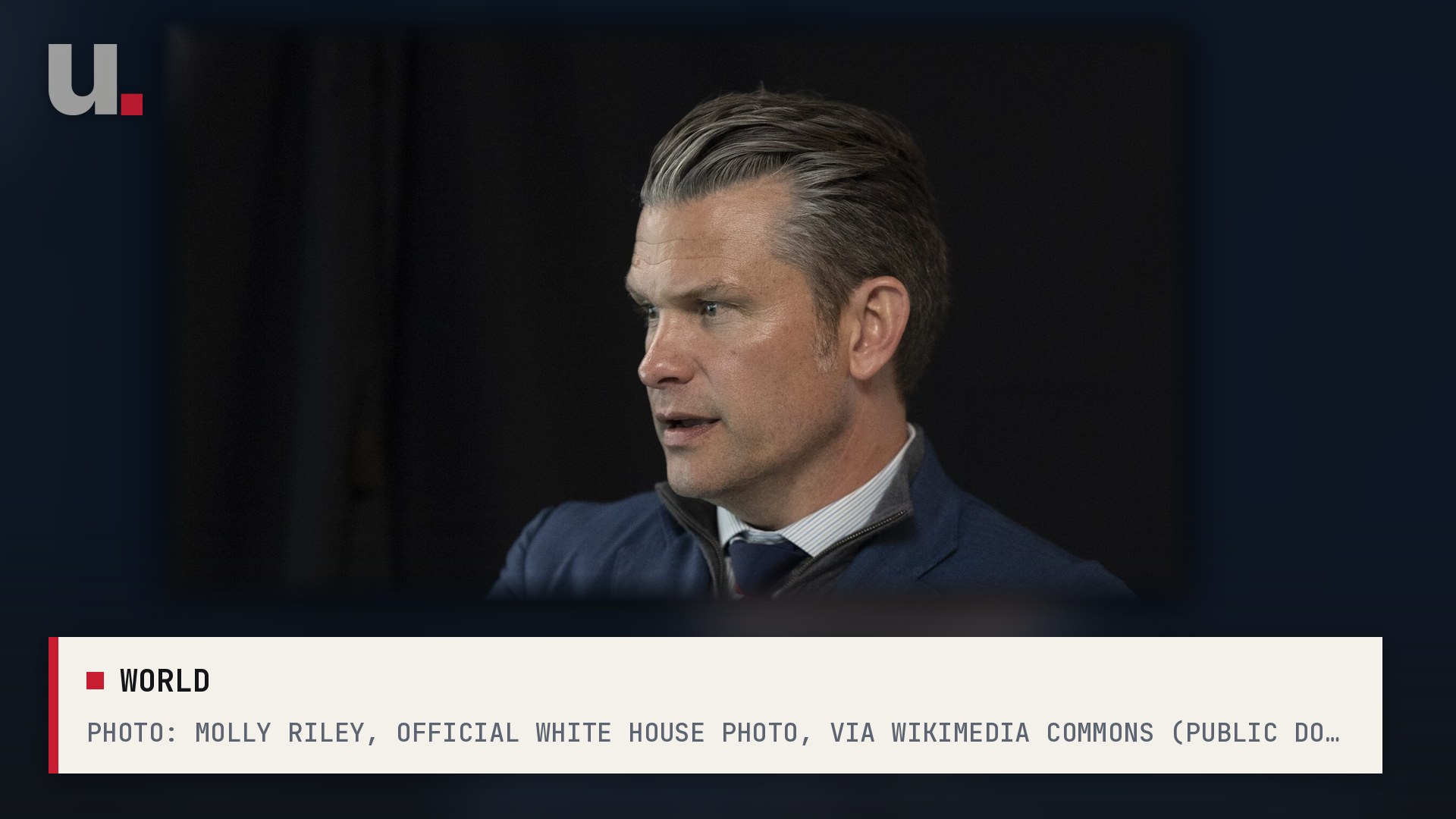
Pete Hegseth landed in Caracas on Wednesday without any public warning. By the time he left Miraflores, the presidential palace, the United States and Venezuela had signed their first military cooperation agreement in 21 years. The deal covers joint training, intelligence sharing, equipment and help modernizing Venezuela’s armed forces, according to UPI and Venezuelan state media.
Ten months ago, American special forces were pulling Nicolás Maduro out of the country. This week the Secretary of War was standing next to Venezuela’s acting president, Delcy Rodríguez, signing a defense pact. Hegseth summed up the turnaround himself in a speech outside the U.S. Embassy: Venezuela “has gone from our most aggressive regional threat to a compliant security partner,” he said, as reported by the Associated Press.
A signing inside Miraflores
Hegseth signed the document with Venezuela’s defense minister, Gustavo González López, in a meeting hosted by Rodríguez. The state broadcaster Radio Nacional de Venezuela called it an agreement “to resume technical-military cooperation between both countries.” Also in the room were Joseph Humire, the Pentagon’s deputy assistant secretary for Western Hemisphere affairs, and John Barrett, who runs the U.S. Embassy in Caracas as chargé d’affaires.
Hegseth told Rodríguez that he came on behalf of President Trump. He spoke of the military relationship the two countries used to have and said they were now restoring it.
“We have the opportunity to jointly fight the terrorists and criminals that affect both countries,” Hegseth said, according to the Venezuelan state account. He said the deal would help strengthen Venezuela’s military and borders so that “hemispheric actors and other malicious actors” can’t threaten either nation.
Rodríguez took the same line. She said the deal would improve training for the Bolivarian National Armed Forces, modernize their equipment and open access to new technology. “This cooperation must serve to guarantee peace,” she said, according to the Venezuelan newspaper El Nacional.
What the deal does, and what it leaves open
The basics are joint training, intelligence sharing, strategic cooperation and the supply of defense equipment and capabilities. Hegseth said the partnership comes with “profound” reforms to Venezuela’s security and defense institutions, which Washington will help carry out, according to Bloomberg. He also said U.S. forces would help Venezuela’s military go after drug cartels, and he called for clearing out the narco-terrorist networks the administration says are operating on Venezuelan soil.
Some details are still private. Neither government said what equipment Venezuela will get, how many troops will be trained or when the programs start, and no money figures were announced, according to the Miami Herald. UPI reported that officials also didn’t say whether the deal allows U.S. bases or a permanent troop presence. The Pentagon didn’t announce the trip ahead of time. The public first saw it on Venezuelan state television.
How 21 years of silence ended
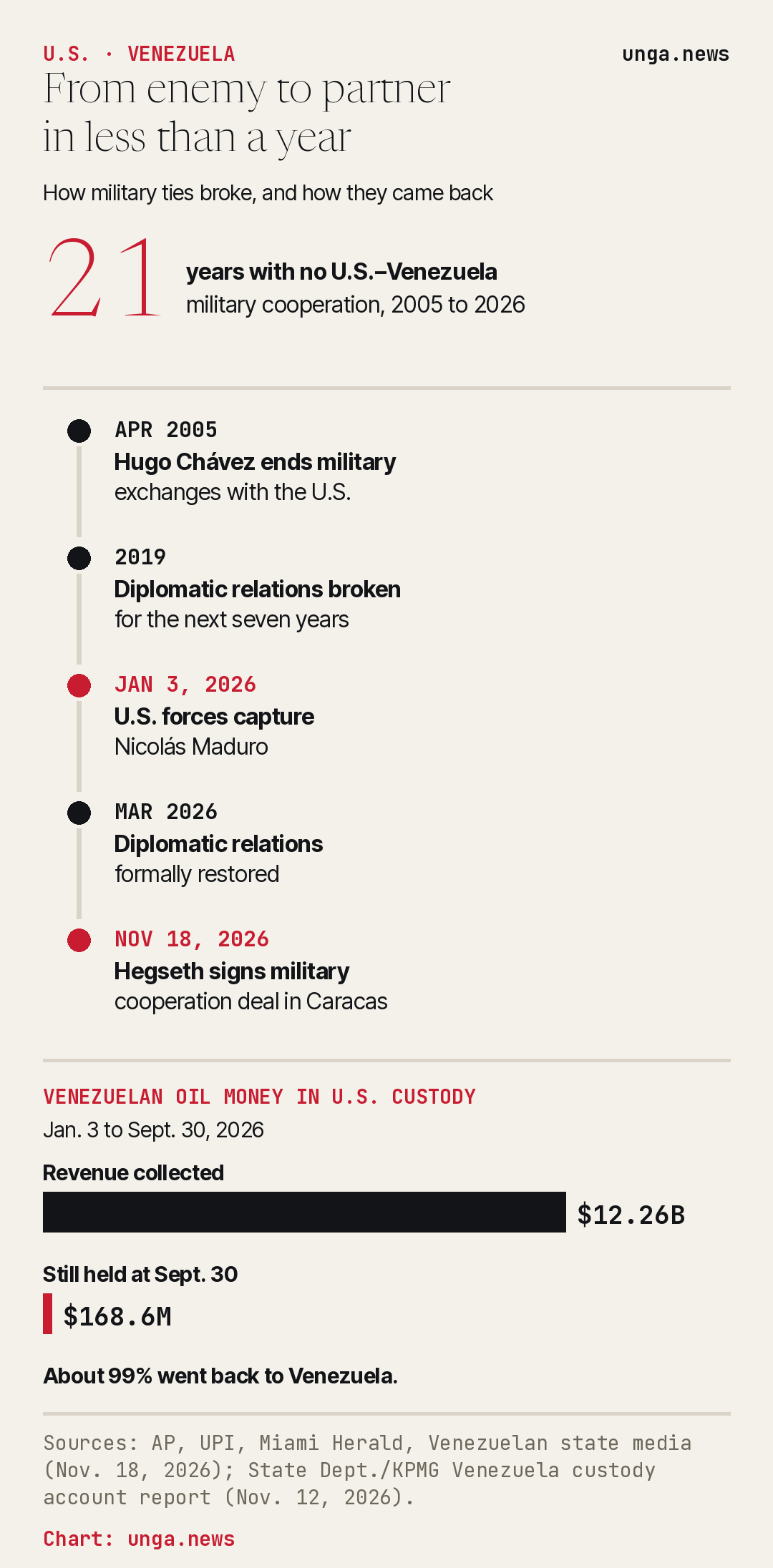
Hugo Chávez cut off military exchanges with the United States in April 2005, at the height of his feud with Washington. Things got worse from there. Under Maduro the two countries broke off diplomatic relations completely, and they stayed broken for seven years. For most of two decades, Caracas leaned on Russia, Cuba and Iran for weapons and advisers while Washington treated the regime as a narco-state.
That ended on Jan. 3, 2026, when U.S. forces captured Maduro. Hegseth called that “a day of liberation for Venezuela,” according to the outlet Efecto Cocuyo. Rodríguez, Maduro’s former vice president, took over as acting president and chose to work with Washington instead of fighting it. Diplomatic relations were formally restored in March.
Since then, a line of Cabinet officials has come through Caracas. Energy Secretary Chris Wright and Interior Secretary Doug Burgum both visited before Hegseth, and Trump said in August that Hegseth helped negotiate the deal that gave the United States control over some Venezuelan oil reserves. Hegseth’s trip is the highest-level U.S. visit since the January operation, UPI reported.
The oil money that bought trust
The other half of the partnership is money. Under the arrangement with Rodríguez’s government, Venezuelan oil and mineral revenue runs through a U.S.-held custody account. A State Department report released this month, with an audit by KPMG, found $12.26 billion collected from Jan. 3 through Sept. 30. About 99% of it went back to Venezuela, with $168.6 million still in the account at the end of September.
That is the opposite of how Venezuela’s oil money used to move under Maduro, when billions disappeared into regime accounts and cronies’ pockets. Hegseth’s pitch on Wednesday tied the two together. A stable, cooperative Venezuela gets its oil cash back, a military rebuilt with American help and a partner against the cartels. In exchange, the United States gets a friendly government on the north coast of South America instead of a Russian and Iranian outpost.
“Venezuela is better today than it was yesterday, and it will be better tomorrow than it is today,” Hegseth said.
A different map for the hemisphere
Wednesday’s signing caps one of the fastest reversals in modern American foreign policy. In January, the Trump administration took out a regime that U.S. officials say backed cartels and hosted America’s rivals. By November, that same country’s military was signing on to train alongside American forces and share intelligence with them.
Critics will point to how much is still unwritten. They will also note that Rodríguez served Maduro for years before she switched sides. But this deal was a Trump administration project from the start, and it came with real conditions: reforms to Venezuela’s security forces, cooperation against the cartels, and oil revenue that runs through an audited account instead of a dictator’s pocket. Hegseth made the trip in person to lock it in.
Sources
- Associated Press — US and Venezuela sign a deal to reestablish military ties, Hegseth says in visit to Caracas (Nov. 18, 2026)
- UPI — Venezuela, U.S. resume military cooperation after 21 years (Nov. 18, 2026)
- Bloomberg — Hegseth Signs Venezuela Military Agreement In Unannounced Visit (Nov. 18, 2026)
- Miami Herald — Hegseth announces military deal with Venezuela’s Rodríguez (Nov. 18, 2026)
- Radio Nacional de Venezuela — Venezuela y EE. UU. firman acuerdo para reanudar cooperación técnico-militar (Nov. 18, 2026)