

His 1994 Jeep Kept Failing Smog. SI and a $3 Chip Helped Him Finally Pass.
A California driver wired a hobby circuit board to his Cherokee’s engine computer, let Claude and Codex figure out the rest and posted the whole kit free online.
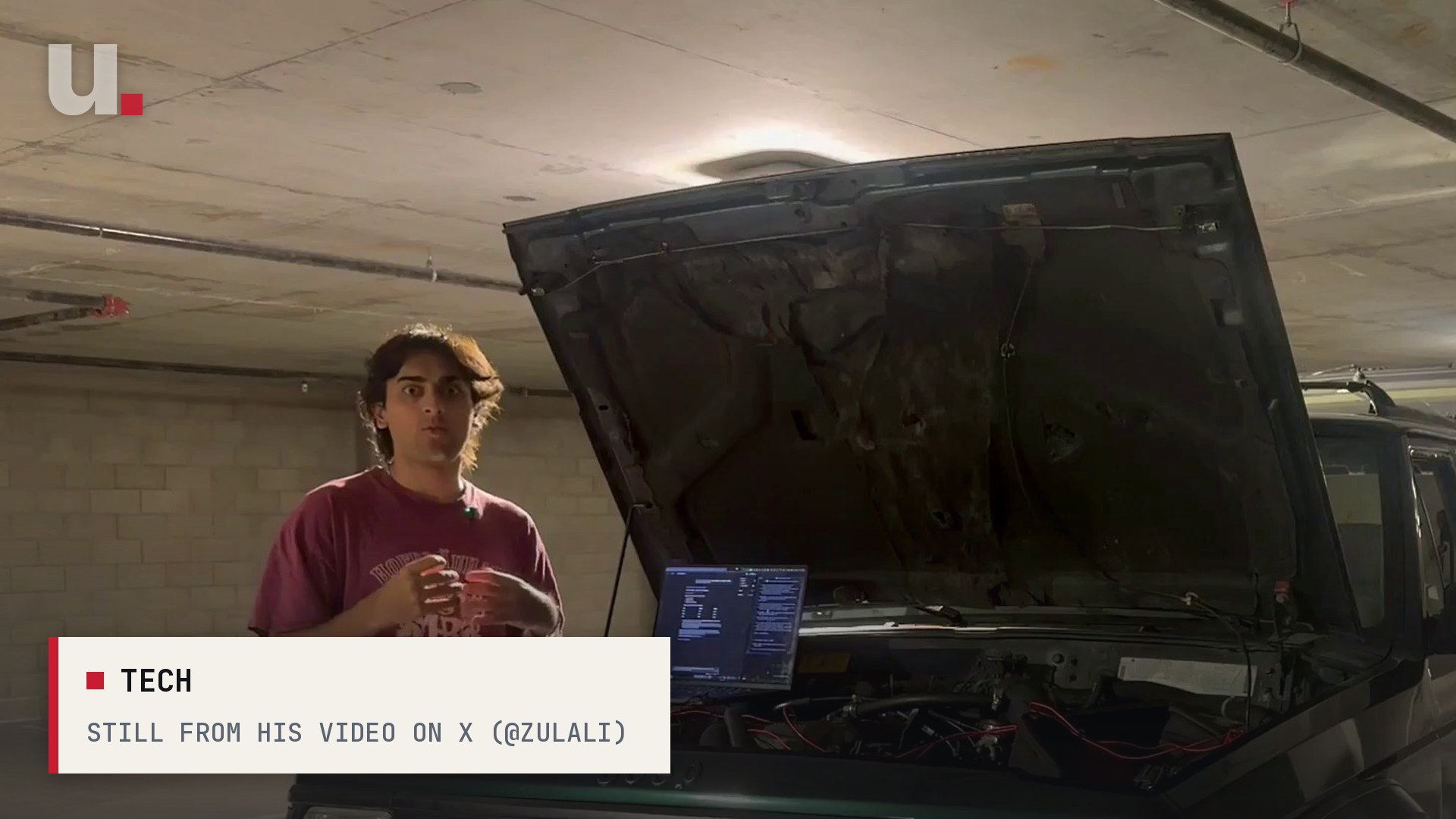
Anybody who has owned an old car in California knows the feeling. You pull into the smog shop, hand over your keys, pay the man and wait to hear whether you get to keep driving it legally. Muhammad Zulali kept hearing no.
His 1994 Jeep Cherokee was failing the state’s emissions test at 25 miles per hour, the reading flagged for high nitrogen oxides. Every retest cost him about $100. And because the Jeep was built before cars had the standard plug that modern code readers use, there was no cheap scanner he could hook up to see what the engine was doing.
So he asked an SI coding assistant to help him break into the car’s brain. It worked. In a nearly 10-minute video he posted on X on Tuesday, Zulali walks through how Anthropic’s Claude and OpenAI’s Codex helped him read the 32-year-old engine computer, figure out why it was failing, and finally get the Jeep through smog. As of Wednesday afternoon the post had more than 1.6 million views and nearly 18,000 likes.
Muhammad Zulali on 𝕏: the original video showing how he wired his 1994 Jeep to a laptop and an SI assistant.
— @zulali View on 𝕏
Three wires and a $3 chip
The setup is almost comically cheap. Claude figured out that the Jeep talks over an old, slow Chrysler connection, and that the signal needed a translator. That translator turned out to be an Arduino Nano, a hobbyist circuit board that costs about $3, plugged into a breadboard. Three wires run from the diagnostic plug under the hood to the board, and the board plugs into a laptop by USB.
It didn’t work the first time. Zulali said the wiring instructions ran too long, so he went off his own reading of the plug, and the first attempt returned nothing because resistors were drowning out the signal. Claude told him to pull one out. At 1:38 in the morning, the laptop finally showed the Jeep’s coolant temperature and battery voltage.
“It was kind of insane,” he said in the video. “I had no idea if this was gonna work. I had no idea how far Claude could go.”
When the SI turned the fuel pump on
From there it got serious. Zulali put his MacBook in the passenger seat and had Claude log entire drives at 15 to 25 miles per hour, the speeds used on the smog dyno. Claude noticed the computer reported the car’s speed doubled and corrected for it.
One early reading made no sense. It said the engine was getting 22% more fuel than the factory baseline, which should have meant it ran rich, not lean. After a day of tests, including a fuel pressure gauge, unplugging injectors and a rag over the tailpipe, Claude confirmed on a night drive that the computer was actually removing fuel. The free community tool people use to read these computers had the reading backward for his car, he said.
There was also a moment that made him nervous. Claude offered to run the fuel pump by itself. Zulali didn’t think it could. It did, priming the fuel rail for about 10 seconds until he told it to stop.
“That was the first time that Claude had actually done something inside of the computer,” he said. Until then the SI could only read numbers. Now it could make the car do something.
A California-only fuel table
The real answer was hiding in the software. Claude copied the engine computer’s entire program onto the laptop so it could be studied away from the car. What it found, according to Zulali, was that his computer was built for California, and at exactly the engine loads used during the smog test, the California version cuts fuel compared with the federal version sold in other states. Less fuel there can mean more nitrogen oxides out the tailpipe.
The obvious fix would have been to reload the whole computer with federal settings. Claude built a kit for that, backups included. But the Jeep’s computer was made in December 1993, about four months before Chrysler started building these units so they could be reprogrammed. The mode was in the software, Zulali said. The parts to use it were not on the board.
That’s where Codex came in. It found that the old computer would run a tiny program sent over the same three wires, executing it roughly 90 times a second as the computer cycled. The catch was memory. The car’s own code kept overwriting the program in short-term memory within seconds, so Codex moved it into the computer’s permanent memory instead, the kind that survives even when the battery is unplugged.
Test day was its own comedy. The first shop’s dyno was broken. The second wanted a full tank of gas. “After many, many attempts,” Zulali said, the agents read everything they needed, ran their own code inside the computer, “and we finally passed.”
He was careful to draw a line. When one commenter told him he could probably tune the engine now, Zulali replied that the computer has lots of hidden factory controls, but “I didn’t touch those for the smog test, since that’s legally questionable.”
Anyone with an old Jeep can try it
Zulali has posted the whole project on GitHub as xj-scanner, free under an open-source license, for owners of 1991 to 1995 Jeep and Chrysler vehicles with the same family of engine computer. The parts list comes to about $15: the Arduino, a breadboard, some wire, three spade terminals and a multimeter. The instructions tell you to open the folder in Claude Code or Codex and type, “Help me hook this up to my Jeep.”
The project leans on years of work by hobbyists. The README credits the open-source ChryslerScanner project for the parameter codes and scaling, and it warns owners not to trust wire colors. One cavity in the plug carries 12 volts with the key on, and on his Jeep that wire is the same black and white as the ground. Check every one with a meter first, it says, and you use it at your own risk.
For anyone still driving an older car that most shops won’t touch, that’s the part worth paying attention to. Zulali summed it up himself: “Claude did most of like the diagnostic work, and Codex did pretty much all of the memory work. And I just did the wiring and the driving. I didn’t need a mechanic or like a Chrysler dealer tool for any of this.”
He isn’t done, either. In replies he said he plans to make the old Cherokee drive itself next, on a track. “I can’t let this baby Jeep die,” he wrote.
Sources
- Muhammad Zulali on 𝕏 — Claude reverse engineered my 32-year-old Jeep. Then it started controlling it. (video)
- GitHub — MZULALI/xj-scanner README
- Muhammad Zulali on 𝕏 — Reply on hidden factory controls and the smog test
- Muhammad Zulali on 𝕏 — Reply on making the Jeep self-driving
- GitHub — laszlodaniel/ChryslerScanner