

Houston and San Antonio Asked Texas’s Top Court to Kill a Pro-Business Law. It Said No.
The Supreme Court of Texas refused to hear the big cities’ challenge to the 2023 law that keeps local rules from going further than state law, so the law stands.
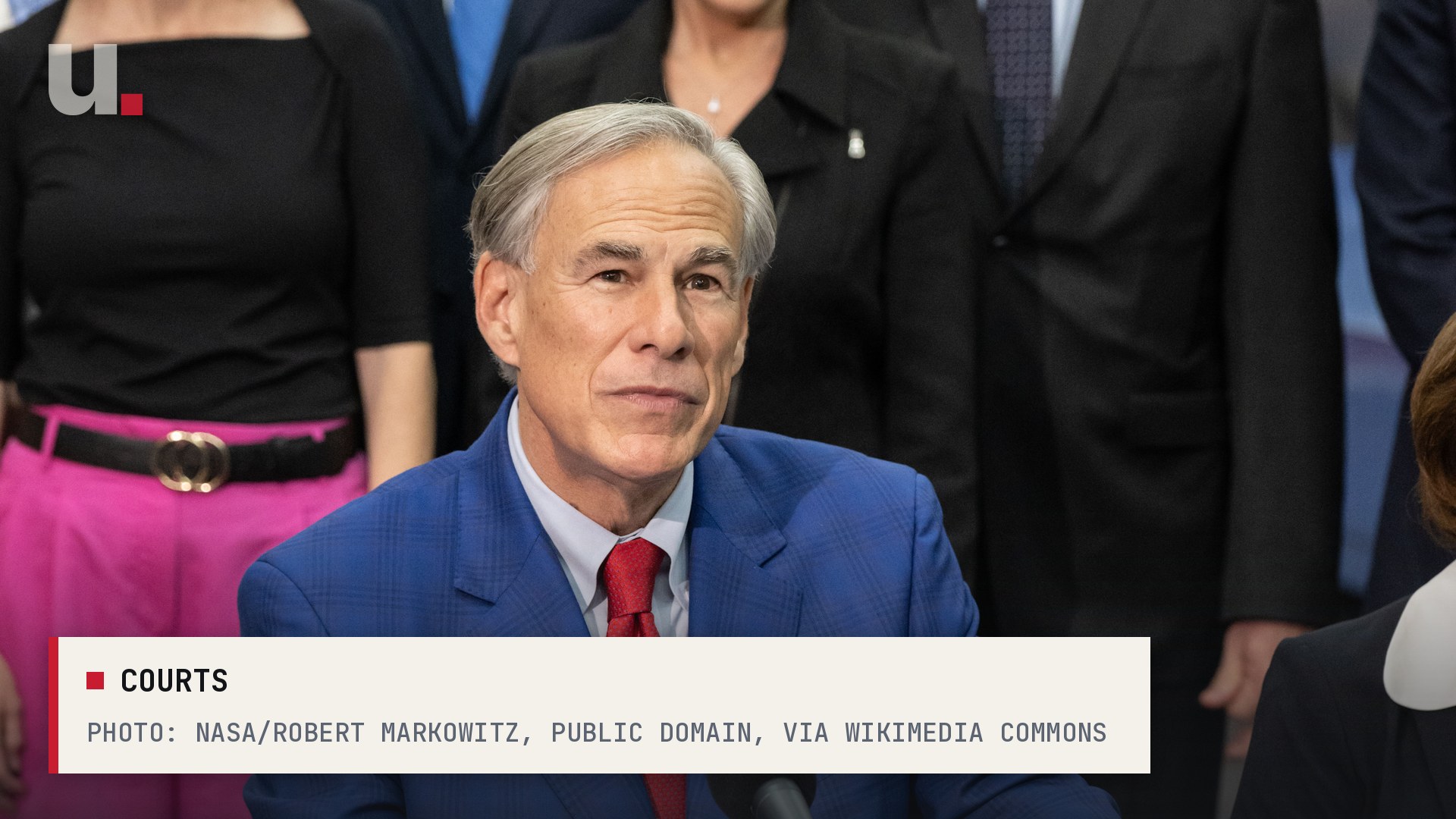
For three years, the mayors of Texas’s biggest cities have been trying to get a court to throw out the law that told them to stop writing their own versions of state rules. On Friday, the Supreme Court of Texas ended that effort without saying a word about it.
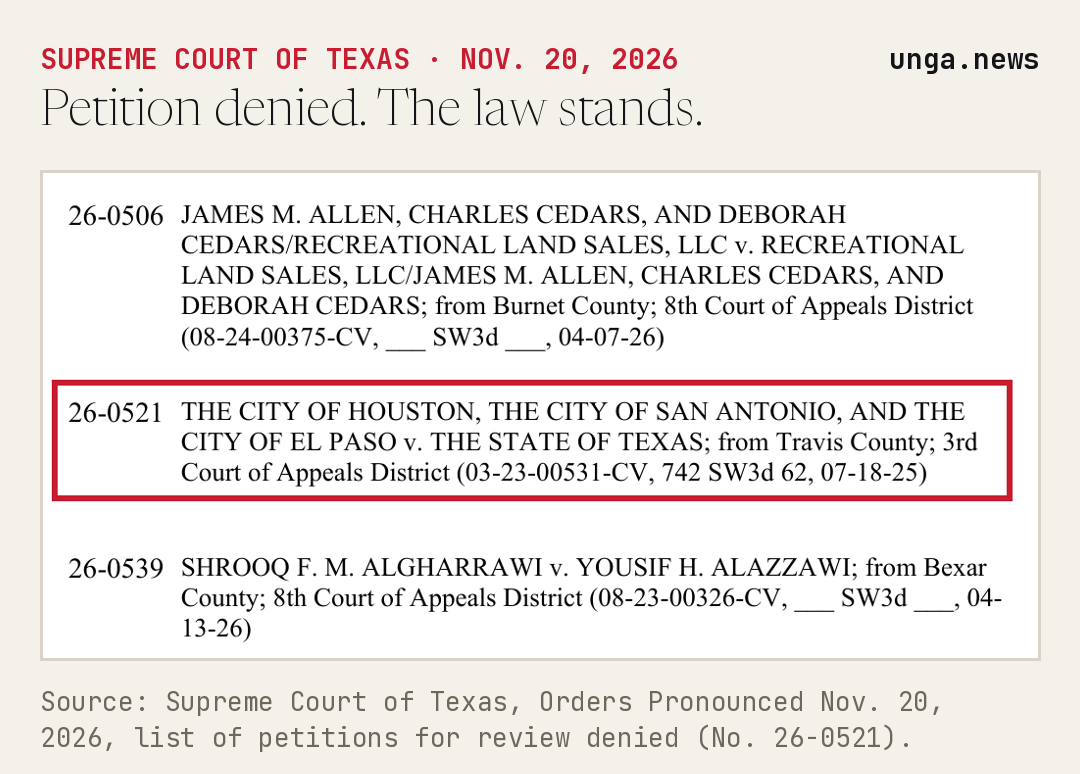
In its weekly orders, the state’s highest court listed The City of Houston, The City of San Antonio, and The City of El Paso v. The State of Texas, No. 26-0521, among the petitions for review it denied. No opinion, no dissent noted, no oral argument. That leaves in place a 2025 appeals court ruling that threw out the cities’ lawsuit, and it leaves House Bill 2127, the law critics nicknamed the “Death Star,” fully on the books.
One set of rules from El Paso to Beaumont
The idea behind the law is simple. Texas has 254 counties and more than 1,200 cities, and before 2023 a business working across the state could face a different rule on the same subject every time it crossed a city line. HB 2127 says that in eight big areas of state law, cities and counties can’t go further than the state already does. Those areas are the Agriculture, Business and Commerce, Finance, Insurance, Labor, Natural Resources, Occupations and Property codes.
If a city passes a rule that steps past those codes anyway, anyone hurt by it can sue. That private right to sue is what gives the law teeth. A mayor can’t simply ignore it and dare Austin to do something.
The author was Rep. Dustin Burrows, a Lubbock Republican, who told colleagues the bill would bring regulatory stability and certainty so the Texas economy could keep growing. He also pointed out what it didn’t touch. Cities kept their say over zoning, daycare centers, utilities, parking and other local business, KHOU reported at the time.
Gov. Greg Abbott had pushed for this kind of law for years, alongside Republican lawmakers and small-business groups like the National Federation of Independent Business. Versions failed in 2019 and 2021. In 2023 it finally moved.
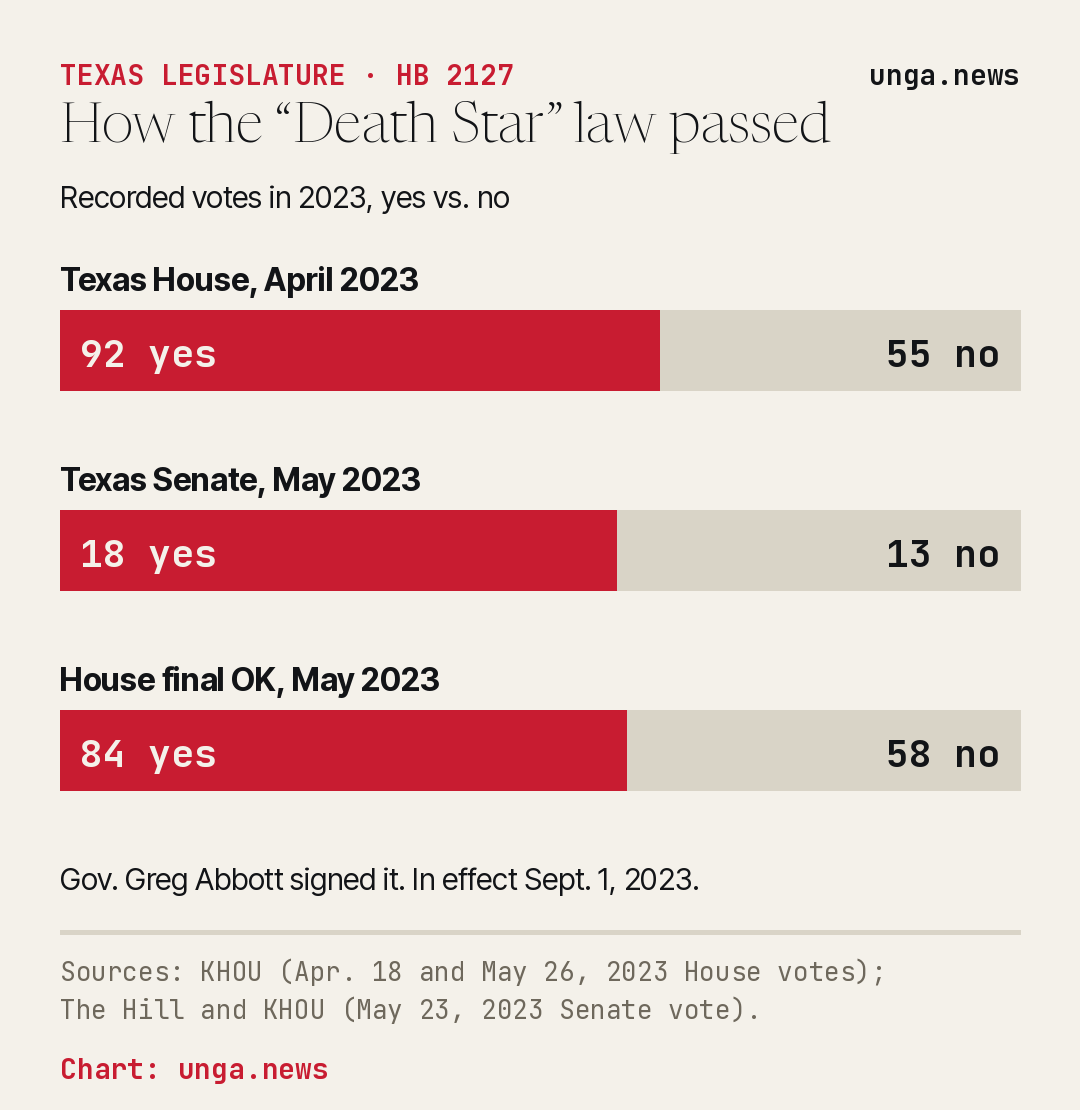
The House passed it 92-55 in April 2023, with eight of 65 Democrats voting yes, according to The Hill. The Senate followed 18-13 in May, with Sen. Robert Nichols, a Jacksonville Republican and former mayor, the lone Republican no. The House signed off on the Senate’s changes 84-58 a few days later. Abbott signed it, and it took effect Sept. 1, 2023.
Why the cities lost without a ruling on the merits
Houston sued the state on July 3, 2023, before the law even took effect. San Antonio and El Paso joined. The cities argued that HB 2127 violated the home-rule provision of the Texas Constitution, that it was too vague to follow, and that it handed lawmaking power to judges, according to a litigation summary from the Texas Municipal League, the cities’ own trade group.
A Travis County district judge agreed and declared the law unconstitutional on Aug. 30, 2023. But the ruling didn’t stop the law from taking effect two days later, and the state appealed.
On July 18, 2025, the Third Court of Appeals in Austin reversed that judgment and dismissed the case. The appeals court held that the cities lacked standing. They hadn’t shown a concrete injury from the law, and they couldn’t trace whatever harm they feared back to the state. In plain English: the cities were asking a court to strike down a law in the abstract, before anyone had actually used it against them.
That’s a basic rule of how courts work, and it’s a sound one. Judges decide real disputes between real parties. They aren’t supposed to issue advisory opinions because a city council doesn’t like a bill. The appeals court denied the cities’ request for rehearing on April 15, 2026, and the cities asked the Supreme Court to step in. Friday’s order means it won’t.
What has already changed on the ground
The law has been doing its job for more than two years. When it took effect, Austin’s and Dallas’s mandatory water-break rules for construction workers were wiped out, The Hill reported, because worker rules belong in the state Labor Code. The Texas Tribune reported Friday that some local rules on noise levels and car towing also fell off the books.
Local officials say the law is so broad they can’t always tell which rules are safe, and that the threat of a lawsuit has kept them from trying new ones. Supporters would answer that this is the point. A city that has to think twice before piling another layer of rules on employers and landlords is a city that is behaving the way the Legislature intended.
The law wasn’t a total wipeout for local governments either. After a long fight in 2023, existing city rules on payday lending were preserved, even though new ones are barred.
The bigger legal fight now runs through real cases, not hypothetical ones. On Oct. 29, 2025, three people sued the City of Dallas, claiming 83 of its ordinances and regulations went past what state law allows. A trial court granted Dallas’s motion to dismiss, which argued the plaintiffs hadn’t shown an actual or threatened injury, and the plaintiffs appealed to the Fifteenth Court of Appeals, according to the Texas Municipal League summary. That case, or one like it, is where the law will be tested against an actual ordinance.
The repeal push in Austin
Friday’s order doesn’t settle the political fight. Democrats, who will hold the governor’s office and control the Texas House when the Legislature convenes in January, want the law gone. Gov.-elect Gina Hinojosa told the Texas Tribune this week that she wants it repealed, and state Sen. José Menéndez, a San Antonio Democrat, has already filed a bill to do it.
They’ll have to get it through the Texas Senate first, where Republicans still hold the majority, and that is where the repeal is expected to meet stiff resistance. Any bill that dies there never reaches the new governor’s desk.
So for now the scoreboard reads like this: the Legislature passed the law, the governor signed it, an appeals court tossed the challenge, and the state’s highest court declined to revisit it. Because the case was tossed on standing, the cities’ constitutional arguments were never decided, and they can come back the day the law is used against an actual ordinance. Until then, one set of rules covers the whole state, and the people who wrote it got exactly the result they asked for.
Sources
- Supreme Court of Texas — Orders Pronounced November 20, 2026 (No. 26-0521, petition for review denied)
- Texas Municipal League — H.B. 2127 Litigation Update (June 4, 2026)
- The Texas Tribune — Texas Supreme Court leaves “Death Star” law intact as Democrats plan effort to repeal it (Nov. 20, 2026)
- KHOU — Texas House passes controversial ‘Death Star Bill’ 92-55 (Apr. 18, 2023)
- KHOU — Texas Death Star Bill heads to Gov. Greg Abbott’s desk (May 2023)
- The Hill — Texas passes bill stripping authority from cities (May 2023)