

Illinois Freed the Drunk Driver Who Killed a Marine Veteran. ICE Caught Him Nine Days Later.
An Illinois prison paroled an illegal alien serving 25 years for a crash that killed a Marine vet. ICE had asked twice to be told first. The state never called, so ICE officers tracked him down themselves.
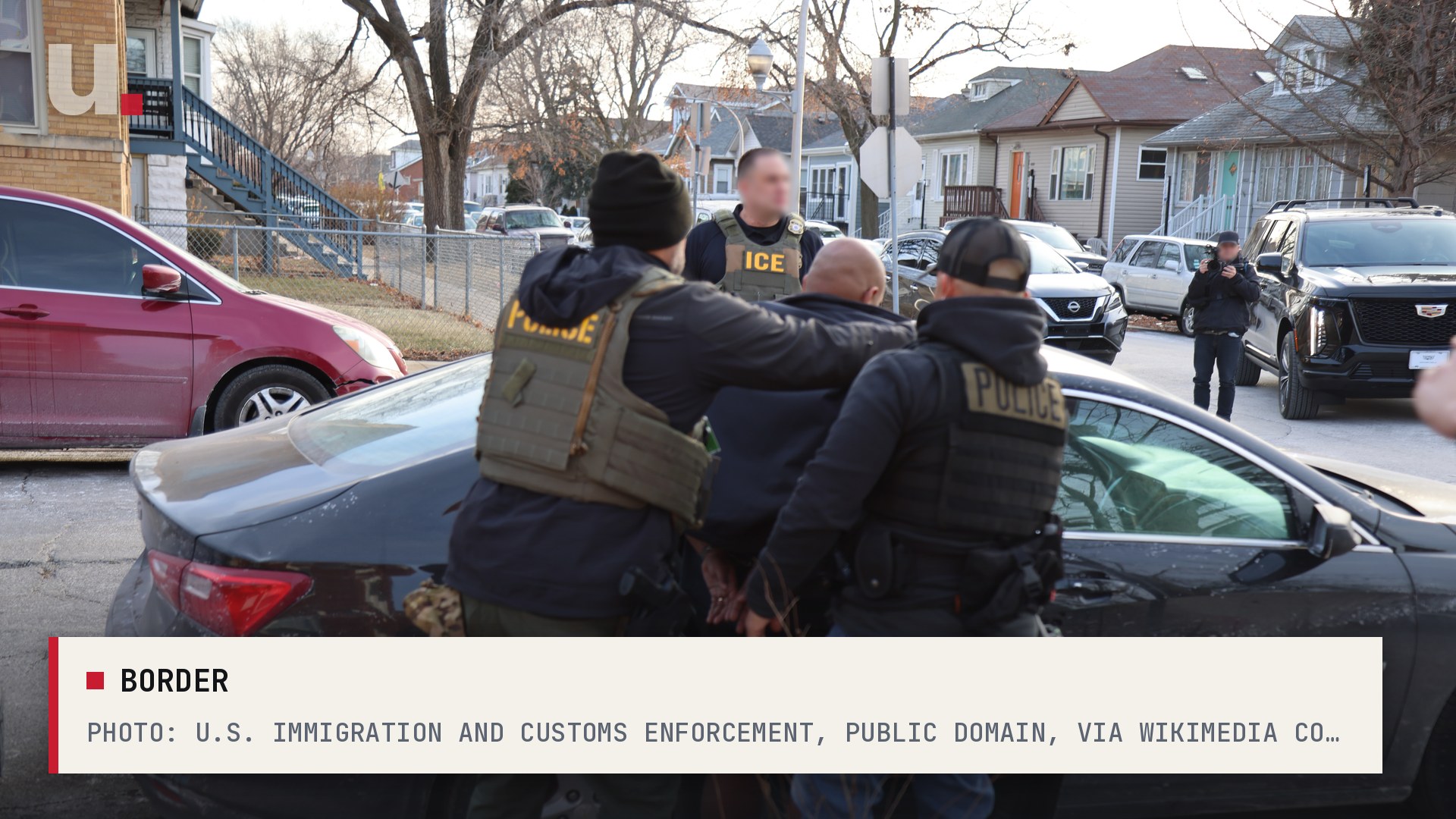
Gregory Homola was 55 years old and riding his motorcycle on July 24, 2011, when a drunk driver hit him. The Marine Corps veteran died. Two women in another car were hurt. The man behind the wheel had already been caught crossing the border illegally, already been ordered out of the country by a judge, and already been arrested for driving drunk, according to the Department of Homeland Security.
On Nov. 2, an Illinois state prison let that man walk out on parole. It did not call ICE, even though ICE had asked twice to be told when he got out. Nine days later, ICE officers tracked him down anyway.
DHS laid out the case in a statement Friday. The man is Vicente Torres-Vasquez, an illegal alien from Mexico. ICE’s Chicago field office arrested him Nov. 11 in Wauconda, a small town in Lake County north of Chicago. He is now in federal custody awaiting removal.
A record that kept growing
The paper trail DHS released reads like a list of chances the system had to stop him.
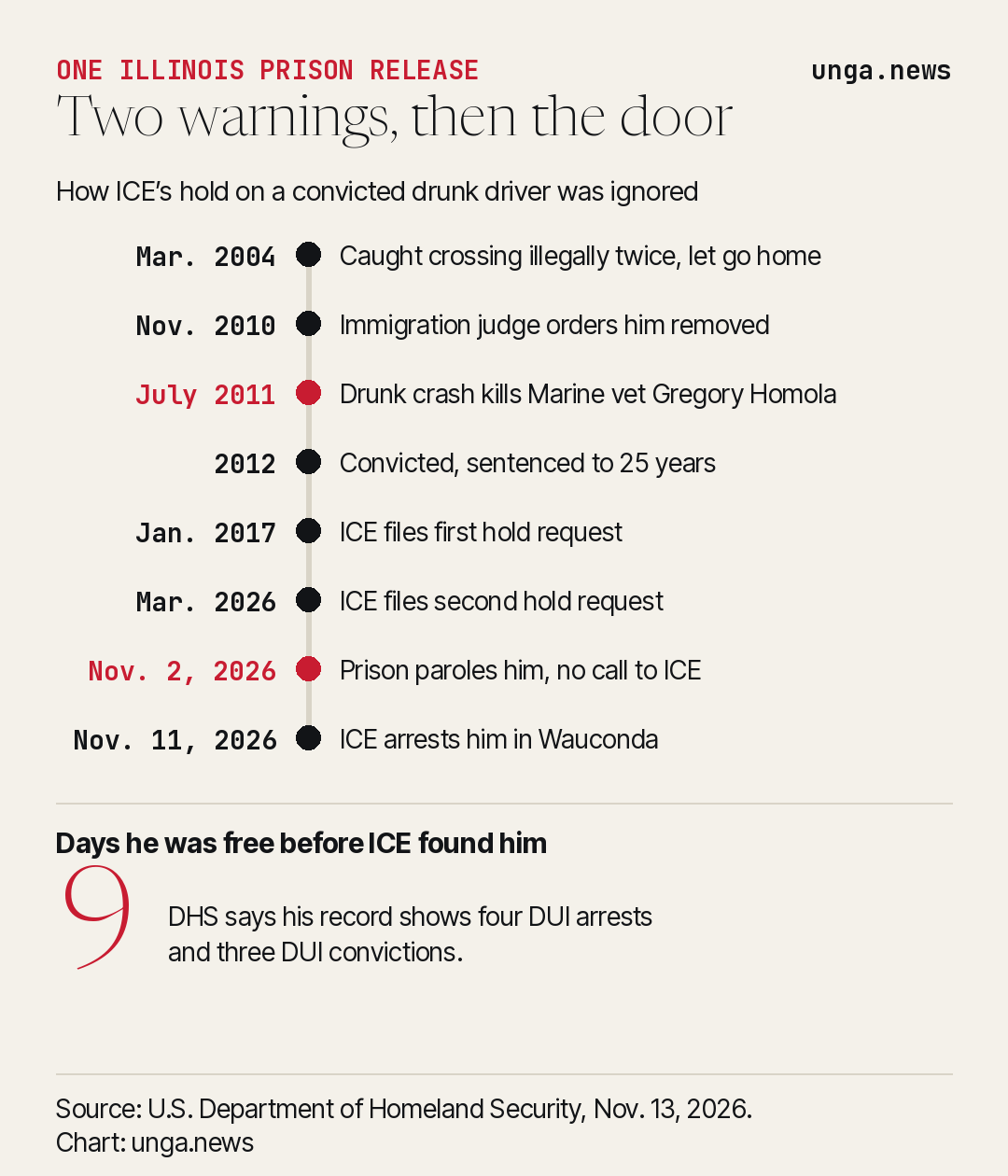
In March 2004, Torres-Vasquez was caught crossing into Arizona illegally, twice. Both times he was allowed to leave on what’s called voluntary departure, which is basically a pass to go home with no removal order on his record. He came back a third time, by a route and on a date nobody recorded. On Nov. 11, 2010, an immigration judge issued him a final order of removal.
Eight months later, he killed Homola. DHS says Torres-Vasquez had been arrested four times for drunk driving and convicted three times. In 2012, an Illinois court convicted him of aggravated DUI resulting in death, plus two counts of aggravated DUI causing great bodily harm for the women in the other car. The sentence was 25 years.
So for all of his prison time, the state knew exactly who he was. He wasn’t a mystery. He was a convicted killer with a deportation order already signed.
Two requests, no phone call
ICE did its part. On Jan. 16, 2017, it lodged a detainer with the Illinois River Correctional Center in Canton, where he was serving his time. A detainer is a simple request: tell us before this person gets out, and hold him up to 48 hours so our officers can come get him.
In March of this year, the state moved Torres-Vasquez to Stateville Correctional Center in Crest Hill to get ready for his parole date. ICE lodged a second detainer there. On Nov. 2, according to DHS, Stateville “refused to honor the ICE detainer” and released him without telling ICE.
Homeland Security Secretary Markwayne Mullin put the blame where he thinks it belongs. “When ICE lodged a detainer ahead of his release on parole, sanctuary politicians in J.B. Pritzker’s Illinois refused to cooperate with us and released him without notifying ICE,” he said. “Thankfully, the brave patriots of ICE managed to arrest this killer anyway, and he will now be deported from our country.”
We found no public response from the Illinois Department of Corrections or Gov. Pritzker’s office to DHS’s account as of Saturday.
The law Illinois wrote for itself
This didn’t happen by accident. Illinois passed the TRUST Act in 2017 and has tightened it since. The key line, as Illinois Attorney General Kwame Raoul’s office explains in its guidance to police, says a law enforcement agency “shall not detain or continue to detain any individual solely on the basis of any immigration detainer or civil immigration warrant or otherwise comply with an immigration detainer or civil immigration warrant.”
Read that last part again. Not just “don’t hold him an extra day.” Don’t comply, period. The state’s own guidance tells local agencies that holding someone for ICE past their release date could expose them to lawsuits.
Supporters say the law builds trust between immigrant neighborhoods and local police. Maybe so. But the man in this case had nothing to do with a neighbor reporting a burglary. He was sitting in a state prison cell for killing a veteran, with a removal order already on the books, and all ICE wanted was a heads-up and a short hold before the gate opened.
Congress has been asking about this exact problem for months. On May 21, House Judiciary Chairman Jim Jordan and immigration subcommittee chairman Tom McClintock sent a letter to Illinois corrections director Latoya Hughes saying “Illinois’s sanctuary laws have prevented IDOC from complying with ICE detainers” for years. They listed other prisoners ICE says the state released instead of handing over: a man sentenced to 30 years for attempted murder, aggravated sexual assault and kidnapping; another convicted of attempted murder; another sentenced to 17 years for assault on a child.
The letter also cited DHS figures saying Illinois sanctuary policies led to the release of nearly 2,000 criminals in less than 11 months of 2025. It asked Hughes to turn over the number of ICE detainers the department had received and declined since 2018, with a June 4 deadline.
Nine days of luck
Here is the part that should bother every family in Lake County. Torres-Vasquez was out for nine days before ICE found him, and ICE found him only because its officers went looking. Nobody in Springfield helped. If he had disappeared, the first anyone heard of him again might have been another crash.
Illinois has a long list of these cases. DHS pointed to several, including Julio Cucul-Bol, the illegal alien charged in the January 2025 drunk-driving crash that killed 20-year-old Katie Abraham in Urbana. ICE named its Chicago-area enforcement surge, Operation Midway Blitz, in her honor.
The fix doesn’t take a new federal program. It takes a state willing to make one phone call when a convicted killer with a deportation order is about to go free. Illinois lawmakers wrote a law that tells their own agencies not to cooperate. ICE’s officers in Chicago made up the difference this time. Gregory Homola’s family should never have had to count on that.
Sources
- U.S. Department of Homeland Security — ICE Arrests Illegal Alien Responsible for Fatal DUI After Illinois Sanctuary Politicians Released Him (Nov. 13, 2026)
- House Judiciary Committee — Letter from Chairmen Jim Jordan and Tom McClintock to Illinois Department of Corrections Director Latoya Hughes (May 21, 2026)
- Illinois Attorney General — Guidance to Law Enforcement on immigration law and the Illinois TRUST Act
- U.S. Immigration and Customs Enforcement — Immigration Detainers