

Iran Is Choking One Oil Route. Its Houthi Allies Just Took Over the Backup.
Saudi-backed Yemeni troops pulled back from the Red Sea’s southern gate on Sunday. That leaves the Iran-backed Houthis over the strait that carried more oil than Hormuz this spring.

For most of this year, the Red Sea was the escape hatch. With Iran choking the Strait of Hormuz, Gulf oil that used to sail out past Iran found another way out, down the west side of the Arabian Peninsula and through a gap roughly 20 miles wide off Yemen called the Bab el-Mandeb. On Sunday, the forces guarding the Yemeni side of that gap packed up and left. The Iran-backed Houthis now hold the high ground over it.
“The Southern Armed Forces announce the implementation of a redeployment operation for its forces from Dhubab Airport and the Bab el Mandeb area, west of Taiz Governorate,” the Saudi-backed group said in a statement reported by Reuters. “This step is taken based on the priority of securing the capital, Aden, and the neighbouring governorates, as well as strengthening the front lines and addressing existing threats.”
Translation: the Houthis are close enough to Aden, the seat of Yemen’s internationally recognized government, that its troops can no longer afford to sit on the coast. Sources told the French news agency AFP the Houthis are now about 60 kilometers from the city, less than 40 miles.
The government side insists this is not a retreat. Jaber Mohammed, a media adviser to Yemen’s presidency, told Asharq Al-Awsat the move “should not be interpreted as a withdrawal in the military sense,” and said the troops pulled back to the Al-Suqyah area, about six to eight kilometers from the strait. He argued that men strung along an exposed coastal strip were easy targets, and that the real danger sits in the mountains overlooking Bab el-Mandeb, Dhubab and Mayyun Island.
Maybe so. But whoever holds those heights holds the gate, and on Sunday that was not the government.
Perim Island is the prize
The fight for this coast has swung back and forth all fall. The Houthis launched a lightning offensive in September, took the port town of Mocha and pushed south toward the strait in a bid for Yemen’s entire Red Sea coastline. The government answered on Oct. 5 with a counteroffensive it called Operation Fajr Yemen, and last month said it had won back Dhubab and Mocha. Now the Houthis are back.
The trade journal Maritime Executive called the pullout “a major reverse” and said the government does not appear to have the forces to mount a counterattack. The withdrawal leaves the Houthis free to reoccupy the Ras Menhali peninsula and Perim Island, which sits right in the mouth of the strait.
That island changes the math for every captain who sails past it. In 2023 and 2024, the Houthis harassed shipping from a distance with drones and missiles. With Perim in hand, Maritime Executive wrote, they can use armed speedboats to attack and board ships, “making it a much more practical operation to close down traffic.”
Where the rerouted oil goes
Here is why a militia fight in one of the poorest countries on earth can reach an American gas pump. The U.S. Energy Information Administration tracks how much oil squeezes through the world’s choke points. Before the Iran war, the Strait of Hormuz carried about 21 million barrels a day. By April through June of this year, it was down to 4.9 million, a 77% drop from the end of 2025.
The Bab el-Mandeb went the other way. It carried 3.9 million barrels a day in early 2025 and 8.1 million in the second quarter of 2026, according to EIA’s global energy security data. For the first time in that data, more oil moved past Yemen than past Iran.
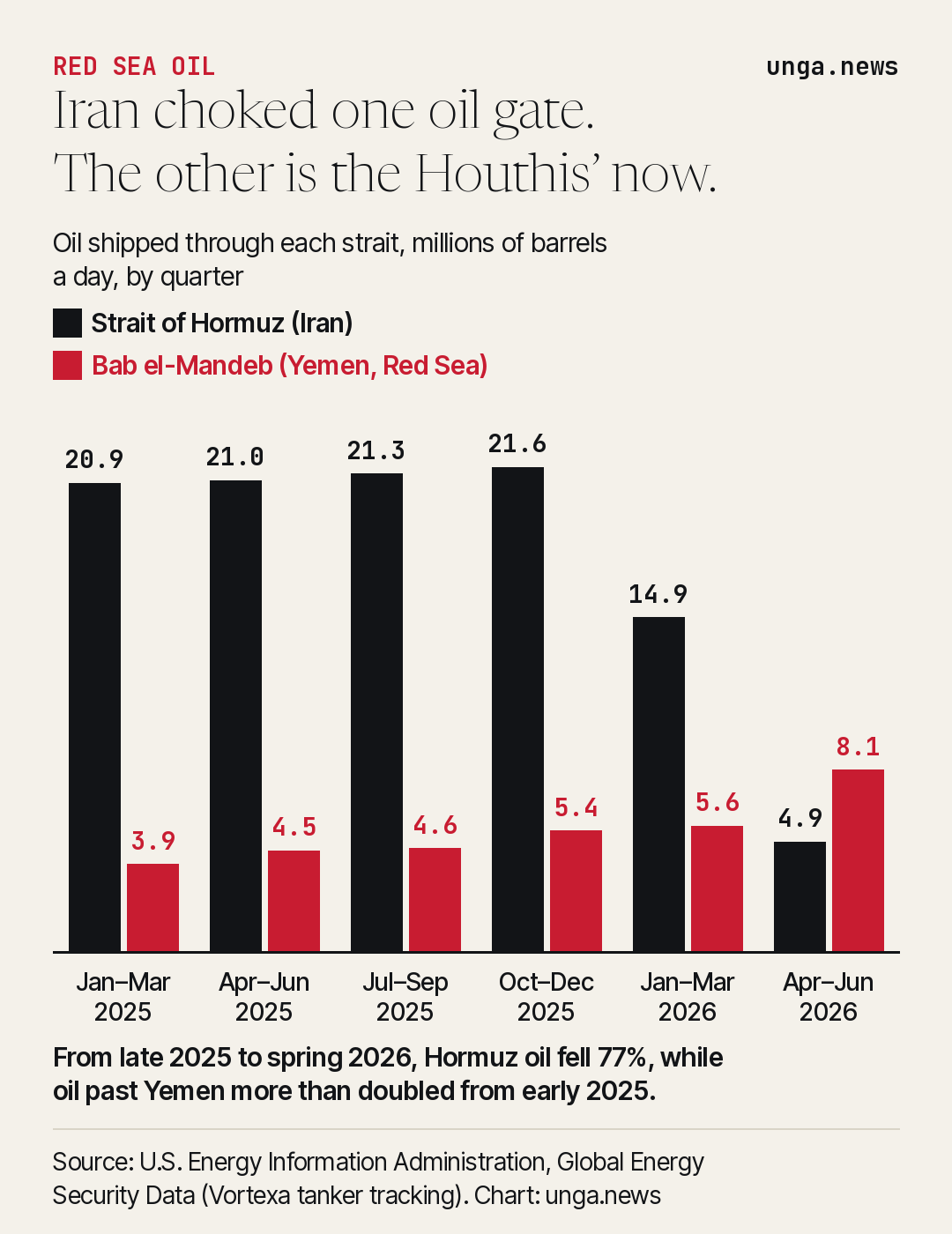
Most of that jump is crude oil, 6.1 million of the 8.1 million barrels a day. Reuters reported the Houthis have already struck Saudi ports, airports and Saudi Aramco facilities, including Yanbu, the kingdom’s Red Sea oil export hub, after their offensive tore up a 2022 truce brokered by the United Nations. Now they sit over the exit, too. Reuters called it a “dual squeeze” that further isolates Gulf oil producers from their main shipping routes.
A broke militia with a tollbooth
So far, the Houthis say they are only going after Saudi and Israeli-linked ships, and that pitch worked. Maritime Executive reported that the United States, the European Union and major shipping lines have accepted it, and container lines have gone back to using the Red Sea.
The same journal warned that may be naive. The Houthis are “desperately short of finance,” it wrote, and they like to point to the fees Egypt charges ships to use the Suez Canal as a model for what they could charge at Bab el-Mandeb. The European naval mission in the area, Operation Aspides, can mount only occasional escorts and is not built to do more than defend itself and a few merchant ships.
There is also a reason Tehran might want its friends to tighten the screws now. Maritime Executive noted that America’s naval blockade of Iranian ships and ports is creating major pressure inside Iran, and that Iran’s Revolutionary Guard still keeps advisers on the ground with the Houthis. A blockade in the Red Sea would be Iran’s way of hitting back through someone else’s hands.
Saudi Arabia has struck Houthi targets in Yemen in response to the attacks on its soil, and the southern forces say the coalition is backing this redeployment. We reported earlier this month when Houthi ballistic missiles were headed for Riyadh and shrapnel hit an Aramco building. Sunday’s pullback puts the strait’s Yemeni shore back in their hands.
Inland, the human cost keeps climbing. Taiz, the city the southern forces say they want to free, remains under siege. Reuters reported that aid cannot get in and civilians cannot get out, and that the city holds about half of the 300,000 people driven from their homes by the latest fighting.
The southern forces say pulling back from the coast will help them break that siege and protect Aden. If they are right, Sunday was a smart trade. If they are wrong, a group that chants “Death to America” just got its hands on the narrowest door the world’s oil still has open, at the exact moment the other one is shut.
Sources
- Reuters via NBC News — Yemen government forces withdraw from area near Bab el Mandeb strait, Houthis in control (Nov. 15, 2026)
- The Maritime Executive — Houthis Recapture Positions Overlooking the Bab el Mandeb (Nov. 15, 2026)
- Arab News / Asharq Al-Awsat — Yemeni presidency: redeployment of forces near Bab Al-Mandab a ‘calculated military move’
- DW — Yemen: Anti-Houthi forces pull back as rebels advance
- The National — Yemen government forces’ pullback hands Houthis greater leverage over Bab Al Mandeb
- U.S. Energy Information Administration — Short-Term Energy Outlook: Global Energy Security Data (chokepoint oil flows, 1Q25–2Q26)
- U.S. Energy Information Administration — Fewer tankers transit the Red Sea in 2024