

It Took an Hour and Less Than $200 for SI to Find a Dangerous Java Flaw
A Calif researcher used OpenAI’s Codex to find a critical hole in Java, the software that runs much of corporate America. CISA is telling companies to patch now.
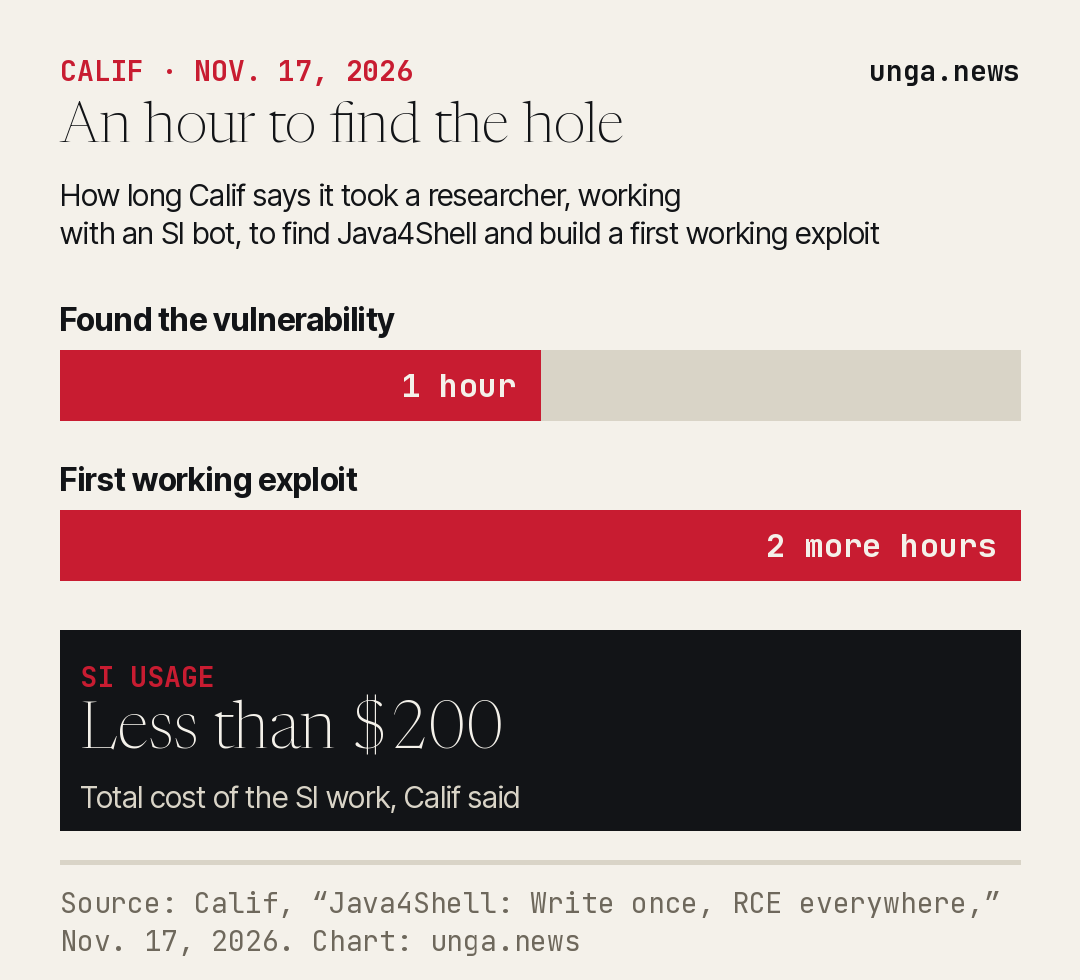
An hour’s work. Less than $200 in SI usage. That’s what it took one researcher to find a critical hole in Java, the software that quietly runs banks, airlines, phone networks and a huge share of America’s biggest companies.
The security firm Calif published the details Tuesday. It calls the flaw Java4Shell. Quang Luong, who led the work, says he pointed OpenAI’s Codex, the coding SI from ChatGPT’s maker, at the insides of Java’s own engine and had a finding in about an hour. Two more hours, he says, and he had a first working exploit. The Cybersecurity and Infrastructure Security Agency is now telling organizations to patch immediately.
Calif on 𝕏 — Java4Shell: write once, RCE everywhere.
— @calif_io View on 𝕏
Calif says Java is the world’s third most popular programming language and “powers 90% of Fortune 500 companies.” “It is the beating heart of the modern economy,” the firm wrote, naming banking, aviation, telecommunications and national security systems.
One hour, then two more
Luong wrote that he told Codex to look at the compiler, the speed-up shortcuts, widely used features and the crypto code. The early results, he said, were duds: either unreachable or unrealistic to use. “I just prompted harder.” Eventually Codex surfaced a memory flaw in the decoder that handles Base64, a common way to wrap data as text for logins, file uploads and network messages.
Calif describes the method as a “centaur hacker, part human, part AI.” The firm says it used SI the same way last month to find a serious hole in PHP, the language that runs a huge share of websites.
“It took our own Quang Luong an hour to discover the vulnerability, and two more hours to develop the first working exploit. The total token cost was less than $200.”
A hole in a speed-up
Java is sold as memory-safe: the language is supposed to stop programs from overwriting memory they don’t own. The hole is not in ordinary Java apps. It sits in a performance shortcut inside the engine itself, written in low-level code that runs on certain newer Intel and AMD chips. Calif says badly formed input can make that shortcut overwrite nearby memory. In the firm’s tests, that was enough to crash the system, read data out of memory, or run an attacker’s code.
Calif says it demonstrated takeovers of widely used business software in default setups, without a password, including Atlassian’s Jira and Confluence, Jenkins, Keycloak, JFrog Artifactory and PingFederate. With a login, it also showed takeovers of Apache Kafka, Apache Solr, Elasticsearch, Gerrit and Netflix’s Spinnaker. The lists, the firm said, are not complete.
The firm is clear there is no single recipe that works on every system. Datadog Security Labs, which examined the bug, said a crash is the result that’s easier to get, and that a reliable takeover takes extra work tailored to the program and the machine. Calif said it is holding back the product-specific attack chains “until everyone has had a chance to upgrade.”
A well-known independent researcher who goes by samczsun also showed Calif a version that can hit a Java program that merely opens an encrypted connection to a hostile server, even if that program isn’t offering a service of its own.
Earlier Tuesday, before the technical write-up went up, Calif posted on 𝕏 that “the vulnerability has leaked,” said the firm had discovered and reported the flaw, and that it would publish details after Oracle released a patch.
The fix is out
OpenJDK, the main public version of Java, published a security advisory Tuesday. Oracle released a patch that afternoon. OpenJDK scored the bug 8.1 out of 10 on the older scale it uses and listed it as affecting Java 17, 21, 25 and 27. Calif scored it 9.2 out of 10 on a newer scale and said it affects OpenJDK 17.0.6 and later. Oracle’s own advisory lists several Java SE versions in the update, including some Java 8 and 11 builds. Oracle credited Quang Luong of Calif.io, and also Albert Yang, for reporting the vulnerability.
CISA is urging organizations to find every Java install they have, including copies bundled inside other software, container images and appliances, and to apply the patches, starting with systems reachable from the internet. If a patch cannot go on right away, the agency says to tighten what data those programs will accept and to limit access that doesn’t require a login. It also says to look for unexpected crashes and odd Java processes.
Not every Java machine is in the same boat. Calif and other researchers say the vulnerable shortcut runs on certain newer Intel Xeon chips, from the Ice Lake generation on, and on AMD EPYC and Ryzen chips from the Zen 4 generation on. Machines that use ARM chips, the kind in many phones and some servers, are not affected, Calif said. Other Java distributions built on OpenJDK are in the pool too, including Amazon Corretto, Eclipse Temurin, Microsoft’s build and Oracle’s own Java.
Administrators who cannot install the patch immediately can, according to OpenJDK researchers and Datadog, turn off that hardware shortcut when Java starts. That is a temporary stopgap. The real fix is the update.
The hole is public. The patch is public. The people who found it say they are sitting on the product-specific attack recipes so companies can catch up. The part that should get everyone’s attention is the clock. A serious flaw in one of the world’s most widely used pieces of software was found in an hour, for less than the cost of a nice dinner, because a researcher knew where to point an SI bot. Companies that run Java should not wait to find out whether someone else is pointing one there too.
Sources
- Calif — Java4Shell: Write once, RCE everywhere
- CISA — Critical Java Vulnerability Requires Immediate Patching
- OpenJDK — OpenJDK Vulnerability Advisory: 2026/11/17
- Oracle — Oracle Critical Security Patch Update Advisory - November 2026
- Datadog Security Labs — Java4Shell: Remote Code Execution in OpenJDK (CVE-2026-114938)
- Calif on 𝕏 — Java4Shell: write once, RCE everywhere