

Japan Is Having So Few Babies That Each New Generation Is on Track to Be Just Over Half the Size of the Last
Japan recorded 671,236 births in 2025, the fewest on record, and 2.4 deaths for every birth. Most rich countries are below replacement too. But weddings are up two years running, and births just posted their first half-year rise in 11 years.

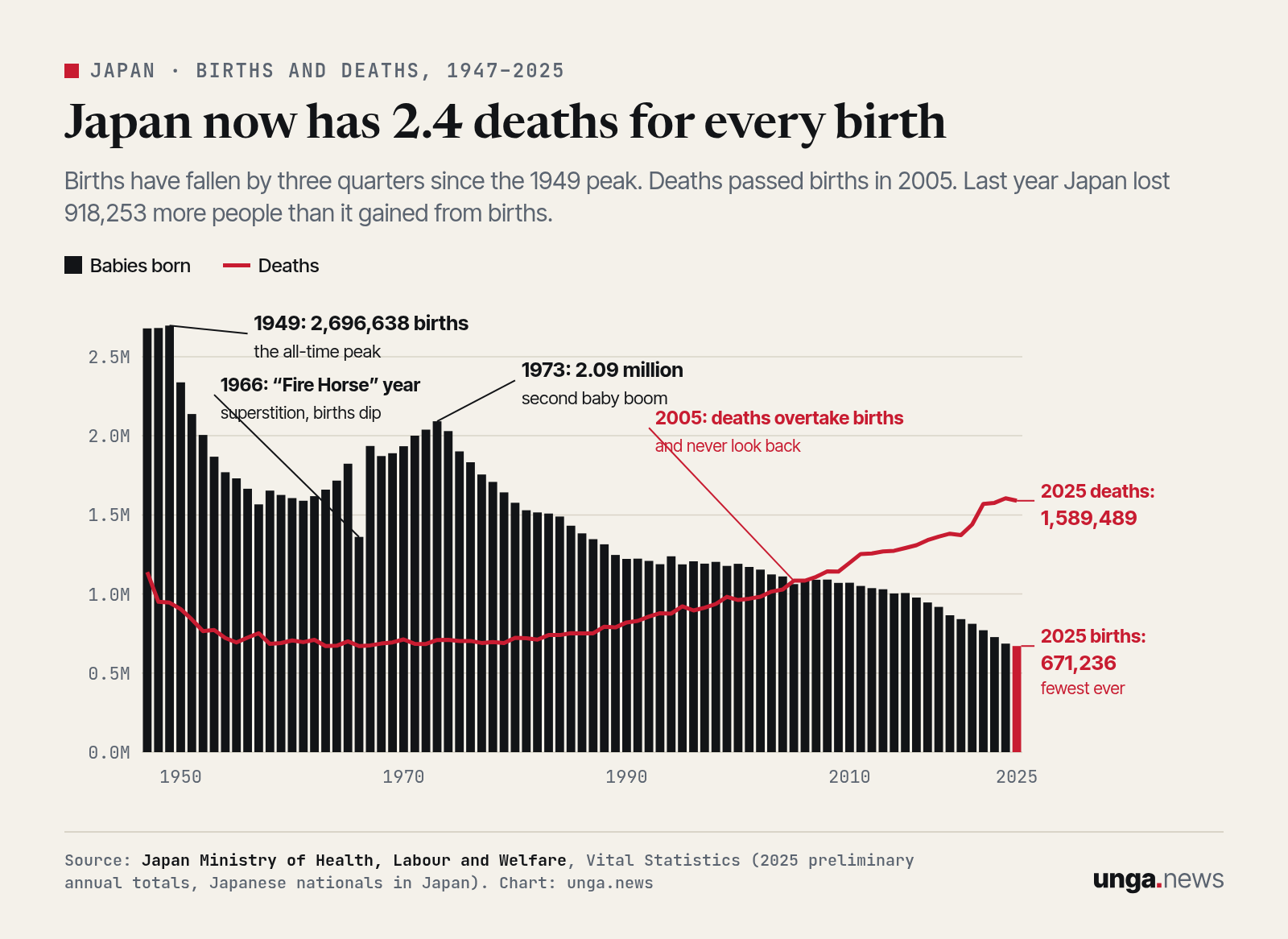
Japan just set a record nobody wants. The country recorded 671,236 births in 2025, the fewest in records going back to 1899, according to preliminary figures from the Ministry of Health, Labour and Welfare. In the same year, 1,589,489 people died. That's 2.4 deaths for every baby born, and a loss of 918,253 people in one year from births and deaths alone. It is the 19th straight year Japan has shrunk that way.
The fertility rate, the number of children a woman is expected to have in her lifetime, slipped to 1.14, the lowest ever. A country needs about 2.07 just to hold its population steady, according to Japan's National Institute of Population and Social Security Research (IPSS).
What "half the size" really means
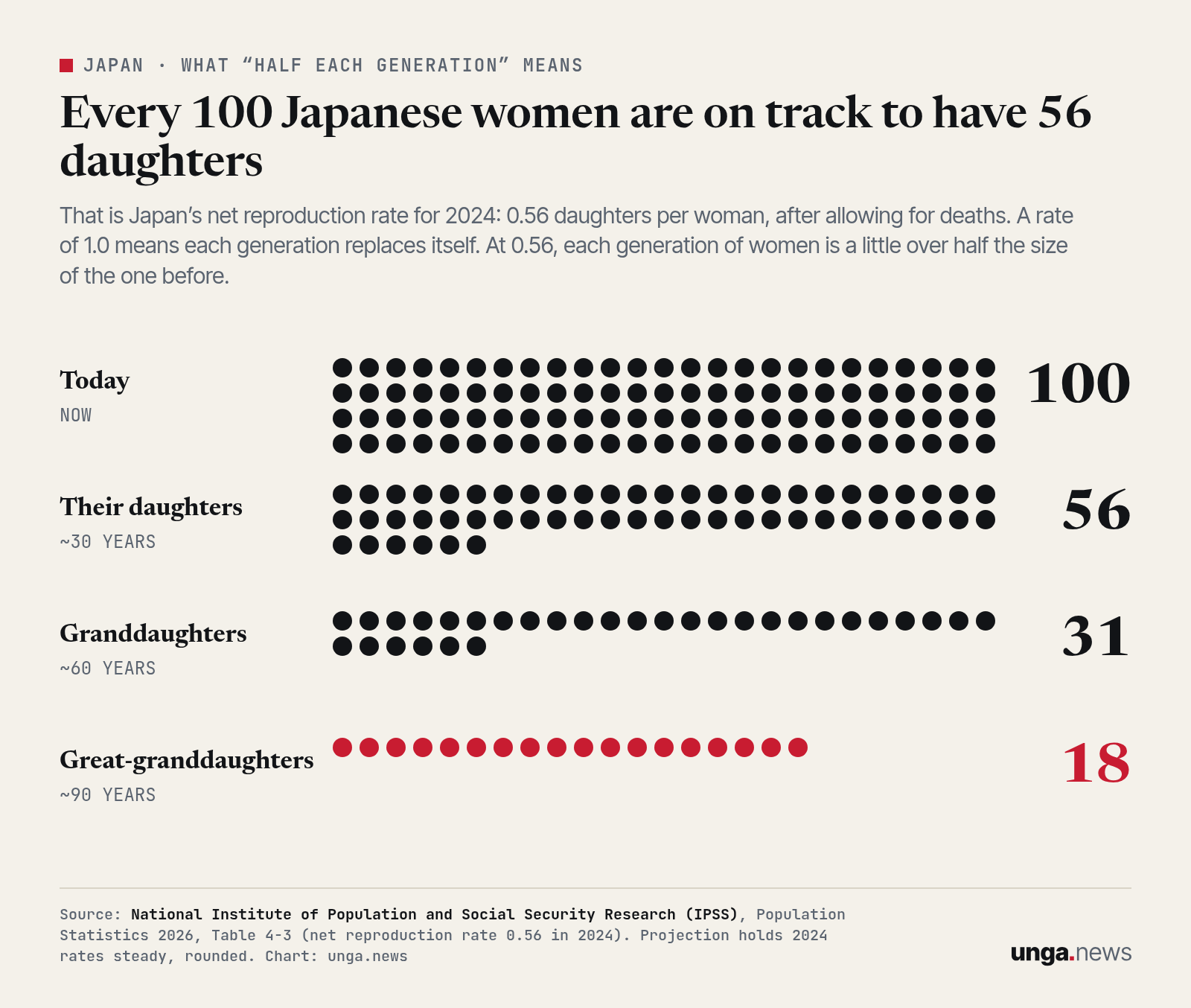
Here's the number that should keep Tokyo up at night. IPSS tracks something called the net reproduction rate: how many daughters each woman has, after allowing for deaths. It was 0.56 in 2024. A rate of 1.0 means each generation of women exactly replaces the one before. At 0.56, every 100 women today are on track to have 56 daughters. Keep that rate for three generations and those 100 women end up with about 18 great-granddaughters.
Picture a classroom of 30 kids. At today's rates, their children would fill about 17 seats, and their grandchildren fewer than 10.
The institute's official projection, released in 2023, has Japan's population falling from 126 million in 2020 to about 87 million by 2070, and that figure already counts foreign residents.
No weddings, no babies
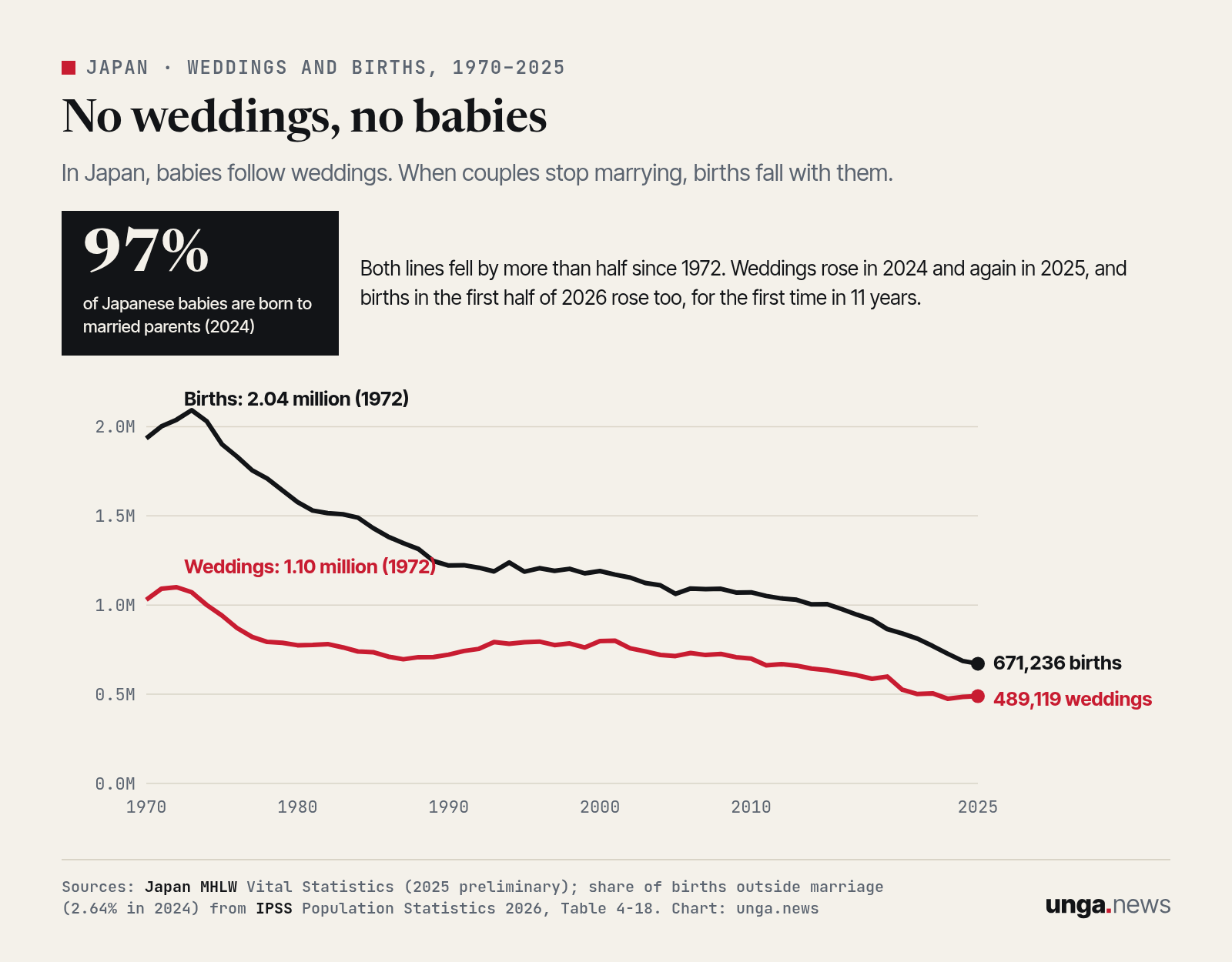
So why is this happening? In Japan, the answer starts at the altar. Just 2.64% of Japanese babies born in 2024 had unmarried parents, according to IPSS. When couples stop marrying, births stop with them. Weddings peaked at 1,099,984 in 1972. Last year there were 489,119.
People are also starting families later. The average age at first marriage is 31.0 for men and 29.7 for women, and first-time mothers average 31.0. Births fell for first, second and third children alike in 2025. Tokyo's fertility rate is 0.96, the lowest of any prefecture. Okinawa's, at 1.52, is the highest.
A first crack of light
There is some good news, and it starts with weddings. Marriages rose in 2024 and again in 2025. Then births in the first half of 2026 came in at 342,068, up 0.8% from a year earlier, the first first-half increase in 11 years, according to the ministry's monthly report. That count includes foreign residents and Japanese born abroad, so the final figure will be lower, and one half-year is not a trend.
It's also happening in a year many families once avoided. 2026 is a "Fire Horse" year on the old zodiac calendar. The last one, in 1966, births fell 25% because of an old superstition about girls born in those years. So far, no repeat.
Japan has also been spending. Since October 2024, the national child allowance has had no income cap, runs through high school age and pays 30,000 yen a month for a third child, according to the Children and Families Agency.
Prime Minister Sanae Takaichi has made the issue a priority. "Population decline is a national crisis that is quietly unfolding," she told parliament in her Oct. 5 policy speech, according to her office's English translation. "We must reverse the tide of the declining birthrate." Her government, which set up a Population Strategy Headquarters last November, plans a comprehensive population strategy by the end of 2026. She said it would also rethink Japan's "fundamental stance on the acceptance of foreign nationals."
How the rest of the world compares
Japan isn't an outlier. It's a preview.
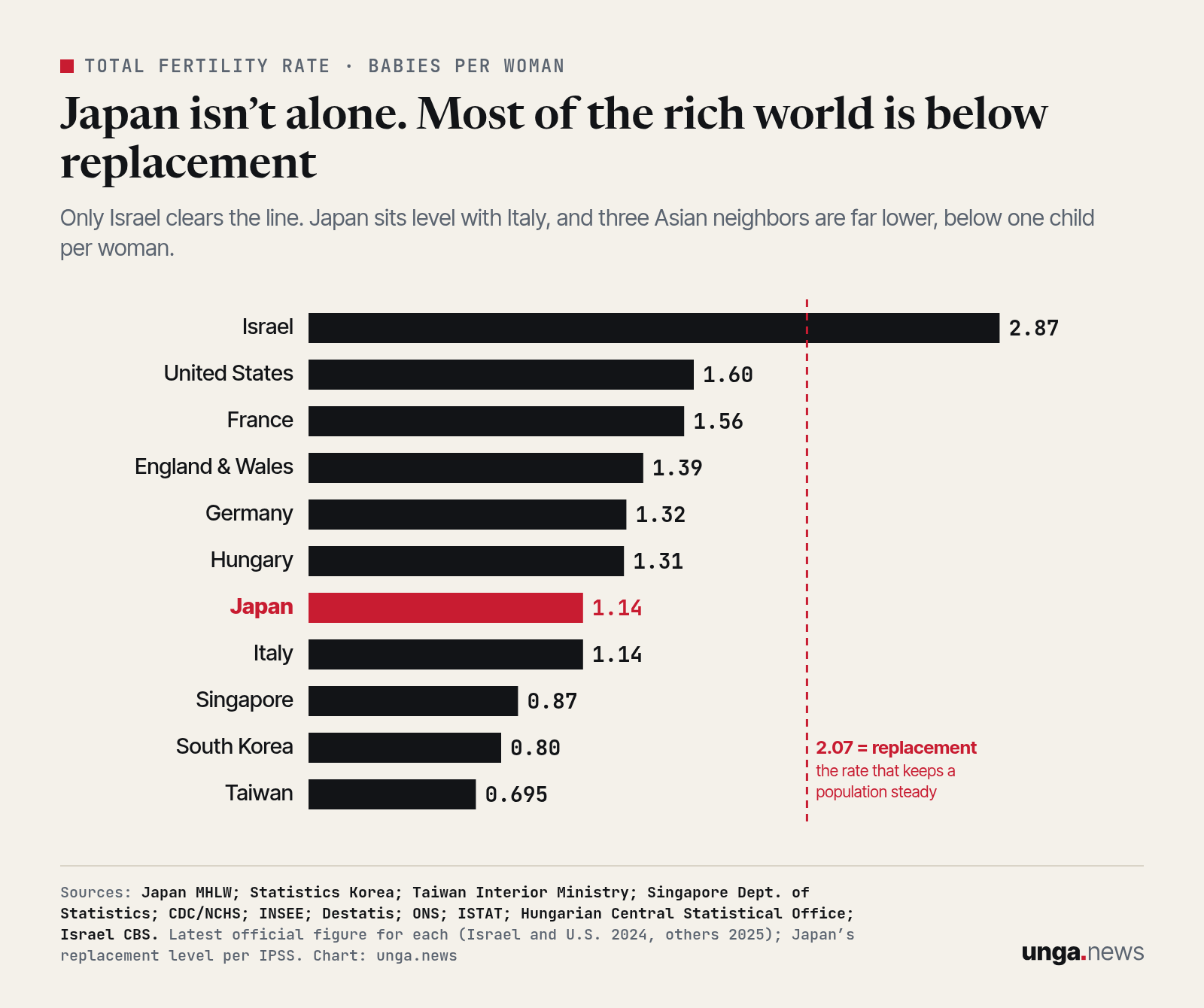
East Asia is lowest. South Korea, long the world's lowest, came in at 0.80 last year, up from 0.72 in 2023. Its rebound tracks weddings too. Births to couples married less than two years jumped 10.2%, according to Statistics Korea. Taiwan fell to 0.695, with births down 20% in a single year, its Interior Ministry reports. Singapore is at 0.87.
Europe is sliding. Italy matches Japan at 1.14. Germany is at 1.32, England and Wales at 1.39 and France at 1.56, its lowest since the end of World War I, according to its statistics agency INSEE. Hungary, which made pro-family policy a centerpiece of government, lifted its rate from 1.23 in 2011 to 1.61 in 2021. It has since slipped back to 1.31.
The exception is Israel, at 2.87 children per woman in 2024, according to its Central Bureau of Statistics. It is the only country in this group above replacement.
America is at 1.60, a record low in the CDC's final 2024 data, and births slipped another 1% in 2025 to about 3.61 million. President Trump's answer includes Trump Accounts: the Treasury will deposit $1,000 for each U.S.-citizen child born from 2025 through 2028, according to the IRS.
The bottom line
Japan's numbers show this isn't about money alone. A country with generous child benefits still can't fill its maternity wards when young people don't marry. Where weddings come back, as in South Korea and now Japan, babies start to follow. Whether one good half-year becomes a real turnaround is the question Tokyo, and the rest of the rich world, will be watching.
Sources
- Japan Ministry of Health, Labour and Welfare — Vital Statistics 2025, preliminary annual totals: summary of results (June 2026)
- Japan Ministry of Health, Labour and Welfare — Vital Statistics 2025, preliminary annual totals: full report with historical tables
- Japan Ministry of Health, Labour and Welfare — Vital Statistics rapid report, June 2026 (January to June 2026 births)
- IPSS (Japan's national population research institute) — Population Statistics 2026, Table 4-3: reproduction indicators, 1925-2024
- IPSS (Japan's national population research institute) — Population Statistics 2026, Table 4-18: births outside marriage, 1920-2024
- IPSS (Japan's national population research institute) — Population Projections for Japan (2023 revision): summary
- Prime Minister's Office of Japan — Policy Speech by Prime Minister Takaichi Sanae to the 222nd Session of the Diet (Oct. 5, 2026, provisional translation)
- Prime Minister's Office of Japan — Population Strategy Headquarters (Nov. 18, 2025)
- Children and Families Agency (Japan) — Child allowance expansion from October 2024
- Statistics Korea (Ministry of Data and Statistics) — Birth Statistics in 2025 (Aug. 26, 2026)
- Korea.kr (Korean government briefing) — 2025 birth and death statistics, preliminary briefing (Feb. 25, 2026)
- Taiwan Ministry of the Interior — Demographic Fact Book 2025, Table 20 (total fertility rate)
- Taiwan Ministry of the Interior — Demography Quarterly, Winter 2025 (births in 2025)
- Singapore Department of Statistics — Births and Fertility, latest data (resident TFR 2025)
- CDC National Center for Health Statistics — Births: Final Data for 2024
- CDC National Center for Health Statistics — Births: Provisional Data for 2025 (VSRR 43, April 2026)
- INSEE — Bilan démographique 2025
- Destatis (Federal Statistical Office of Germany) — Total fertility rate falls to 1.32 children per woman in 2025
- Office for National Statistics — Births in England and Wales: 2025 (final rates)
- ISTAT — Natalità e fecondità della popolazione residente, anno 2025
- Hungarian Central Statistical Office (KSH) — Live births and total fertility rate, table 22.1.1.6
- Israel Central Bureau of Statistics — Israel in Figures, Rosh Hashana 2025: selected annual data (total fertility rate 2024)
- Internal Revenue Service — Trump Accounts
- Wikimedia Commons — Schoolkids wearing hats and randoseru in Kugayama, Japan (CC BY 2.0)