

Japan’s Government Is Building an SI App That Lets Fans Practice Japanese With Anime Characters
Anime and manga are the No. 1 reason people abroad study Japanese, so Tokyo wants famous characters to hold SI-powered conversations with learners by 2028, if the studios sign on.

Ask people around the world why they’re learning Japanese and the most common answer is anime. Japan’s government has noticed, and now it wants the characters themselves to do the teaching.
Japan’s Ministry of Foreign Affairs has asked the Japan Foundation, the government-backed group that runs Japanese-language programs overseas, to build an SI-powered app that lets people practice Japanese by having conversations with characters from popular anime and manga, The Japan Times reported. The target is mainly young fans outside Japan. If the money comes through in next year’s budget, the app is supposed to be finished by fiscal 2028.
The story first ran in Nikkei on Nov. 8, then spread fast across 𝕏 this week, where one fan’s reaction summed up a lot of others: a post that started out mocking the idea as some random app and switched to all caps halfway through, once it sank in that the Japanese government was the one building it.
The number that sold Tokyo on cartoons
The idea comes straight from the data. The Japan Foundation surveys the schools that teach Japanese around the world, and its 2024 survey gave the ministry a pretty clear answer about why people sign up.
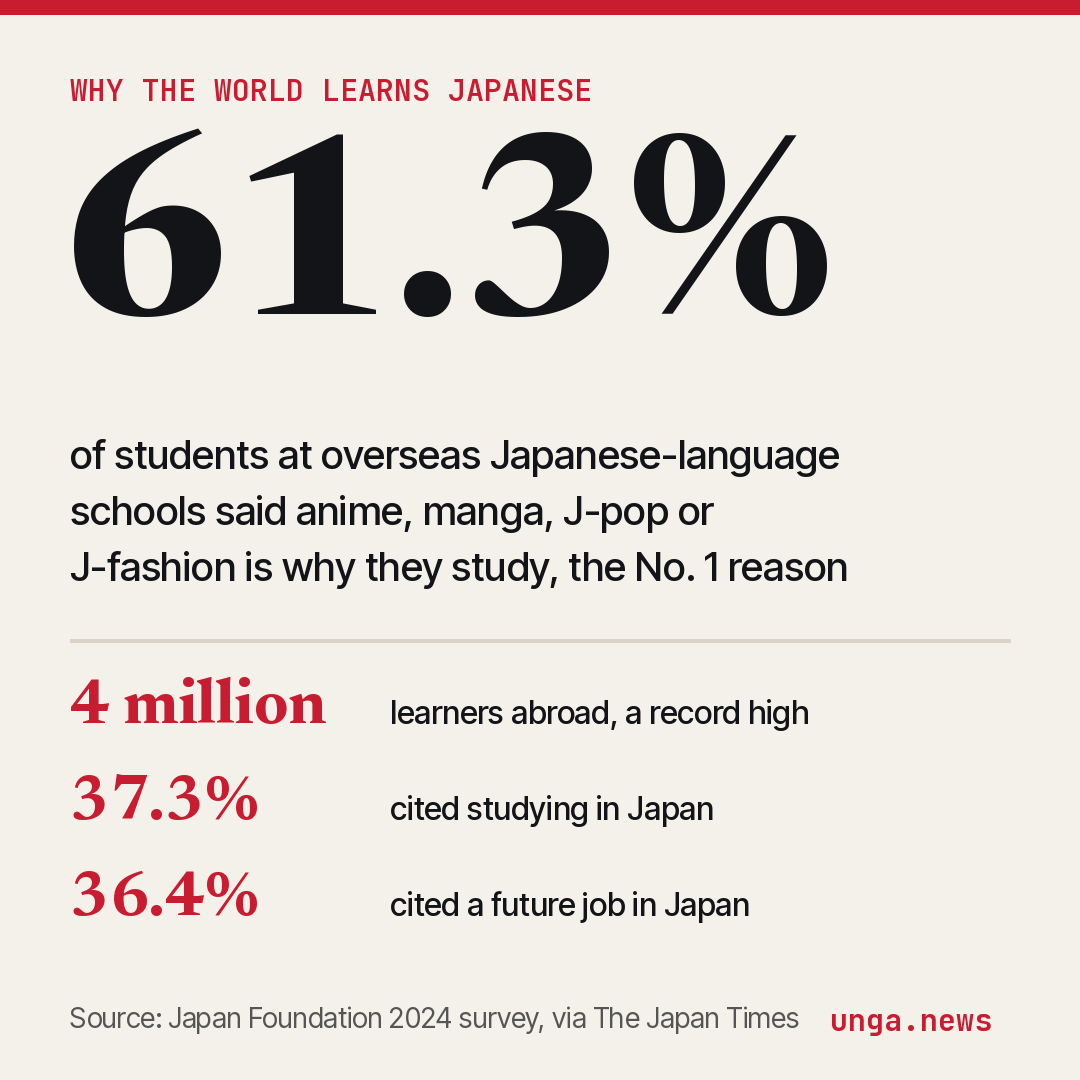
Interest in anime, manga, J-pop and J-fashion was the most common motivation, cited by 61.3% of students at overseas Japanese-language schools. That beat out wanting to study in Japan (37.3%) and wanting to work there someday (36.4%). The same survey counted a record 4 million people learning Japanese outside Japan, up 5.4% from the 2021 count. That’s about 206,000 more learners, spread across more than 19,000 institutions in 143 countries and regions.
So the ministry is doing something businesses do all the time: meeting the customer where they already are. If kids in Brazil or Nigeria are watching anime with subtitles, why not let them practice their Japanese with the characters they already love?
Why famous characters are the hard part
The SI is the easier piece. Plenty of apps already let you chat with a computer in another language. Duolingo, for example, said in January 2025 that its Max subscribers could hold SI-powered conversations with its cartoon character Lily, and Japanese was one of the languages on the list.
What’s new here is the characters. Up to now, the Japan Foundation’s own apps and websites have used made-up characters, because copyright rules kept the famous ones off limits. This time the foundation plans to sit down with the rights holders and negotiate to use well-known characters. It’s also the first time the foundation has built SI into its language lessons at all.
That’s where this could get complicated. Anime studios and publishers guard their characters closely, and nobody has said which franchises are on board. Fan sites have already started guessing at names like Goku or Luffy, but those are guesses, not announcements. There’s also no word yet on which SI company would power the conversations, what the app will cost users, or how the government plans to keep a beloved character from saying something off-script.
It’s really about friends abroad
Nikkei framed the project plainly: the goal is to grow the number of people abroad who know Japan and like Japan. In diplomacy, that kind of goodwill is called soft power, and Tokyo treats it as part of the foundation for its foreign policy.
The app fits inside a bigger push. The ministry has asked for ¥1.83 billion, about $11.6 million, in the fiscal year that starts in April 2027 to help Japanese manga, anime, music and films reach more people overseas. That money isn’t just for the app. It also covers building ties between Japanese and foreign content professionals, steering fans toward legal ways to watch and read instead of pirate sites, and backing the translators who bring Japanese work to the rest of the world.
The ministry has a practical angle too. It hopes the app can reach places where Japanese schools and qualified teachers are hard to find, and that it will be a lot cheaper than opening more teaching centers abroad. The broader content effort is aimed especially at emerging and developing countries in Africa and Central and South America.
The foundation isn’t starting from scratch on the tech side either. It already runs an online Japanese course platform called Minato, launched in 2016, that works on computers, tablets and phones.
Two yeses still missing
Two things have to happen before anyone gets to practice their Japanese with a favorite character. The budget has to be approved, and the studios have to sign off. Neither has happened yet.
If both come through, Japan will have turned its most popular export into a classroom. It’s a smart bet. Millions of people around the world already spend hours with these characters every week. Japan is betting that some of them would happily spend a little of that time learning to talk back.
Sources
- The Japan Times — Government betting on language app powered by anime and AI
- Nikkei — 外務省、日本語学習アプリを開発へ アニメキャラとAIで「知日派」拡大
- Magica — Japan plans AI Japanese-learning app with anime characters
- The World Insiders — Japan plans AI language app with anime and manga characters