

Jeffrey Tucker Is Right: A Family of Six Pays $2,600 to $3,100 a Month for Obamacare
We ran the federal government's own 2026 rate file for 2,055 counties. The typical benchmark plan for two parents and four kids costs $31,000 to $38,000 a year, before a $12,000 deductible. And 2027 rates are going up.

On Sunday morning, Jeffrey Tucker, president of the Brownstone Institute, put a number on something millions of parents already feel every month when the premium comes out of the checking account.
"A husband and wife with four kids will spend $3-4,000 and more per month on medical insurance now, and it buys nothing but the right to pay more when you actually use it," he wrote. "This is an outrage. More outrageous, there is hardly any political talk about this fixing this problem even though the fix is readily at hand. Unsustainable."
"Unsustainable." (@jeffreytucker, Oct. 25, 2026)
— @jeffreytucker View on 𝕏
Is he right? We didn't take anyone's word for it. We pulled the federal government's own numbers.
What the government's own rate file shows
Every year, CMS publishes the full price list for every plan sold on HealthCare.gov (the 2026 file is public). It covers 30 states and 2,055 counties, and it prices a standard household: two parents plus "3 or more children." That is exactly Tucker's family. Under federal rules, insurers can charge for no more than the three oldest children under 21, so a fourth kid adds nothing to the bill. It also doesn't make the bill any smaller.
Here is what that family pays at full price this year, in the typical (median) county:
Parents age 40. The benchmark silver plan, the one the government uses to set subsidies, runs $2,597 a month. That is $31,160 a year. The cheapest gold plan is $2,543. Even the cheapest bronze plan is $1,820.
Parents age 50. The benchmark jumps to $3,141 a month, or $37,692 a year. In 1,180 of the 2,055 counties, 57%, the benchmark plan for this family costs $3,000 a month or more. The most expensive county tops $5,800.
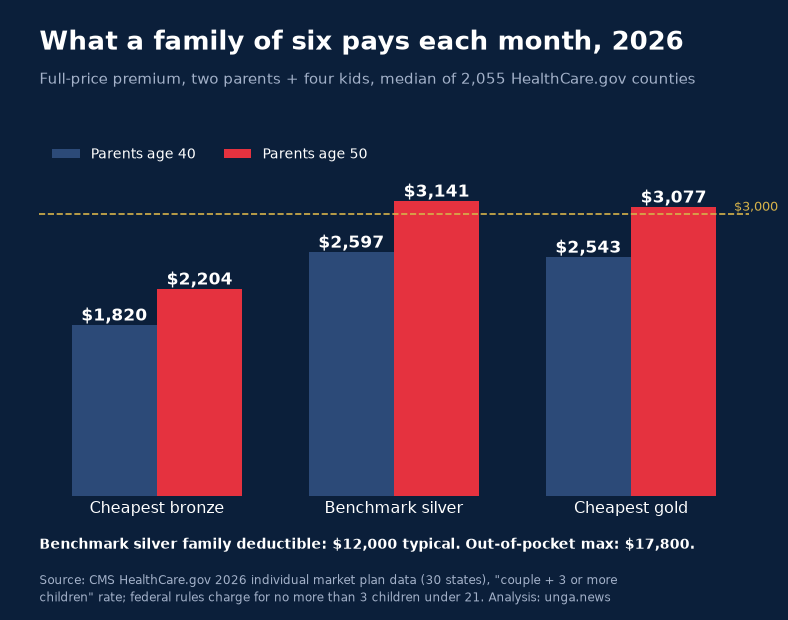
So Tucker's $3,000 to $4,000 isn't an exaggeration for a family with parents in their 40s and 50s. It's the middle of the market, and the top of it is worse.
And that is the 2026 price. For 2027, insurers asked for a median increase of 15%, the second double-digit hike in a row, KFF found in its review of 276 insurers' filings. The benchmark plan for a single 40-year-old already jumped from $497 a month in 2025 to $625 in 2026, according to the Commonwealth Fund. Put a 15% increase on that $3,141 family premium, and it comes to about $3,600 a month.
'The right to pay more'
The second half of Tucker's post is the part that stings. The premium doesn't buy much until something big happens.
On the benchmark silver plan in the same federal file, the typical family deductible is $12,000. The family out-of-pocket maximum is $17,800. On the cheapest bronze plan, the typical family deductible is $16,900.
Add it up for the 40-year-old parents: $31,160 in premiums, plus as much as $17,800 more before the plan pays every bill. That is close to $49,000 in a bad year, before a single dollar of help. Think of it like a car lease where you make the monthly payment, and the dealer still hands you the repair bill for the first $12,000.
Who pays full price
Not everyone pays the sticker price. But the families who do are exactly the ones Tucker is talking about: middle-class, working, and a little too successful for help.
For 2027 coverage, federal premium help stops at 400% of the poverty line. For a family of six, that is $177,440, per HealthCare.gov. Right below that line, the family is expected to pay 10.22% of its income for the benchmark plan under the IRS's 2027 tables, about $1,511 a month. Earn one dollar more, and the help disappears entirely. The "enhanced" credits that smoothed out that cliff expired at the end of 2025.
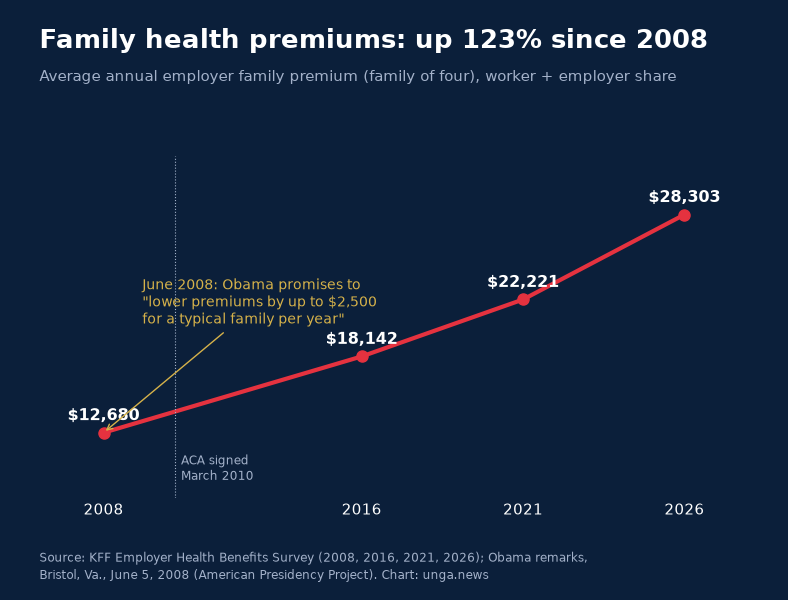
Workers with job-based coverage pay the same bill in a different way. The average employer family plan now costs $28,303 a year, up 5% while wages rose 3.7%, KFF's 2026 survey found. Workers pay $7,471 of that directly, and $9,687 at small firms. KFF counts a "family" as four people.
The promise
This was supposed to go the other way. On June 5, 2008, in Bristol, Virginia, candidate Barack Obama told voters, "In an Obama administration, we'll lower premiums by up to $2,500 for a typical family per year," and that "we'll do it by the end of my first term as President of the United States," according to the transcript.
That year, KFF put the average employer family premium at $12,680. This year it is $28,303. That is up 123%.
Tucker's fix
When a follower replied, "And the fix is?", Tucker answered with a five-point list:
"1. Catastrophic plans that skip preventive care. 2. Premiums adjusted by individual risk. 3. Allow employee/employer opt outs. 4. Universal HSAs. 5. Allow HSAs to be spent on alternative paths."
Tucker's five-point fix. (@jeffreytucker)
— @jeffreytucker View on 𝕏
Here is where each one actually stands:
Catastrophic plans. They exist, but only for people under 30 or those with a hardship exemption. The Trump administration tried to open them to more adults for 2027, including families earning over 250% of the poverty line. On July 16, a federal judge in Maryland put that rule on hold in City of Columbus v. Kennedy, and the door stays shut for now.
Premiums by individual risk. Obamacare forbids it. Insurers can price only by age, tobacco use, location and family size, and the oldest adult can be charged no more than three times the youngest. That means a healthy family pays the same price as a sick family of the same ages.
HSAs. This is the one place real progress has happened. Under President Trump's Working Families Tax Cuts law, every bronze and catastrophic plan sold on the exchanges became eligible for a health savings account on Jan. 1, 2026, the IRS confirmed in Notice 2026-5. The same law lets families with an HSA pay for a direct primary care doctor, up to $150 a month per person or $300 for a family. It isn't universal yet, but it is the first big step toward Tucker's points four and five.
'Hardly any political talk'
Tucker's last complaint is about Washington, and there he has a point about both sides. In January, President Trump called on Congress to pass his Great Healthcare Plan, which would "stop sending big insurance companies billions in extra taxpayer-funded subsidy payments and instead send that money directly to eligible Americans to allow them to buy the health insurance of their choice," the White House said.
House Republicans already passed a piece of it. The Lower Health Care Premiums for All Americans Act, H.R. 6703, cleared the House 216-211 on Dec. 17, 2025. It expands association health plans, writes CHOICE arrangements into law so workers can take pre-tax employer dollars to a plan they choose, and funds the cost-sharing payments the White House says would cut the most common Obamacare premiums by more than 10%. Congress.gov shows the Senate received it the next day. It has not acted on it since.
Tucker isn't letting Republicans off the hook either. "The Republicans have blown their chance for real reform, even as people are dropping their insurance completely," he wrote on Friday.
The bottom line
Open enrollment for 2027 starts Nov. 1. The deadline for coverage that starts Jan. 1 is Dec. 15. Families shopping this year will find the same thing Tucker described: about $31,000 to $38,000 a year for a middle-of-the-road plan, and a $12,000 deductible before it really kicks in.
Obama promised $2,500 in savings. The government's own data shows a family of six paying $31,000 or more a year for a plan they hope never to use. The fixes are on paper, and one of them passed the House 10 months ago. Tucker's one-word verdict holds: unsustainable.
Sources
- 𝕏 / @jeffreytucker — "A husband and wife with four kids will spend $3-4,000 and more per month on medical insurance now..." (Oct. 25, 2026)
- 𝕏 / @jeffreytucker — Five-point fix: catastrophic plans, risk-based premiums, opt outs, universal HSAs (Oct. 25, 2026)
- 𝕏 / @jeffreytucker — "The Republicans have blown their chance for real reform..." (Oct. 23, 2026)
- CMS / HealthCare.gov — Health plan datasets: 2026 individual market medical plan data (analysis: UNGANEWS)
- eCFR — 45 CFR 147.102, Fair health insurance premiums (three-oldest-children rule)
- KFF — 2026 Employer Health Benefits Survey (Oct. 22, 2026)
- KFF — How Much and Why ACA Marketplace Premiums Are Going Up in 2027
- Commonwealth Fund — More ACA Premium Spikes to Come in 2027 Amid Federal Policy Changes
- HealthCare.gov — Federal poverty level (FPL), 2026 guidelines
- IRS — Rev. Proc. 2026-26, applicable percentage table for 2027
- IRS — Notice 2026-5, Expanded availability of health savings accounts under the OBBBA
- Federal Register — HHS Notice of Benefit and Payment Parameters for 2027 (May 20, 2026)
- U.S. District Court for the District of Maryland — City of Columbus v. Kennedy, No. 1:26-cv-02215, order (July 16, 2026)
- The White House — Fact Sheet: President Donald J. Trump Calls on Congress to Enact The Great Healthcare Plan (Jan. 15, 2026)
- Congress.gov — H.R. 6703, Lower Health Care Premiums for All Americans Act, all actions
- The American Presidency Project — Barack Obama, Remarks in Bristol, Virginia (June 5, 2008)