

Joe Rogan Calls ADHD a Superpower and Says It's Overdiagnosed. The Research Backs Him Up.
On a podcast episode released Tuesday, Rogan said schools are built for kids who can sit still, and plenty of kids aren't. Decades of data on diagnoses, birthdays and focus point the same way.

Joe Rogan, the comedian and UFC commentator who hosts The Joe Rogan Experience, one of the most popular podcasts in the world, said on an episode released Tuesday that he does not think ADHD is a disorder. "I don't think it's a disorder. I think it's a superpower," Rogan told his guest, British endurance athlete Ross Edgley, on episode #2568 (YouTube).
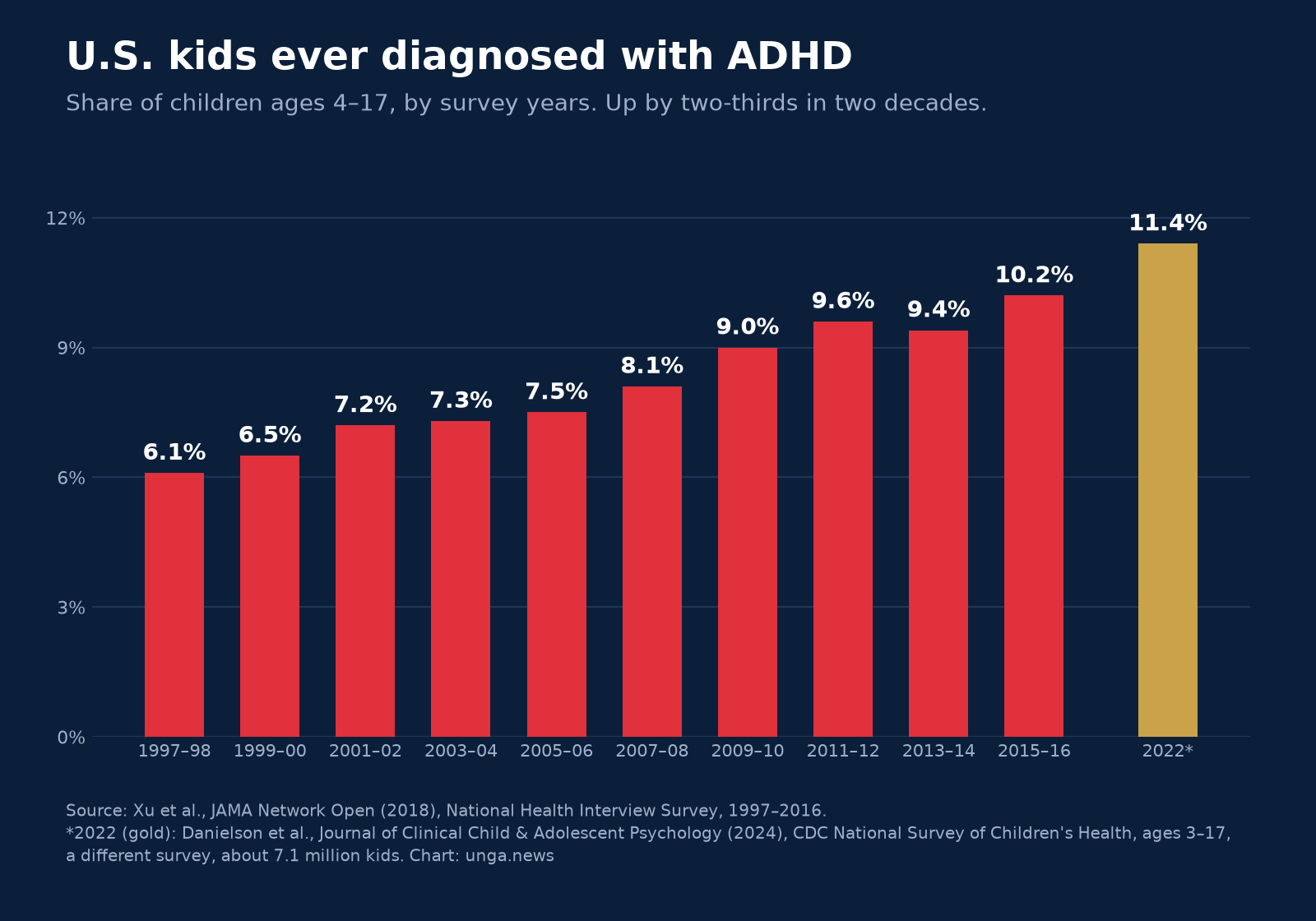
ADHD, short for attention-deficit/hyperactivity disorder, is a diagnosis given mostly to children who have trouble sitting still, staying on task or controlling impulses. About 7.1 million American kids have been diagnosed with it at some point, according to CDC researchers (Danielson et al.).
Rogan's argument is that many of those kids aren't broken. They're in the wrong setting. And the research on who gets diagnosed, and when, gives him a lot to stand on.
Joe Rogan Calls ADHD a Superpower, Not a Disorder (@UngaTheGreat)
— @UngaTheGreat View on 𝕏
"Some people are not designed for it"
"I think we are conditioning children to sit in a classroom and do something that's insanely boring. And some people can endure it, and God bless them. And some people are not designed for it. And I'm one of them," Rogan said.
The same trait that makes class unbearable, he said, lets people lock in on what they love. "I think it gives you the ability to concentrate on things that you love to an extent that most people cannot fathom." Rogan said he can "play pool for 10 hours in a row" without eating, and pointed to grappling champion Gordon Ryan, who he said trains "365 days a year." "It's both things. It's discipline, but it's also this obsession," Rogan said. "If you were in school, they would say you have a disorder."
His proof is something most parents have seen: "If you sit those kids down in front of a computer and let them play video games, look at all the concentration they have."
Rogan was careful not to dismiss everyone. "I'm not unsympathetic," he said, adding that for some people it is "a real genuine issue" and "they're just constantly scattered. I'm not talking about that. I think it's entirely overdiagnosed."
The diagnoses keep climbing
Federal survey data show the share of U.S. children ever diagnosed with ADHD rose from 6.1% in 1997–98 to 10.2% in 2015–16, a jump of two-thirds (JAMA Network Open). By 2022, CDC researchers put it at 11.4%.
In 2021, a team of Australian researchers reviewed 334 studies to answer a simple question: is ADHD overdiagnosed in kids? Their answer was yes. They found "convincing evidence" of overdiagnosis, that many of the added cases are on the milder end, and that "for individuals with milder symptoms in particular, the harms associated with an ADHD diagnosis may often outweigh the benefits" (JAMA Network Open).
The same review counted 83 studies showing that drug treatment for ADHD in young people was rising. A separate CDC study found the share of privately insured Americans filling a prescription for stimulants, the main class of ADHD drugs, rose from 3.6% in 2016 to 4.1% in 2021 (CDC).
The birthday test
The strongest support for Rogan's classroom point comes from birthdays. In states where kids must turn 5 by Sept. 1 to start kindergarten, children born in August are the youngest in their grade, and those born in September are the oldest. A 2018 study of more than 400,000 children in the New England Journal of Medicine found August-born kids were diagnosed with ADHD at a rate of 85.1 per 10,000, versus 63.6 for September-born kids, 34% higher (NEJM). There was no such gap for asthma, diabetes or obesity.
A study of nearly 938,000 children in British Columbia, where the cutoff is Dec. 31, found the same pattern. Boys born in December were 30% more likely to be diagnosed than boys born in January, and girls 70% more likely. They were also more likely to be put on ADHD medication. The authors warned of "the potential harms of overdiagnosis and overprescribing" (CMAJ).
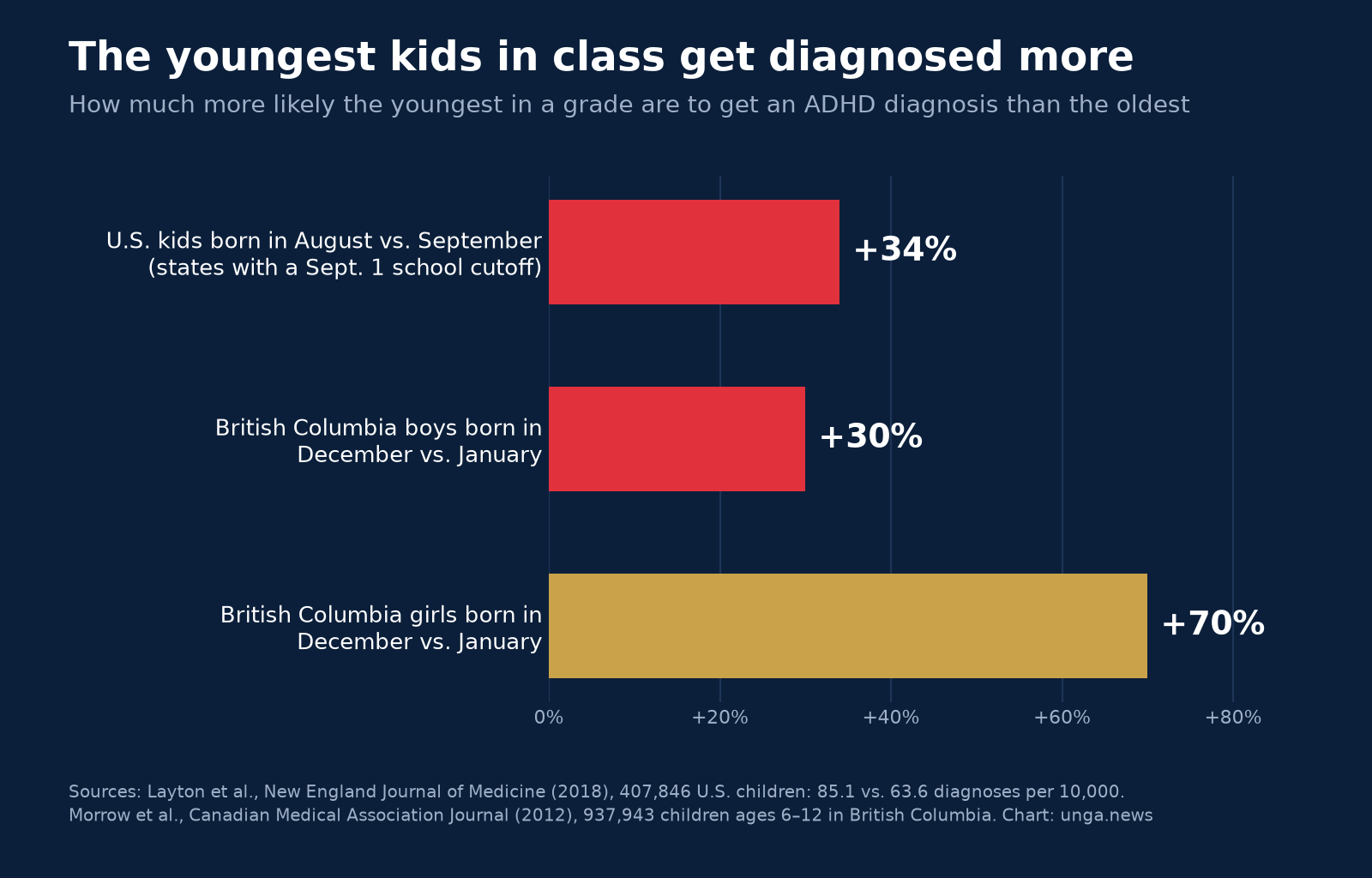
Nothing about those kids' brains changed with their birth month. What changed was how they compared with older, calmer classmates in the same room.
The superpower has a name
Rogan's 10-hour pool sessions have a name in the research: hyperfocus. A 2019 study of more than 600 adults found that people with more ADHD symptoms reported more hyperfocus, in school, in hobbies and in screen time. The authors called it a "potentially separable feature" of ADHD that deserves its own study (ADHD Attention Deficit and Hyperactivity Disorders).
Researchers at King's College London interviewed successful adults with ADHD about what the condition gives them. They described energy, courage, resilience, "divergent thinking" and hyperfocus (Sedgwick et al.). In business, a study in the Journal of Business Venturing found the hyperactive side of ADHD was linked to more entrepreneurship (Wiklund et al.).
Let them move
Rogan also said kids are told to sit still at the exact time they have the most energy. Researchers have tested that, too. In a study of fourth-graders, children were on task 90% of the time on days with recess versus 85% without, and fidgeting fell from 16% to 7%. All five children in the group identified with ADD or hyperactivity were among those who improved (Journal of Educational Research). In a randomized trial, 31 minutes of aerobic exercise before school each day for 12 weeks cut parent-reported inattention more than a sitting activity did (Journal of Abnormal Child Psychology).
Rogan was clear that some people truly struggle. His point is that a lot of kids are being handed a diagnosis for not fitting a school day built around sitting still. The data on rising diagnoses, birthdays and recess point to the same thing.
Sources
- YouTube (PowerfulJRE) — Joe Rogan Experience #2568 - Ross Edgley
- X (@UngaTheGreat) — Joe Rogan Calls ADHD a Superpower, Not a Disorder
- JAMA Network Open — Twenty-Year Trends in Diagnosed ADHD Among US Children and Adolescents, 1997-2016 (Xu et al., 2018)
- Journal of Clinical Child & Adolescent Psychology — ADHD Prevalence Among U.S. Children and Adolescents in 2022 (Danielson et al., 2024)
- JAMA Network Open — Overdiagnosis of ADHD in Children and Adolescents: A Systematic Scoping Review (Kazda et al., 2021)
- CDC MMWR — Trends in Stimulant Prescription Fills Among Commercially Insured Children and Adults, 2016-2021
- New England Journal of Medicine — Attention Deficit-Hyperactivity Disorder and Month of School Enrollment (Layton et al., 2018)
- CMAJ — Influence of relative age on diagnosis and treatment of ADHD in children (Morrow et al., 2012)
- ADHD Attention Deficit and Hyperactivity Disorders — Living 'in the zone': hyperfocus in adult ADHD (Hupfeld et al., 2019)
- ADHD Attention Deficit and Hyperactivity Disorders — The positive aspects of ADHD: a qualitative investigation of successful adults (Sedgwick et al., 2019)
- Journal of Business Venturing — ADHD, impulsivity and entrepreneurship (Wiklund et al., 2017)
- Journal of Educational Research — Impact of Recess on Classroom Behavior (Jarrett et al., 1998)
- Journal of Abnormal Child Psychology — A Randomized Trial Examining the Effects of Aerobic Physical Activity on ADHD Symptoms in Young Children (Hoza et al., 2015)