

Judge Says DOJ Broke Civil Service Law Firing James Comey's Daughter. She Isn't Coming Back
An Obama-appointed judge ordered back pay and paper reinstatement for Maurene Comey, who already has a new job. The real fight, whether Trump can fire career prosecutors at will, is one he says only the Supreme Court can settle.
Maurene Comey, the daughter of former FBI Director James Comey, won her lawsuit against the Justice Department on Monday. U.S. District Judge Jesse Furman, an Obama appointee in Manhattan, ruled that DOJ broke federal civil service law when it fired her as a prosecutor in July 2025 and ordered her "retroactive reinstatement and backpay."
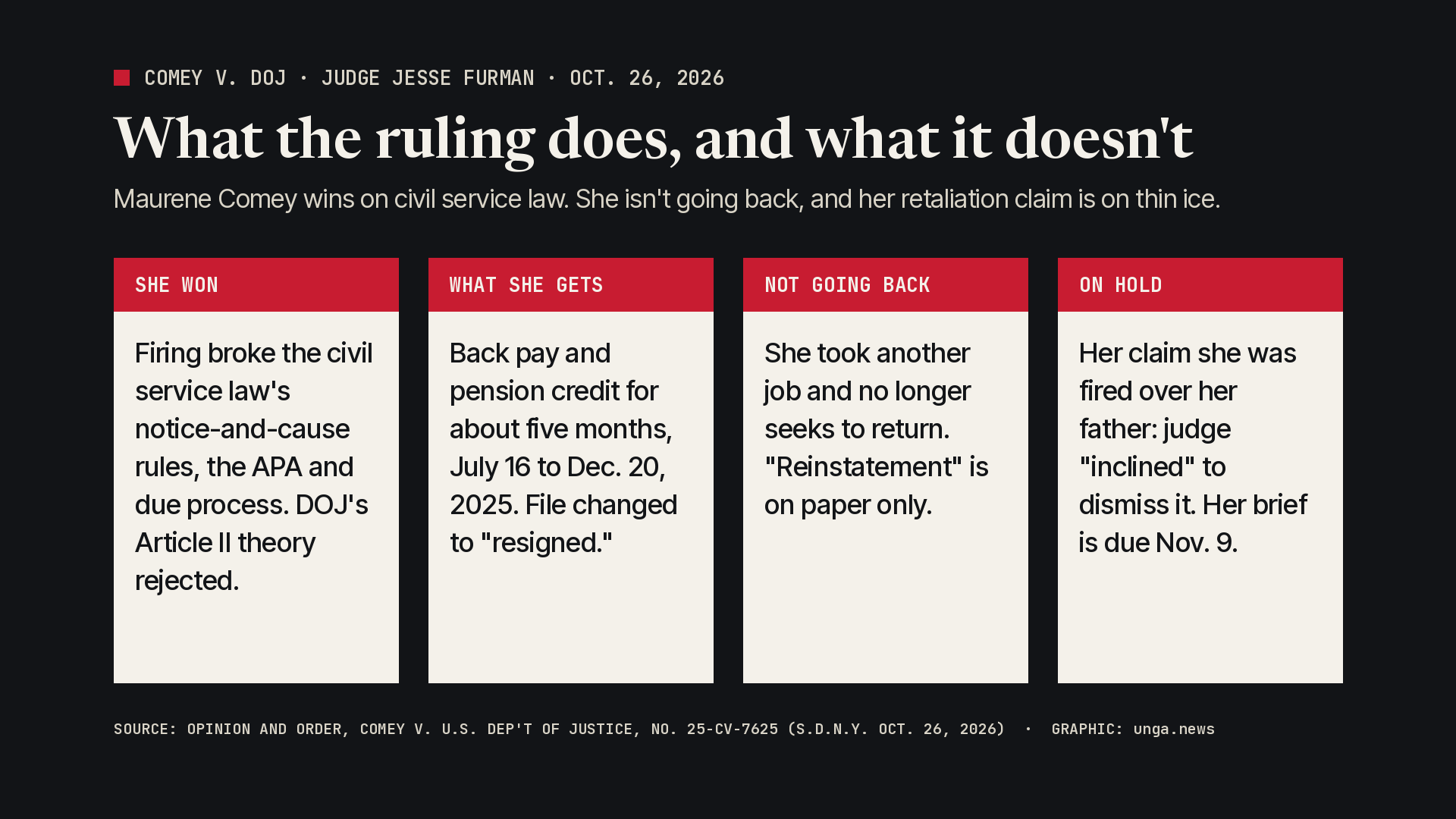
Here's the part most headlines skip: she isn't going back. Comey took another job on Dec. 20, 2025, and told the court she no longer wants to return. So the "reinstatement" exists on paper. What she actually gets is about five months of back pay and pension credit, plus a personnel file that will now say she resigned instead of being fired.
The bigger story is the fight underneath. Trump's Justice Department argued that career prosecutors who try cases in court use the president's own law-enforcement power, so he can fire them at will. Furman said no, and said that as a lower court he couldn't say yes even if he wanted to. That question is built for the Supreme Court.
How she was fired
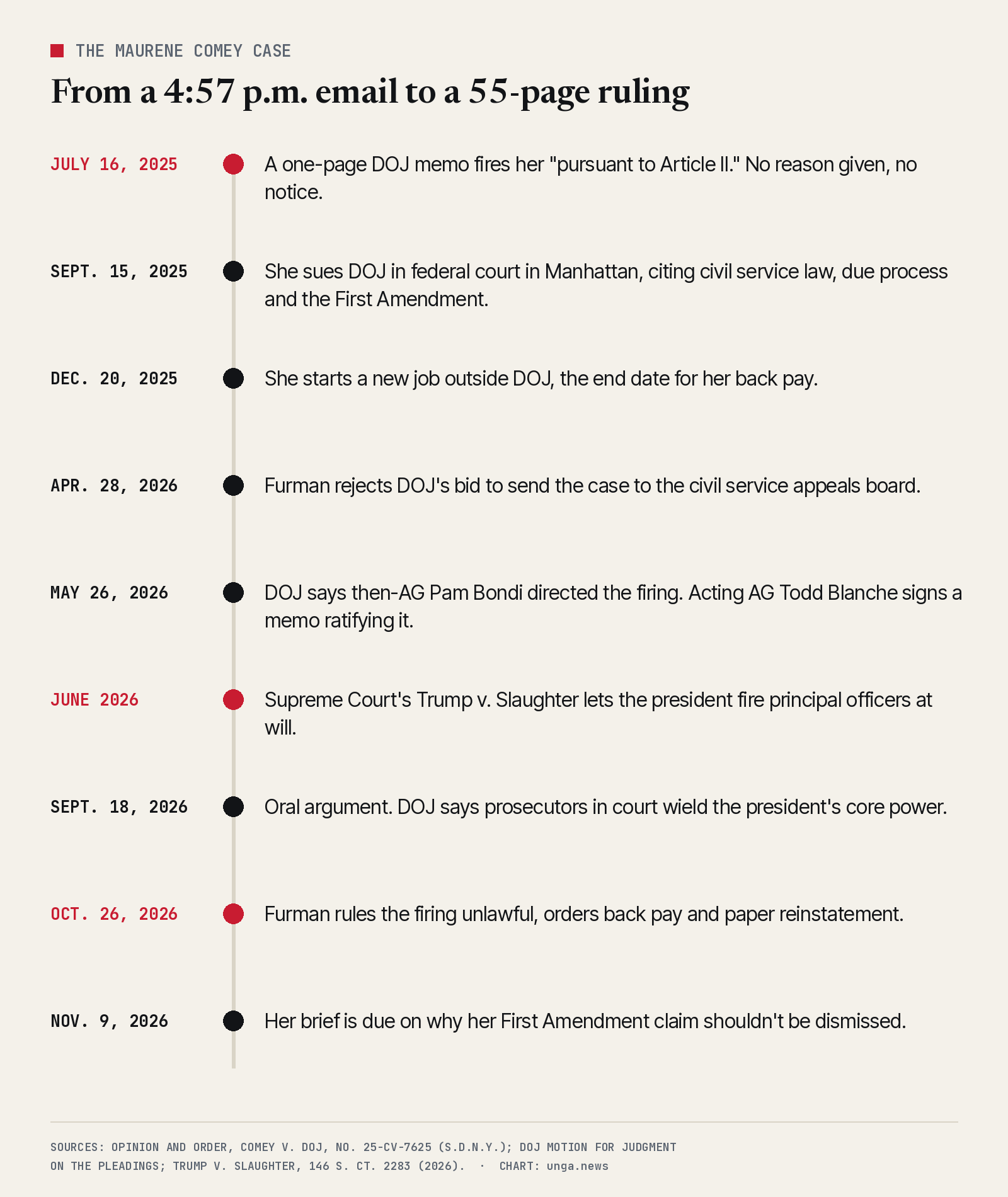
Comey spent almost ten years as an assistant U.S. attorney in the Southern District of New York, working cases including Jeffrey Epstein, Ghislaine Maxwell, Sean "Diddy" Combs and former Sen. Bob Menendez. At 4:57 p.m. on July 16, 2025, she got a one-page memo from the Executive Office for U.S. Attorneys removing her "[p]ursuant to Article II of the United States Constitution and the laws of the United States," effective immediately.
The memo gave no reason. Her government personnel form listed one legal authority: "ART II CONSTITUTION." DOJ later admitted in court that the firing "was not 'for cause' and was not based on her performance." In a filing last May, the department said then-Attorney General Pam Bondi directed it, and Todd Blanche, then acting attorney general, signed a memo ratifying it.
What the judge actually ruled
Furman's 55-page opinion turns on two federal laws. One, from 1966, says every assistant U.S. attorney "is subject to removal by the Attorney General." The other, the Civil Service Reform Act of 1978, says covered employees can be removed "only for such cause as will promote the efficiency of the service," with 30 days' written notice and a chance to respond.
DOJ said the first law lets the attorney general fire prosecutors without cause. Furman said both laws apply together: the attorney general can fire an assistant U.S. attorney, but only the way the civil service law allows. Comey got no notice and no chance to respond, and DOJ conceded that. Furman called the concession "fatal" to its civil service defense. Think of it like a landlord who has the right to evict but still has to serve the papers first.
DOJ's case, and why it isn't going away
The government's argument is serious. In its motion for judgment, DOJ wrote that assistant U.S. attorneys "exercise the President's 'conclusive and preclusive' executive power when they engage in prosecutorial activities." That phrase comes from the Supreme Court's 2024 presidential immunity decision, Trump v. United States. And in June, in Trump v. Slaughter, the justices overruled the 1935 Humphrey's Executor decision and held that the president can fire the principal officers who run executive agencies.
Furman wrote that DOJ's reading of the immunity case is "at least colorable." He still rejected it. His reasons: a line of Supreme Court cases going back to the 1800s lets Congress protect "inferior officers" hired by department heads, and Slaughter dealt with agency leaders, not line staff. He quoted Slaughter itself declining to "determine the fate of officials not before" the Court, and noted Justice Neil Gorsuch's concurrence describing the civil service law's "considerable protection" for rank-and-file workers.
Then he said the quiet part: "while the Supreme Court may be free to overrule its prior cases holding that Congress can regulate and limit the removal of inferior officers and adopt Defendants' argument, this Court is not." In plain English, a district judge can't get ahead of the Supreme Court. Only the justices can say whether Slaughter reaches the prosecutors who actually carry out the president's law enforcement.
The retaliation claim is on thin ice
Comey's suit says she was fired "solely or substantially" because of who her father is. Trump fired James Comey as FBI director in 2017, and the two have traded public shots ever since, as DOJ's own court answer acknowledges. The judge did not rule for her on that claim. He wrote that he is "inclined to grant" DOJ's motion to dismiss it, because her other wins already cover the money she could recover and she no longer wants her job back.
He also threw out four of her ten claims and ruled for DOJ on a fifth. And he warned that proving a First Amendment claim could drag in executive privilege, one more reason, he wrote, to avoid deciding it.
What happens next
Comey's brief on why her First Amendment claim should survive is due Nov. 9, and DOJ gets a week to answer. The judge still has to set the exact back pay and decide whether taxpayers cover her lawyers' fees. He also paused discovery, the evidence-gathering stage, saying Monday's rulings make most of it unnecessary.
The Justice Department hadn't commented as of Monday, NBC News and The Hill reported. An appeal would go to the Second Circuit, and from there the at-will question could reach the Supreme Court.
The bottom line: Comey won back pay, not her old office. The real prize is the question of whether a president can fire the prosecutors who work for him, and the judge who ruled Monday just said he isn't the one who gets to answer it.
Sources
- U.S. District Court, Southern District of New York (via Cour — Opinion and Order, Comey v. U.S. Department of Justice, No. 25-cv-7625 (JMF) (Oct. 26, 2026)
- U.S. Department of Justice (via Courthouse News) — Memorandum of Law in Support of Defendants' Motion for Judgment on the Pleadings, Comey v. DOJ
- U.S. Code (Cornell LII) — 5 U.S.C. § 7513: Cause and procedure
- U.S. Code (Cornell LII) — 28 U.S.C. § 542: Assistant United States attorneys
- NBC News — Judge orders DOJ to reinstate former federal prosecutor Maurene Comey (Oct. 26, 2026)
- The Hill — Judge rules James Comey's daughter unlawfully fired as federal prosecutor (Oct. 26, 2026)
- Wikimedia Commons — Thurgood Marshall United States Courthouse 008.jpg (Kidfly182, CC BY 4.0)