

Kentucky’s Republican Attorney General Keeps a Veto Over Beshear’s Million-Dollar Settlements on the Way Out
A Frankfort judge struck down most of the law Republicans passed over Beshear’s veto. The piece he kept puts a second elected official in charge of big taxpayer payouts before a new governor moves in.

Kentucky’s Democratic governor went to court to tear up a Republican law that put guardrails on his final months in office. On Wednesday he got most of what he asked for. But the one piece that touches taxpayers’ money most directly is still standing, and it gives Republican Attorney General Russell Coleman the final say on any big legal settlement the governor’s office tries to sign on its way out the door.
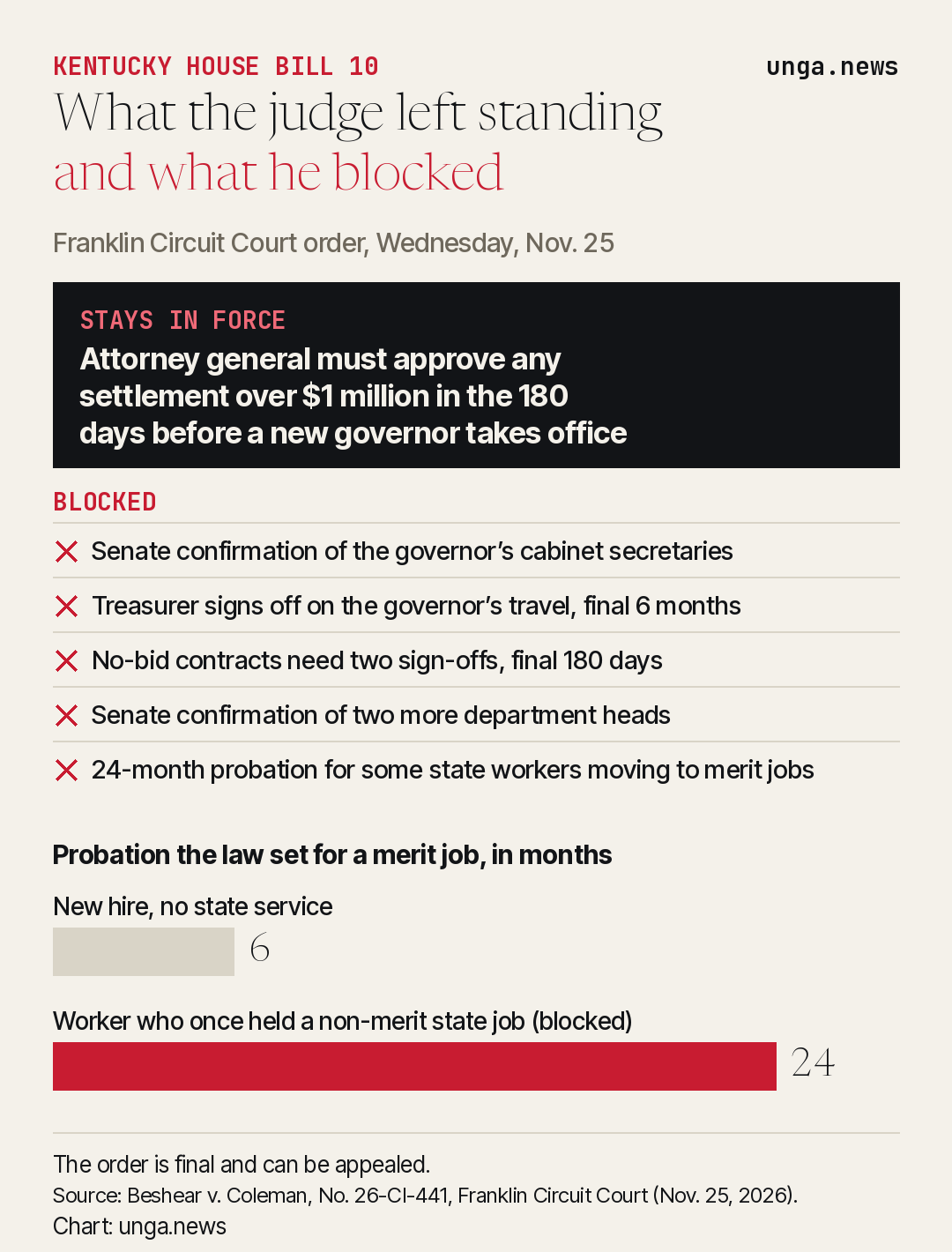
Franklin Circuit Judge Thomas Wingate permanently blocked nearly all of House Bill 10, the law the Republican supermajority in the General Assembly passed on April 1 and then forced into law over Gov. Andy Beshear’s April 13 veto just one day later. Wingate kept Section 1. It says that in the 180 days before a new governor is sworn in, the attorney general, working with the state’s finance secretary, must “review and approve or disapprove” any settlement involving the executive branch worth more than $1 million.
Beshear’s term ends in December 2027. That puts the window at roughly the last half of next year, the stretch when a departing administration has the least to lose.
Even Frankfort’s court found the money check sound
The ruling comes from the Franklin Circuit Court in Frankfort, the court where nearly every fight between Beshear and the legislature starts. Coleman’s office had asked Wingate to hold off and wait for the Kentucky Supreme Court to settle related separation-of-powers cases. Wingate said no to that in May. So it says something that even this court found the settlement check on solid constitutional ground.
The judge leaned on a 1982 Kentucky Supreme Court case, Brown v. Barkley, which says the legislature can hand executive powers to other elected constitutional officers who answer to the voters, not to the governor. The attorney general is exactly that kind of officer. Wingate also pointed out that Beshear’s own administration already sends some settlements to the attorney general for sign-off under an existing state regulation, which made it hard to argue the idea is unthinkable.
Then he wrote the line Republicans will be quoting for a while: “This provision is not without merit and good intent: the Commonwealth has an interest in protecting its people and preventing the undervaluing of the Commonwealth’s litigation position during the 180 day period prior to the gubernatorial inauguration.”
In plain English: when a governor is packing up, nobody should be cutting quick, cheap deals that leave Kentuckians holding the bag. The judge added that the check covers a narrow window and “does not take away any power of the Governor, nor does it elevate the position of the Attorney General above the Governor.”
The rest of the bill went down
Everything else in House Bill 10 is now permanently on ice. Gone is the requirement that the state Senate confirm the governor’s cabinet secretaries, along with Senate confirmation for the heads of the Department of Aviation and the housing and buildings office. Gone is the rule that a governor in his last six months must get State Treasurer Mark Metcalf, a Republican, to approve his travel expenses.
Also blocked is a limit on no-bid contracts. For the 180 days before an inauguration, the law would have let executive agencies sign or renew a contract without competitive bidding only if both the finance secretary and the treasurer certified a real emergency. Wingate ruled that the governor’s power to sign contracts runs “from the time he or she is sworn in until the time the next Governor is sworn in,” and the legislature can’t shave days off the end.
The judge spent the most ink on the hiring provisions. Kentucky has a merit system for most state jobs and a separate set of “unclassified” jobs, many of them political appointments. The law said anyone who had held one of those unclassified jobs and moved into a merit job within 18 months of an inauguration would serve 24 months of probation, four times the normal six. Republicans wrote that to stop a familiar trick, where a departing administration slides its political people into protected civil-service jobs so the next governor can’t touch them. Beshear’s side said more than 400 current unclassified employees were in the crosshairs. Wingate agreed with Beshear, noting the rule would also sweep in park lifeguards and retired state troopers, and found it violated the Kentucky Constitution’s ban on special and arbitrary laws.
Beshear’s victory lap
Beshear wasted no time. His office called it the seventh time Kentucky courts have struck down legislation from the Republican supermajority aimed at the governor’s powers. “It’s time for the General Assembly’s Republican supermajority to stop passing legislation that is blatantly unconstitutional,” he said, and he accused lawmakers of “petty politics.”
That’s a funny charge from a governor who just lost the argument on the part of the law that guards the treasury. Rep. John Hodgson, the Fisherville Republican who sponsored the bill, said when he filed it that the old system had “little political accountability” for a governor’s final acts in office. Wednesday’s ruling confirms that lawmakers can put a second elected official in the room before a lame-duck administration writes a seven-figure check. Kentucky voters chose Coleman as attorney general, the same way they chose Beshear.
It also matters for who comes next. The 2027 race for governor is already taking shape, with Rep. James Comer in on the Republican side and promising to take Kentucky’s income tax to zero. Whoever wins inherits whatever the outgoing administration settles in its final six months, and now a constitutional officer outside the governor’s office has to sign off on the biggest of those deals first.
Round two goes up the ladder
Wingate called his order “final and appealable” with “no just cause for delay,” which clears the way for Coleman and Metcalf to take the rest of the fight to the Kentucky Court of Appeals and, almost certainly, the Kentucky Supreme Court. Those are the same courts already weighing other separation-of-powers fights between Beshear and the legislature, the cases Coleman wanted the circuit court to wait on in the first place.
For now, Kentucky Republicans walk away with the piece that most directly protects the people paying the bills. The confirmation fights and hiring rules will be argued again by judges further up the line. The million-dollar check on a departing governor is law today.
Sources
- Franklin Circuit Court — Beshear v. Coleman, No. 26-CI-441, order on summary judgment and judgment on the pleadings (Nov. 25, 2026)
- Office of Gov. Andy Beshear — Franklin Circuit Court strikes down portions of House Bill 10 (Nov. 25, 2026), as reproduced by KentuckyFeed
- Kentucky Lantern — With new lawsuit, Beshear tries to stop KY lawmakers’ latest moves on executive power (June 1, 2026)
- Franklin Circuit Court — Beshear v. Coleman complaint, No. 26-CI-441 (2026)