

Kim Gardner Paid Her Own Ethics Fine With Taxpayer Money. Missouri’s Top Court Just Disbarred Her
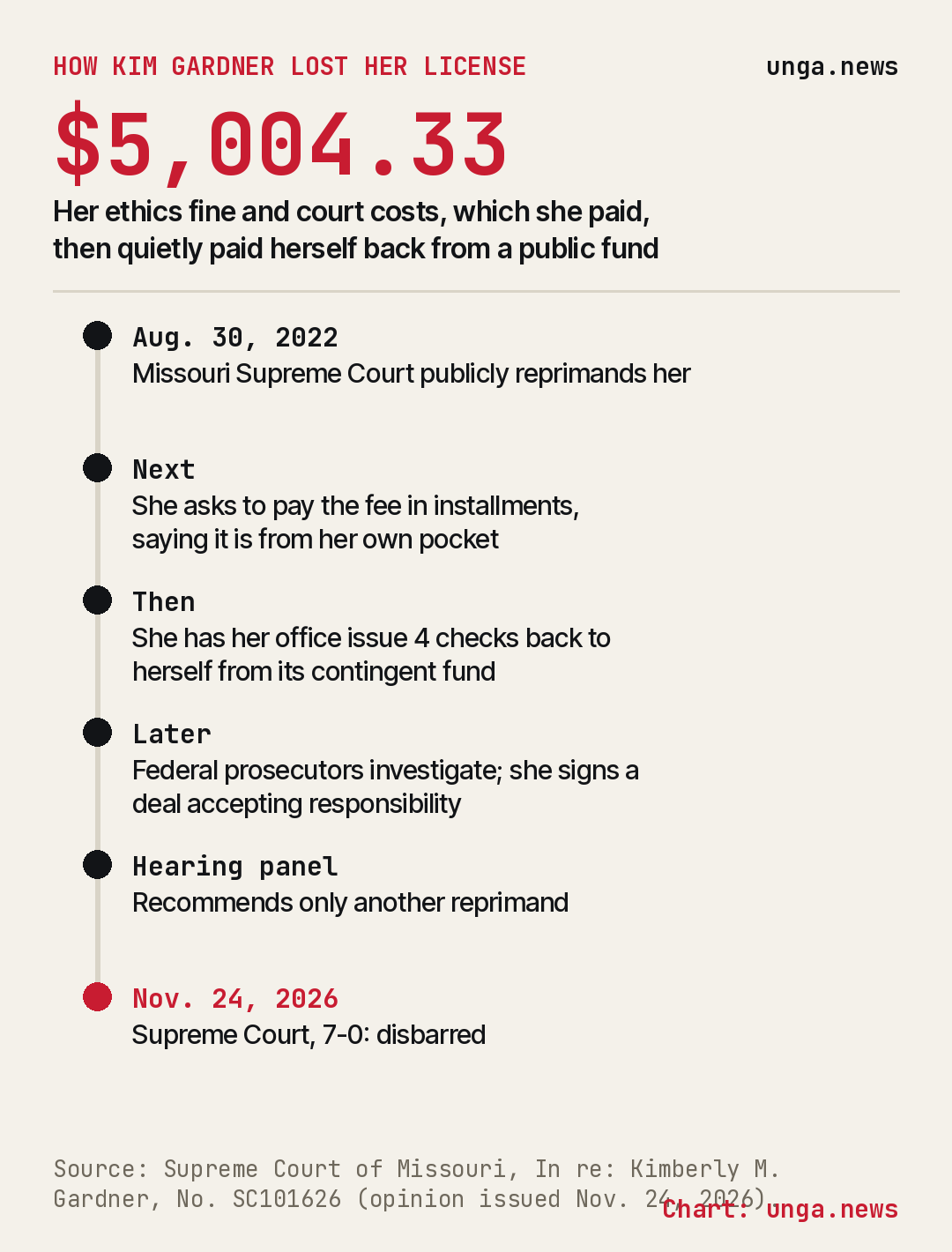
St. Louis’s former top prosecutor told the court she was paying a $5,004.33 ethics bill herself, then had her office write her four checks from a public fund. All seven judges agreed she has to go.
Kim Gardner spent years lecturing St. Louis about accountability. This week, Missouri’s highest court finally held her to it. In a unanimous opinion issued Nov. 24, the Supreme Court of Missouri disbarred the city’s former top prosecutor, ruling that she quietly paid herself back with public money for an ethics fine she owed the court, then misled the judges about where her payments came from.
Seven judges heard the case and all seven agreed. Judge Mary R. Russell wrote the opinion, joined by Chief Justice Powell and five colleagues, with one judge not taking part. The court’s own disciplinary panel had recommended letting her off with another reprimand. The judges threw that out.
The fine she said she was paying herself
The story starts with an earlier scolding. In August 2022, the same court publicly reprimanded Gardner for breaking the rules of professional conduct as St. Louis circuit attorney, the job she held from 2017 until she resigned in 2023. That case grew out of her office’s failed 2018 prosecution of then-Gov. Eric Greitens. The reprimand came with a bill: $5,004.33 in disciplinary fees and court costs.
Gardner didn’t fight the charges. She asked for time. Her lawyer wrote to the state’s ethics office that she “is not going to contest any of the costs, but she is going to need time to pay,” proposing $750 up front and about $500 a month after that. The ethics office agreed. Everyone involved understood that Gardner was paying out of her own pocket.
At the same time, according to the opinion, she asked that same lawyer whether her office could reimburse her from its contingent fund, a pot of public money state law sets aside for things like flying in witnesses, printing briefs and the “proper and vigorous prosecution” of the office’s duties. The lawyer sent back a draft, unsigned letter saying law firms sometimes cover these fees and that it would be fine “as long as your Office deems it appropriate under its own policies and procedures.” He never looked at the law that governs the fund.
That was all Gardner needed. She had her chief clerk cut four checks to herself, one for each payment she’d sent the court, and she co-signed every one of them. The court noted the fund had paid for plenty of office odds and ends over the years, but it had never once been used to pay a lawyer’s discipline fees.
A federal deal, then a denial
The U.S. Attorney’s Office in St. Louis caught on and opened an investigation into whether she had misused public funds under a federal law that bars local officials from converting $5,000 or more in government property. Gardner signed a pre-charge diversion agreement “accepting responsibility” and paid the money back. Because of that deal, she was never charged.
The agreement she signed didn’t mince words: “Kimberly Gardner was not entitled under the law to that additional compensation.”
Then she turned around and told the ethics system she had done nothing wrong. At her disciplinary hearing, Gardner didn’t testify. Her lawyers argued she had simply relied on legal advice, and that because no one in her office, not even the clerk who ran the fund, knew its limits, a sort of “universal ignorance” made the practice acceptable.
The court wasn’t buying any of it. Her reading of the statute, the judges wrote, “obliquely omits the word ‘proper.’” Paying fines for breaking the ethics rules has nothing to do with the proper prosecution of crimes. The advice she leaned on was an informal draft that was “equivocal” at best. And her denial now is “inconsistent with the agreement she executed with the United States Attorney’s Office.”
The part that sealed it
What moved this from a reprimand to disbarment was the deception. By sending the court checks from her personal account while secretly reimbursing herself with public money, the judges wrote, “she plainly intended to deceive this Court as to the source of the funds.”
The court also counted it against her that she did this right after being disciplined, which it said shows “a financially selfish motive and a refusal to take accountability for her actions.” Her years in the law and her job as an elected official raised the bar even higher. As the opinion puts it, Gardner was the city’s chief prosecutor and “was presumed to know the law.”
That’s the point conservatives in Missouri made about Gardner for years. A prosecutor’s whole job is holding other people to the law. When Attorney General Andrew Bailey went to court in 2023 to remove her over backlogged cases and victims left waiting, her defenders called it politics. This ruling isn’t politics. It is seven judges reading her own signed checks and her own signed admission and concluding she can’t be trusted with a law license.
The court didn’t pretend her offense was the biggest theft in state history. It was about five thousand dollars. But the judges made clear the dollar figure was never the issue. The issue was a public official treating public money as her own and then telling the court a story that wasn’t true. “Her reliance on the advice of counsel,” Russell wrote, “does not absolve her of her personal obligation to comport herself with the rules of professional conduct.”
For the city that elected her twice, it’s a fitting last word on the Gardner era. The woman who once decided who got charged in St. Louis can no longer practice law in Missouri at all.
Sources
- Supreme Court of Missouri — In re: Kimberly M. Gardner, No. SC101626 (opinion issued Nov. 24, 2026)
- Missouri Courts — Ethics and Discipline
- Missouri Attorney General — Attorney General Andrew Bailey Moves For Removal of St. Louis Circuit Attorney Kim Gardner (Feb. 23, 2023)