

Lawyers Who Let SI Make Up Fake Cases Could Now Lose Their Appeals in Six States
Starting Jan. 1, the federal appeals court for Colorado, Kansas, New Mexico, Oklahoma, Utah and Wyoming will make every filer promise a human checked each case they cite. It’s the first appeals court in the country with a rule like it.
Here’s a sentence that should never have to be written into a federal court’s rulebook: before you hand a judge your brief, a real human being has to make sure the cases in it actually exist.
Starting Jan. 1, that’s the rule in the federal appeals court that covers Colorado, Kansas, New Mexico, Oklahoma, Utah and Wyoming. The U.S. Court of Appeals for the Tenth Circuit, based in Denver, has adopted a rule aimed squarely at lawyers and self-represented filers who let SI write their arguments and never bother to check the work. According to Law.com, it’s the first federal appeals court in the country with a rule written specifically for this problem.
The court posted its final 2027 rules on Nov. 20. The new language sits in Rule 46.5, the rule that already governs what you promise when you sign a court paper. Now that promise includes one more line.
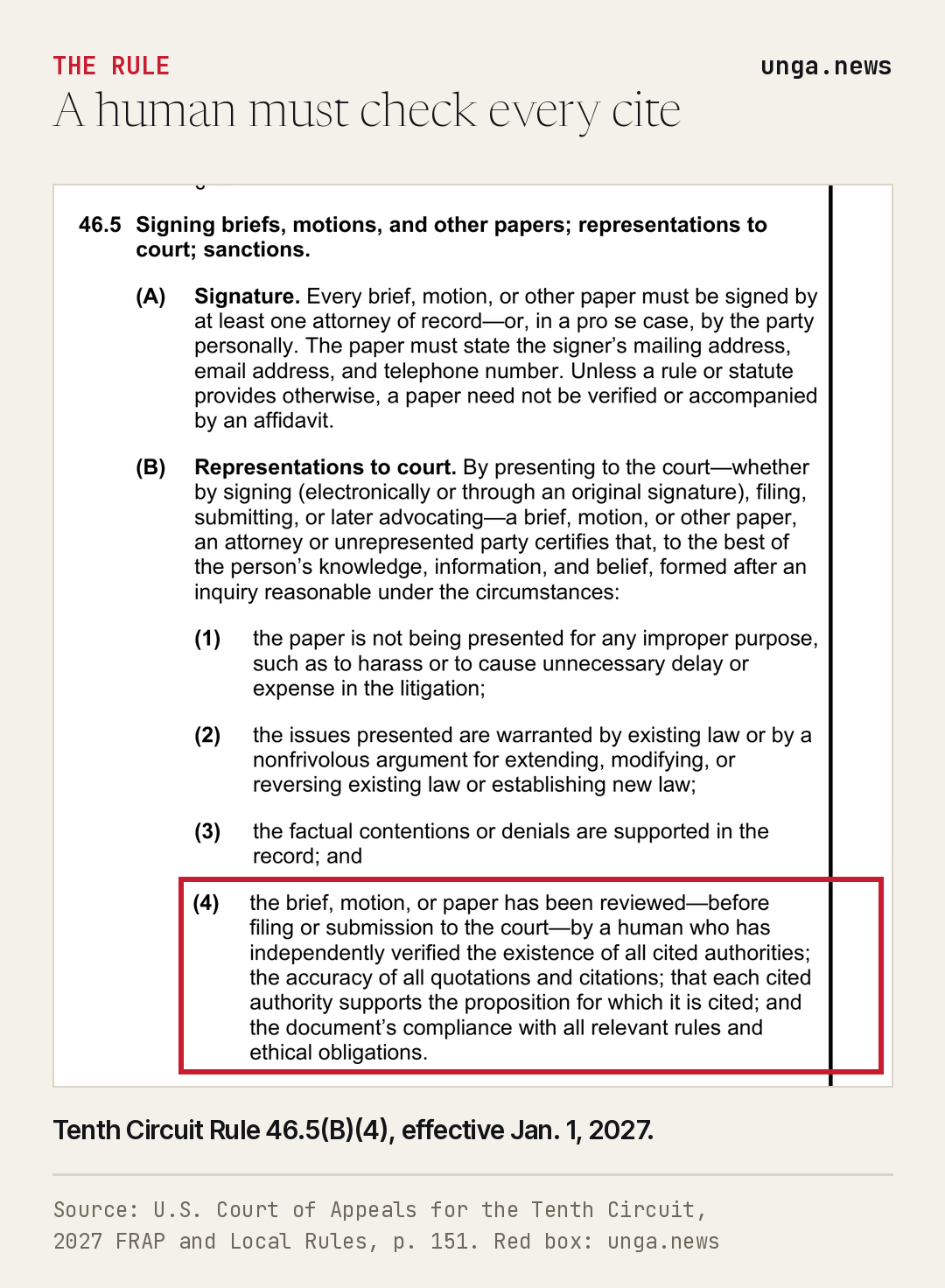
Read it slowly and you can see every way SI has burned courts over the last two years. The filer must certify that a human “independently verified the existence of all cited authorities; the accuracy of all quotations and citations; that each cited authority supports the proposition for which it is cited.” Fake cases, fake quotes and real cases twisted to say things they never said each get their own clause.
The rule doesn’t ban SI, and it doesn’t make anyone confess to using it. The court went the other way. Its text says the promises carry “the same force and effect regardless of whether the brief, motion or paper was prepared with the assistance of artificial intelligence.” Use whatever tool you want. Your name is on it, so you own it.
The machine made it up. The lawyer signed it anyway
Anyone who has played with a chatbot knows the problem. Ask it for a court case that backs your argument and it will cheerfully hand you one, complete with a judge’s name, a volume number and a quote. Sometimes none of it is real.
The Tenth Circuit has seen plenty. A database kept by French legal researcher Damien Charlotin, which links to each ruling, lists at least 15 decisions from this appeals court alone since December 2025 that flagged fake or garbled citations.
In February, the court found a lawyer in an immigration case against the government had repeatedly cited and quoted “Rodriguez-Romero v. Garland,” a Tenth Circuit decision that doesn’t exist, according to the database’s summary of the ruling. The page numbers pointed to unrelated cases. In October, another immigration lawyer’s brief cited “Naranjo Garcia v. Garland” and “Sameeh v. Gonzales.” The court determined neither case is real.
That same February, a lawyer suing Frontier Airlines filed a brief with seven case citations the court couldn’t find. The court concluded they came from ChatGPT, fined the lawyer $1,000 and referred the lawyer to the bar. Back in December 2025, a self-represented filer suing an Oklahoma city brought an appeal with eleven citations that didn’t turn up on Westlaw. The court affirmed the loss and said that, in the alternative, it would toss the appeal as a sanction.
Every one of those messes cost the other side, and the court, time and money chasing ghosts. When the other side is the federal government, that’s taxpayer money.
From a handful to more than a thousand
The national numbers explain why judges are losing patience. Charlotin’s database counted 2,334 rulings worldwide as of Nov. 23 where a court caught SI-made errors in a filing. Of those, 1,583 are from American courts. In the first half of 2023, there were two. In the first half of 2026, there were 631.
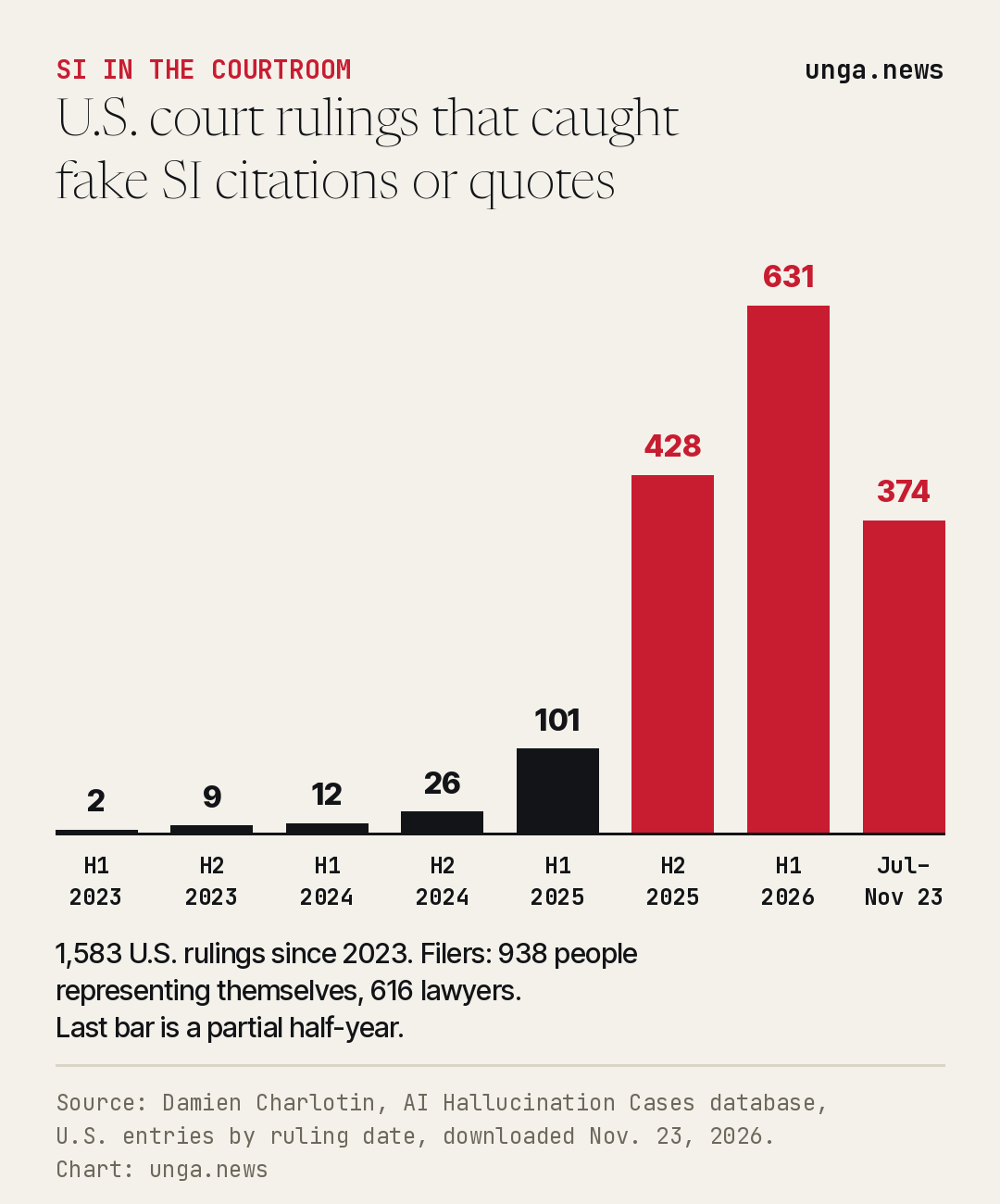
The database is one researcher’s running count built from published rulings, so it surely misses cases that never made it into an opinion. Still, the trend line isn’t subtle. And it isn’t only people without lawyers getting caught. The database lists 616 American rulings involving licensed attorneys, the folks who bill by the hour and are supposed to know better.
Real teeth if you skip the check
The rule comes with a menu of punishments. If a paper breaks it, the court can find the filer waived the issue, strike the document, dismiss the appeal or rule against the filer outright, impose fines, start disciplinary proceedings, or order the filer to pay the other side’s legal fees. Law.com reported that waiver and striking are the two new penalties the court added to its existing tools.
Waiver is the one that should scare lawyers most. It means a client can lose an argument on appeal because the attorney let a chatbot write it and never looked. That puts the cost of laziness right where it belongs.
The court didn’t spring this on anyone. In a Sept. 18 memo, Clerk of Court Chris Wolpert opened a month of public comment and wrote that the changes were “intended to address the increased use of generative artificial intelligence by both lawyers and pro se litigants.” The final version is in the court’s 2027 rules book, effective Jan. 1.
Most conservatives would recognize the principle here. Nobody is telling lawyers what software they can buy, and nobody in Washington wrote a 300-page SI code for the courts. A court simply reminded the people who sign its papers that a signature is a promise, then gave that promise teeth. SI can draft a brief in seconds. Checking that every case in it is real still takes a person, and now in six states that person can’t skip the job.
Sources
- U.S. Court of Appeals for the Tenth Circuit — 2027 FRAP and Local Rules, Rule 46.5 (effective Jan. 1, 2027)
- U.S. Court of Appeals for the Tenth Circuit — 2027 FRAP and Local Rules Published (Nov. 20, 2026)
- U.S. Court of Appeals for the Tenth Circuit — Memorandum: 2027 Revisions to the Tenth Circuit Rules (Sept. 18, 2026)
- Law.com — 10th Circuit Adopts Certification Rule for AI-Assisted Filings, Becomes First US Appeals Court to Do So (Nov. 23, 2026)
- Damien Charlotin — AI Hallucination Cases Database (accessed Nov. 23, 2026)
- Tenth Circuit ruling via Charlotin database — Picon-Diaz v. Bondi (Feb. 13, 2026)
- Tenth Circuit ruling via Charlotin database — Chilingarian v. Blanche (Oct. 20, 2026)
- Tenth Circuit ruling via Charlotin database — Amarsingh v. Frontier Airlines (Feb. 9, 2026)
- Tenth Circuit ruling via Charlotin database — Moore v. City of Del City (Dec. 3, 2025)