

Maricopa Ballot Reviewer: Crossed-Out Biggs Votes Went to Hobbs. Arizona Law Says Every Call Is Logged.
A worker inside Maricopa County’s ballot tabulation center says ballots with a Biggs mark crossed out were resolved for Katie Hobbs, and the voter ID amendment was hit too. State law requires a log of every one of those decisions. Nobody has opened them.

Someone working inside Maricopa County’s ballot tabulation center says the people judging hard-to-read ballots have been taking votes away from Andy Biggs and handing them to Gov. Katie Hobbs. The county keeps a record of every one of those calls. It just hasn’t shown anyone.
The account went public Friday afternoon, when Arizona conservative journalist Rachel Alexander posted a message she said came from a working adjudicator at the county’s Ballot Tabulation Center, the downtown Phoenix building where Maricopa’s ballots are run through scanners. Her post has passed 141,000 views.
Here is the message, word for word as she posted it:
“Hi. I am working as an adjudicator in the Maricopa County BTC. There are and continue to be anomalies in adjudication. What we are seeing is Republican ballots that were voted Biggs but also voted Hobbs. With an X through the Biggs vote. This takes the ballot to adjudication as an over vote. Adjudicators will then remove the Biggs vote because the X shows voter intent to change their mind. The vote goes to Hobbs. We have also been seeing votes for Biggs and Lombardo together. Creating another over vote. Only this time the Biggs vote isnt counted and neither is Lombardo. This is how they stole votes and shaved votes imho. The anomalies also appear on Prop 144 and others. There is something going on with adjudication. The ballots were stored in a hallway that wasn’t secure, boxes an…”
Rachel Alexander: “I am working as an adjudicator in the Maricopa County BTC. There are and continue to be anomalies in adjudication.”
— @Rach_IC View on 𝕏
The message cuts off mid-sentence, right in the middle of the hallway claim. Alexander hasn’t named the source, and nobody has backed the account on the record yet. But the details are specific, and every one of them can be checked.
The numbers behind it
Saturday afternoon Alexander posted a follow-up: a screenshot of what she said was the adjudication tally her source showed her. It lists 153,404 ballots sent to adjudication, with daily counts from Nov. 1 through Nov. 6 running between 5,517 and 14,138. It breaks the reasons down three ways: 54.70% overvotes, 27.82% ambiguous marks and 17.27% write-ins.
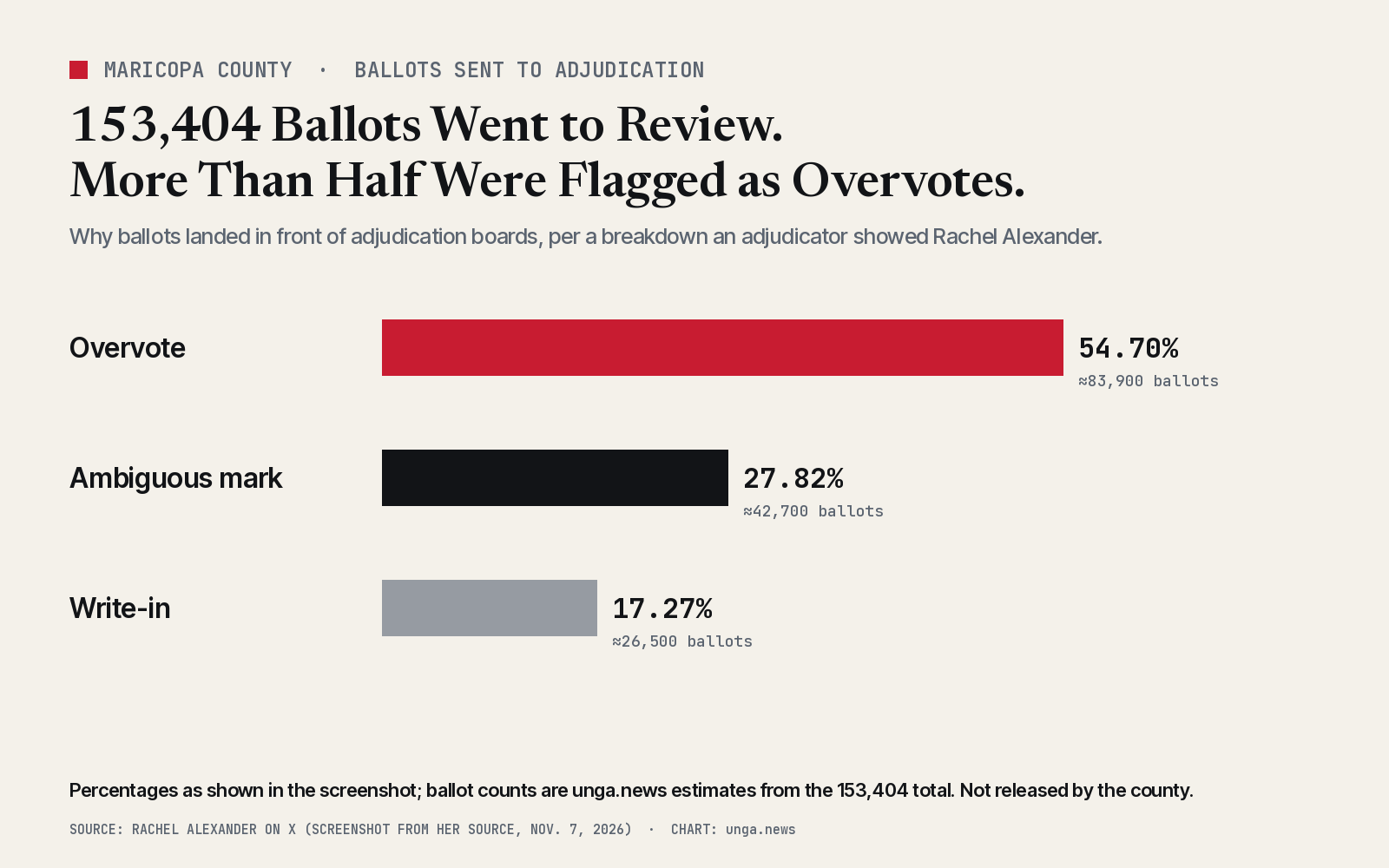
“My source who was adjudicating ballots showed me this breakdown,” Alexander wrote. “Look at how many ballots sent to adjudication were due to overvotes. Over 50%. I smell a rat.”
Rachel Alexander: “My source who was adjudicating ballots showed me this breakdown. Look at how many ballots sent to adjudication were due to overvotes. Over 50%. I smell a rat.”
— @Rach_IC View on 𝕏
Do the math on the screenshot’s own figures and roughly 84,000 ballots went to review because a scanner read too many choices in at least one race. That is a lot of ballots where two people at a computer screen, not the voter’s pen, decided what counted.
How a ballot gets “adjudicated”
Most coverage skips the part that matters, so here it is in plain English. When a scanner can’t read a race on a ballot, or reads two bubbles filled in a pick-one race, the ballot gets kicked to adjudication. A digital image pops up in front of a two-person board. They look at that race and decide whether the voter’s intent is clear.
Arizona law spells this out in A.R.S. 16-621. The board is two judges, “equally divided between the two largest political parties,” overseen by an inspector. If they can’t tell what the voter meant, the race counts as an overvote: no vote for anyone in that race, while the rest of the ballot still counts. The county’s own voter guide says the same thing.
Think of it like a referee looking at a replay. The ref is supposed to call what the replay shows. The adjudicator’s claim is that the replays all seem to break one way.
That’s the first scenario: a Biggs bubble filled in, an X drawn through it, and the Hobbs bubble filled in too. If a voter really did change their mind, the vote goes to Hobbs, and that’s the rule. The question is whether those X marks are what they look like, how many there were, and why the adjudicator says they kept showing up on Republican ballots and not the other way around.
The second scenario is stranger. Ballots marked for both Biggs and Risa Lombardo, the Green Party candidate. Under the rule, that’s an overvote and nobody gets the vote. A Republican voter filling in the Green Party bubble by accident happens. The adjudicator says it kept happening, enough to notice.
The voter ID amendment was on the same ballots
The adjudicator also named Prop 144. That’s the constitutional amendment the Republican Legislature sent to voters this year to require ID for every voter, mail ballots included, and to say plainly that only U.S. citizens can vote in Arizona.
It lost. The secretary of state’s unofficial count Saturday evening had it failing 1,311,576 to 1,149,112, 53.3% to 46.7%. Maricopa County alone voted it down 810,108 to 660,467. Voter ID went down in the most closely watched election county in America, and now a worker inside that county’s count says the adjudication on it looked off too.
In the governor’s race, the same unofficial count has Hobbs at 1,415,725 votes (55.6%) and Biggs at 1,081,317 (42.5%), with Lombardo at 24,080 and No Labels candidate Teri Ann Hourihan at 23,112.
The logs exist. The law says so.
Here’s the hole in this story that nobody is filling. The adjudicator’s account doesn’t have to be taken on faith, and it doesn’t have to be waved away either. The same law that sets up those two-person boards requires the county to keep:
• A serial number on every digital ballot image that tracks what the board did to it.
• “Comprehensive logs of all digital duplication and adjudication actions performed by an electronic vote adjudication board.”
• The original paper ballot and the digital duplicate, side by side.
• Live video of every ballot while it sits in the tabulation room, and chain-of-custody records for every ballot through the end of the count.
So every crossed-out Biggs vote that became a Hobbs vote has an image, a serial number and a log entry. Every Biggs-and-Lombardo overvote has one. Every Prop 144 call has one. And if ballots really sat in an unsecured hallway, the custody records and the video would show it.
What officials haven’t said
As of Saturday night, Maricopa County Elections had posted nothing but routine results updates. The county’s board chair, Kate McGee, put out a statement Friday night touting that 99% of ballots were tabulated within 72 hours. Neither has addressed the adjudicator’s account. Biggs hasn’t addressed it on his congressional 𝕏 account either.
The questions write themselves. How many governor’s race ballots were adjudicated, and how many went to each candidate? How many Prop 144 ballots? What written standard told judges to read an X as a change of mind? Did the party observers in the room object, and what happened when they did? Were any ballots kept in a hallway, and who had access?
Maricopa says its process is bipartisan, on camera and logged. Good. Then the answers are already sitting on a county server. Release the adjudication logs before the board of supervisors canvasses this election, and let Arizona see the replay.
Sources
- Rachel Alexander on 𝕏 — Message from a Maricopa County BTC adjudicator on Biggs/Hobbs overvotes and Prop 144, Nov. 6, 2026
- Rachel Alexander on 𝕏 — Adjudication breakdown screenshot: 153,404 ballots, 54.70% overvotes, Nov. 7, 2026
- Arizona Legislature — A.R.S. 16-621: Proceedings at the counting center (electronic vote adjudication boards, logs, video, chain of custody)
- Arizona Secretary of State — 2026 General Election unofficial results: Governor and Lieutenant Governor
- Arizona Secretary of State — 2026 General Election unofficial results: Proposition 144, by county
- Maricopa County Elections — Just the Facts: overvotes and electronic adjudication
- Maricopa County on 𝕏 — Chair Kate McGee statement on 99% of ballots tabulated within 72 hours, Nov. 6, 2026
- Maricopa County Elections on 𝕏 — Updated unofficial results posted, Nov. 7, 2026
- Arizona Legislature — SB 1135 fact sheet (2020): electronic vote adjudication boards